Balogun and Pepi: The Future of USMNT Strikers
The next wave of American No.9s is already here. Now the question is where they land.
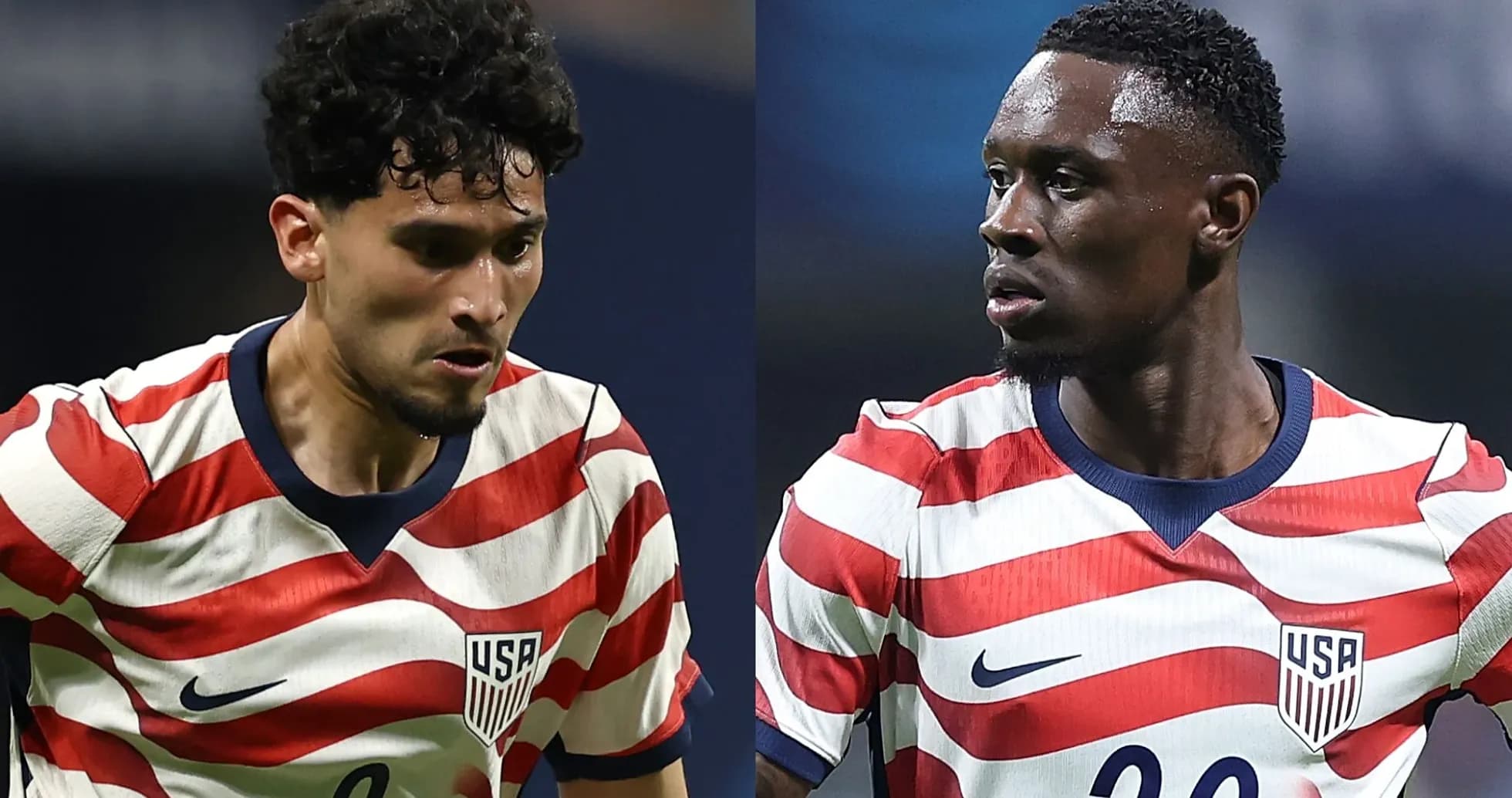
Folarin Balogun and Ricardo Pepi are heading into a home World Cup as the twin focal points of the USMNT attack, and their club futures are beginning to feel just as intriguing as their international roles. Brad Friedel, who knows the Premier League and the U.S. game as well as anyone, can see both making the jump to England. He just doesn’t see them walking through the same door.
Balogun the “big club” striker
Balogun’s journey has already taken him through one of European football’s powerhouses. Born in New York but raised in Arsenal’s academy, he never truly broke through in north London – just 10 competitive appearances and two Europa League goals – yet his reputation grew away from the Emirates.
A ruthless 22-goal loan spell at Reims turned heads across the continent and forced Monaco to put down around €40 million in 2023. This season he has justified that outlay, hitting 19 goals in all competitions and carrying himself like a forward who belongs at the sharp end of major leagues.
That profile, Friedel believes, changes the kind of Premier League club that can realistically pick up the phone.
“With Balogun, I think Balogun could play at one of the big boys and deal with the perception and reality situation, because I think he would be deemed more of a seasoned player,” he told GOAL in association with MrQ, making it clear that the striker’s European mileage matters when English clubs start assessing risk.
Balogun has already lived the pressure-cooker environment at Arsenal, then thrived with the responsibility of leading the line in Ligue 1. That blend – academy polish and frontline burden – is why Friedel sees him as a candidate for the Premier League’s elite rather than a project for the bottom half.
Pepi built for the grind
Pepi’s path has been different, and so is the bracket Friedel places him in.
The Texan’s move from MLS to Augsburg in January 2022 was a leap into the unknown. It has paid off over time. A productive loan at Groningen sharpened his instincts, and his switch to PSV gave him a platform in a team expected to win every week. Even without a guaranteed starting role in Eindhoven, he still matched Balogun’s 19-goal haul while helping PSV to another Eredivisie title.
The output is similar. The context is not. Friedel sees a forward who might need a more measured step into England.
“Someone like Pepi would need to be one of the mid to lower teams. Something like Brentford, Bournemouth, Fulham,” he said. “If he moved to a Manchester United or Arsenal, it would be too much for him, too quick.”
That’s not a slight on talent. It’s a judgement on timing, expectation and environment. Brentford’s data-driven approach, Bournemouth’s openness in attack, Fulham’s willingness to build around a focal point – those are the kinds of situations where a developing striker can grow without the glare of a global superclub on his back.
Pepi has already been linked with Fulham, a move Friedel can picture clearly. The comparison he draws is telling.
If you understand Raul Jiménez’s role – a hard-working, penalty-box presence who can occupy defenders and attack crosses – you get a sense of why Pepi might slot in seamlessly. Friedel even reaches back to the Fulham days of Brian McBride and Clint Dempsey: one a dominant aerial threat, the other more crafty between the lines but still strong in the air. Different profiles, same willingness to fight in the box. Pepi fits that lineage.
“I think that would actually be a seamless transition,” Friedel said. He sees echoes of that McBride–Dempsey handover in a potential Jiménez–Pepi succession.
Premier League next? Friedel wouldn’t blink
Speculation is already swirling that Premier League recruitment teams are tracking both strikers ahead of the World Cup. For Friedel, that noise makes sense.
“I wouldn’t be surprised at all to see Balogun or Pepi in England next season, and I think they could both be successful in the Premier League.”
The distinction he draws is not about ceiling. It’s about stage. Balogun, with his price tag, his Monaco output and his previous Arsenal education, looks ready to walk into a top-end dressing room and live with the scrutiny. Pepi, still just 21 and still refining his game, might thrive best where the spotlight is bright but not blinding.
Either way, the Premier League feels less like a dream and more like the next logical step.
Pochettino’s choice: Balogun first, Pepi as the hammer off the bench
Before any of that unfolds, there is a World Cup to host and a starting shirt to win.
Mauricio Pochettino, tasked with steering the USMNT through a group containing Paraguay, Australia and Turkiye, will have to pick a No.9 for the biggest stage the country has ever seen. If Friedel had the final say, Balogun would walk out first.
“Balogun would be my pick,” he said. “If you look historically at Pochettino’s teams, he usually likes to have players who play very vertically and who are really dynamic, and that’s more of what Balogun is.”
That verticality – the willingness to stretch defences, run in behind, constantly threaten space – has been a hallmark of Pochettino’s sides at Southampton, Tottenham and Paris Saint-Germain. Balogun’s movement and aggression dovetail neatly with that philosophy.
Pepi, in Friedel’s eyes, becomes the change-up. The striker you unleash when the game tilts into the box and the U.S. need a finisher amid chaos.
“To have the option of Pepi, who again will work really hard, but is very good in the box, good in the air, to come off the bench,” Friedel added, sketching out a one-two punch that few U.S. teams have ever enjoyed at centre-forward.
The conditions will add another layer. A summer World Cup on home soil, with players coming off long European seasons, will test depth as much as quality. Friedel can see Pochettino rotating the pair in the group stage, adjusting not just to opponents but to heat and fatigue.
“You could see Mauricio maybe wanting to take a different tactical approach against Paraguay and Australia,” he said, hinting at games that might demand different weapons at different moments.
A warning about Turkiye – and the stakes
One detail from Friedel cuts through the optimism: Turkiye.
“Hopefully, they have points in the bag by the time they play Turkiye,” he said. “Because if they’re not careful by the time they get to Turkiye, and they have to win that match, Turkiye is a very talented possession-based team.”
That’s the scenario the U.S. will want to avoid – chasing a result against a side comfortable with the ball, able to dictate tempo and drag the game away from the hosts’ strengths. It’s also where the choice between Balogun’s dynamism and Pepi’s penalty-area craft could decide more than just a tactical debate. It could decide a tournament.
For now, both strikers stand on the brink of a summer that could reshape their careers. A home World Cup, a potential Premier League move, a battle for the No.9 shirt.
Balogun looks ready for the “big boys.” Pepi looks built for the grind. England is watching. So is the rest of the world.