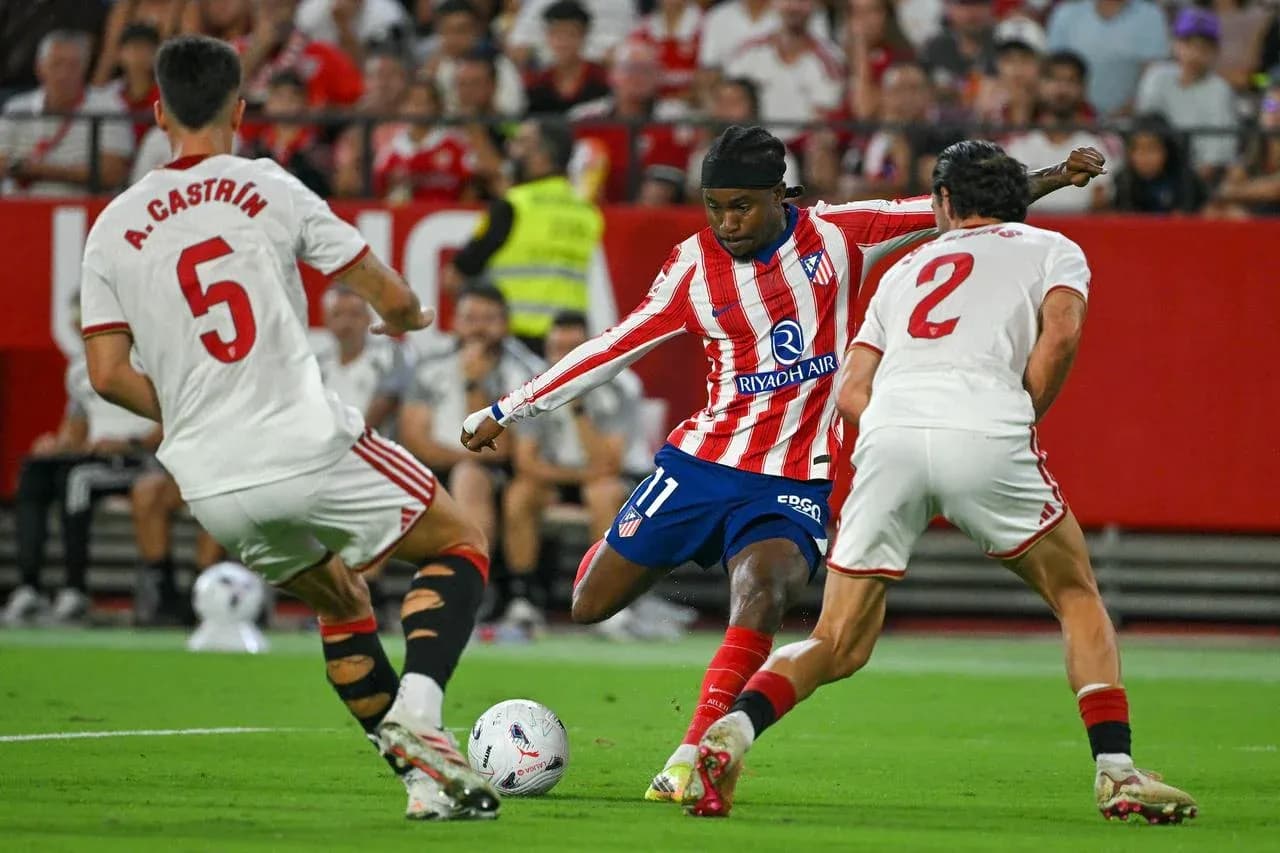
Atletico Madrid Overcomes Sevilla in Tactical Showdown
Under the lights of the Ramón Sánchez Pizjuán, this was billed as an early litmus test of Sevilla’s new identity under Luis Garcia Plaza against an Atletico Madrid side already humming in Diego Simeone’s latest evolution. It ended 3–1 to Atletico, a scoreline that crystallised the gap in both structure and ruthlessness between a Sevilla team still learning its 4-2-3-1 and an Atletico side that has carried its early-season steel into Seville.
Heading into this game, the table told a story of cautious optimism for both. Sevilla sat 5th with 6 points from 3 matches, their overall goal difference a slim +1 after scoring 6 and conceding 5. At home, though, the picture was more fragile: 1 win and 1 defeat, 3 goals for and 4 against, with no clean sheets in any venue. Atletico arrived as the more complete machine: 2nd in La Liga with 7 points from 3, unbeaten, with 7 goals scored and only 3 conceded overall – a robust +4 goal difference built on balance rather than excess.
From the first whistle, the formations framed the narrative. Sevilla’s 4-2-3-1 was orthodox on paper: Odisseas Vlachodimos in goal; a back four of J. Iglesias, Castrin, Kike Salas and G. Suazo; a double pivot of L. Agoume and Jon Guridi; M. Sierra, Peque and J. Diaz supporting lone striker R. Ure. But the structure was brittle whenever Atletico accelerated.
Simeone’s 4-4-2 was anything but old-fashioned. Jan Oblak anchored a back line of Marcos Llorente, M. Pubill, D. Hancko and A. Grimaldo. Across midfield, G. Simeone and A. Lookman worked the flanks with P. Barrios and M. Hjulmand inside, while Lee Kang-In and Álex Baena formed a fluid front pair. On their travels this season, Atletico had already scored 3 and conceded just 1; that away sharpness translated directly into the first half in Seville, where they went in 3–0 up by half-time.
The tactical voids began with Sevilla’s defensive spacing. Salas, who already carries the stain of a red card in this La Liga campaign, again walked a tightrope. His profile – 4 tackles, 2 blocked shots, 2 interceptions across the season – speaks of an aggressive front-foot defender, but here that aggression was repeatedly isolated. With Suazo pushing high to provide width and Peque drifting inside, Sevilla’s left channel became a target. Atletico’s right-sided triangle of Llorente, G. Simeone and Lee Kang-In constantly overloaded that corridor, forcing Salas and Castrin into emergency defending and dragging Agoume out of the pivot to plug gaps.
On the other side, Iglesias was pinned back by Lookman and Grimaldo’s rotations. Sevilla’s double pivot, which on paper should stabilise them, struggled to control tempo. Guridi’s numbers this season – 54 passes at 87% accuracy and 3 shots on target, plus 2 yellow cards – show a player willing but often overstretched. Here, as he stepped forward to help link with Sierra and Diaz, Hjulmand and Barrios found pockets behind him, turning Sevilla’s 4-2-3-1 into a stretched 4-1-4-1 in defensive transition.
Atletico’s engine room was the decisive layer. Hjulmand anchored, screening the back four, while Barrios pressed and recycled. That platform allowed Lee and Baena to roam between the lines. Baena, already with 3 goals and 1 assist this season, is La Liga’s early creative finisher; his 7 key passes and 4 shots on target underline how he blends chance creation with end product. In Seville, that dual threat forced Sevilla’s centre-backs to step out, opening seams for diagonal runs from Lee and G. Simeone.
The “Hunter vs Shield” duel was embodied by Baena and Sevilla’s back line. Overall, Sevilla concede an average of 1.7 goals per match, and at home that climbs to 2.0. That defensive softness met an Atletico attack averaging 2.3 goals overall and 3.0 away. The outcome felt almost pre-written in the first 45 minutes: Baena drifting off the front, Lee knitting play with his 88% pass accuracy and 4 key passes across the season, and G. Simeone adding relentless off-ball running plus the defensive work of an extra midfielder – his 8 tackles and 1 blocked shot a testament to that dual role.
Sevilla’s offensive “hunter”, in theory, should be Isaac Romero, whose 1 goal and 1 assist in limited minutes and heavy duel volume (26 duels, 10 won) mark him as a combative focal point. But he began on the bench, leaving R. Ure to wrestle with Hancko and Pubill without the same penalty-box craft. Sevilla have not failed to score in any league game this season – 6 goals in 3 matches, 3 at home – and they did eventually pierce Atletico after the break. Yet that late consolation only underlined the structural issue: they are capable of scoring, but they must work far harder than their opponents to create clear chances.
Discipline added another layer of tension. Heading into this game, Sevilla’s yellow-card profile skewed late: 27.27% of their cautions between 76–90 minutes and another 27.27% in added time. Atletico’s pattern was similar, with a combined 42.86% of their yellows from 46–60 and 91–105 minutes, plus a red card already in the 76–90 window this season. That shared tendency toward late volatility meant the second half was always likely to fray, especially with Sevilla chasing a lost cause and Atletico protecting a lead.
In the end, the statistical prognosis was borne out on the pitch. Atletico’s defensive solidity – just 1.0 goal conceded on average overall, 1.0 away – allowed them to absorb Sevilla’s second-half push without panic. Their attack, powered by Baena’s end product, Lee’s elasticity and the work rate of G. Simeone and Lookman, continues to punch at a level that suggests their underlying xG will remain strong even on tougher nights.
For Sevilla, following this result, the story is more nuanced. The 4-2-3-1 has given them attacking variety – they are still scoring 2.0 goals per match overall – but the trade-off is a porous back line and a midfield that can be pulled apart by high-class movement. Garcia Plaza must decide whether to protect his centre-backs with a more conservative full-back approach or to lean into the chaos and outscore opponents.
Atletico, meanwhile, leave Seville looking every inch a Champions League-level contender. They are unbeaten, efficient, and tactically coherent. If their finishing continues to match the quality of their approach play, and their defensive metrics hold, this performance at the Ramón Sánchez Pizjuán will be remembered less as an early-season anomaly and more as a statement of intent.