Atletico Madrid Dominates Real Sociedad 3-0 at Reale Arena
Under the Basque night sky at Reale Arena, this was billed as a test of identities as much as a test of form. Real Sociedad, in their familiar 4-2-3-1, tried to reassert a possession-heavy, technical game. Atletico Madrid, arriving in San Sebastian with a 3-4-2-1 and a growing aura of efficiency, left with a 3-0 win that underlined the gap in clarity between a side still searching and one already sure of itself.
Following this result, the table tells a stark story. Real Sociedad sit 12th with 7 points from 6 matches, their overall goal difference at -5, the product of 6 goals scored and 11 conceded. Atletico, by contrast, are up in 5th with 10 points from 5 games, their overall goal difference a healthy +4 from 10 goals for and 6 against. The numbers echo what unfolded on the pitch: one team fragile at both ends, the other ruthlessly balanced.
I. The Big Picture – Structures and Season DNA
Real Sociedad’s season pattern was already fragile heading into this game. Overall, they had scored 6 goals in 6 matches at an average of 1.0 per game, but conceded 11 at 1.8 per match. At home, the imbalance was even more worrying: only 2 goals scored in 3 home fixtures (0.7 per game) against 4 conceded (1.3 per game). The 4-2-3-1 has been their default – used 4 times this season – but it has not delivered control on either side of the ball.
Atletico arrived with a very different profile. Overall, they had scored 10 goals in 5 matches at a rate of 2.0 per game, conceding 6 at 1.2 per match. On their travels, that attacking edge remained sharp: 6 away goals in 3 matches, again 2.0 per game, while conceding 4 (1.3 per game). Diego Simeone has alternated systems – three matches in a 4-4-2, one in a 4-1-4-1 and now this 3-4-2-1 – but the underlying identity is clear: vertical, direct, and efficient.
The formations set the tone. P. Matarazzo’s 4-2-3-1 placed Álex Remiro behind a back four of J. Aramburu, Luken Beitia, M. Sarr and Sergio Gómez. Y. Herrera and Carlos Soler formed the double pivot, with Barrenetxea, L. Sučić and Gonçalo Guedes supporting Mikel Oyarzabal up front. On paper, it is a structure built for fluid combinations and late runs from midfield.
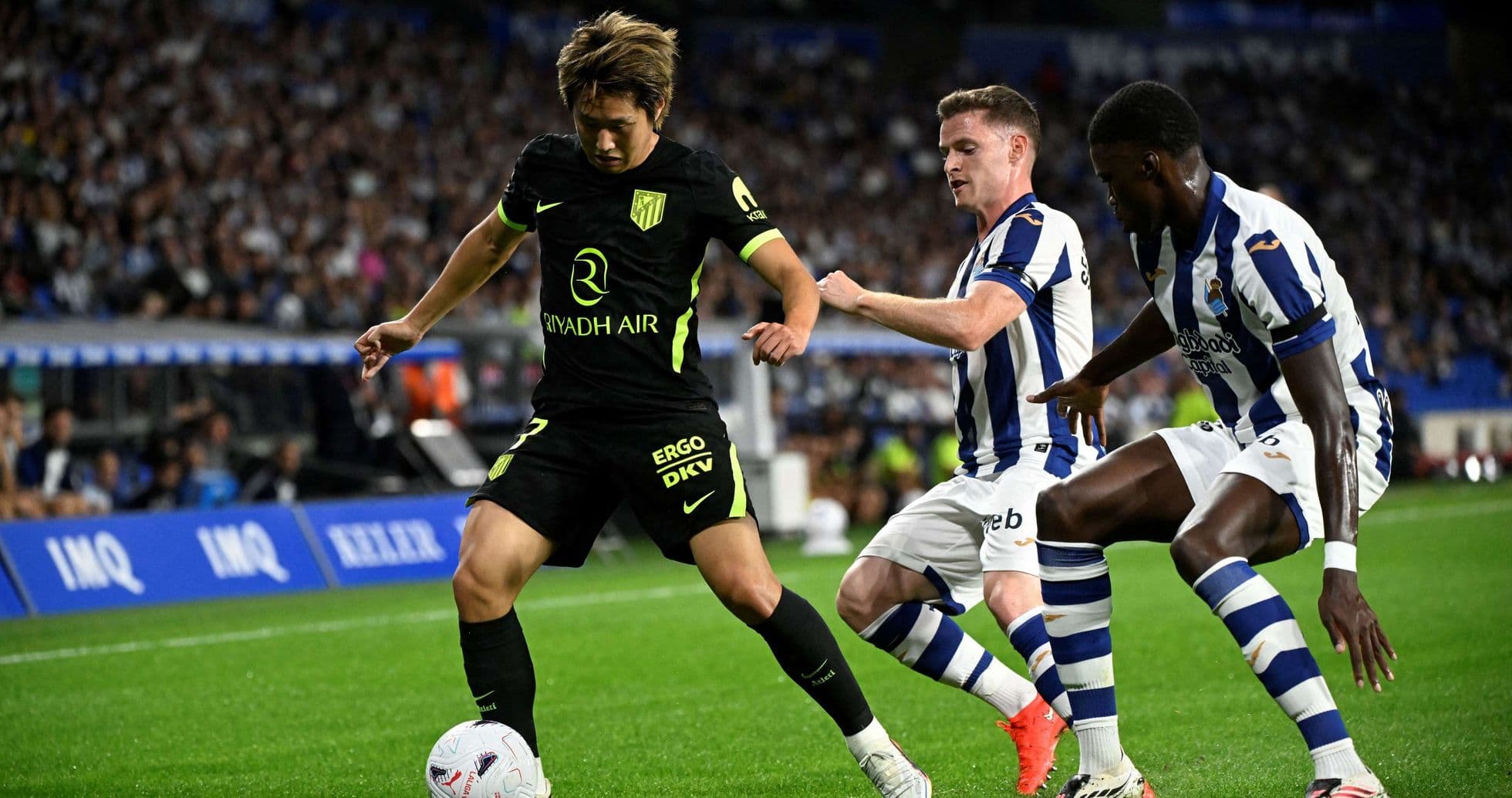
Atletico’s 3-4-2-1, with J. Oblak protected by Marc Pubill, C. Romero and D. Hancko, and a midfield line of G. Simeone, Marcos Llorente, M. Hjulmand and Álex Grimaldo, was different in intent. Lee Kang-In and Álex Baena operated between the lines behind A. Lookman. It is a shape that compresses the central lane, invites pressure, then explodes into space.
II. Tactical Voids – Absences and Discipline
Real Sociedad’s back line was already under stress before kick-off. Jon Martín’s suspension for a red card removed a defender who had featured in 5 league appearances and, crucially, had shown composure on the ball with 249 passes at 92% accuracy. The absence of I. Zubeldia and A. Odriozola further stripped Matarazzo of experience and rotation options in defence. It forced reliance on Luken Beitia and M. Sarr in central areas, a pairing that struggled to impose authority against Atletico’s dynamic front three.
In midfield, Y. Herrera carried not just responsibility for build-up but also for defensive fire-fighting. He entered the game as one of La Liga’s most card-prone players, with 3 yellow cards from 6 appearances and 8 fouls committed. Alongside him, J. Aramburu – also on 3 yellows and 24 fouls committed this season – formed a combustible right flank. This is a team that, overall, shows a broad spread of yellow cards, with notable peaks between 16-30 minutes and 46-75 minutes, suggesting a tendency to foul when games become stretched.
Atletico’s disciplinary profile is more controlled but still aggressive. They have yellow-card spikes in the 31-45 and 46-60 minute ranges, reflecting their habit of raising intensity around half-time. They have also already suffered one red card this season via Robin Le Normand, who was on the bench here. That previous dismissal, coupled with 1 penalty conceded by him, has likely sharpened Simeone’s message on timing and risk in the defensive line.
III. Key Matchups – Hunter vs Shield, Engine Room Battles
The “Hunter vs Shield” duel here centred on Atletico’s creative and finishing cluster versus a Real Sociedad defence missing key pieces. Álex Baena arrived as one of La Liga’s more productive attacking midfielders: 3 goals and 1 assist in 5 appearances, with 8 shots and 10 key passes. His role in the left half-space, combining with Álex Grimaldo and Lee Kang-In, repeatedly targeted the channel between Sergio Gómez and M. Sarr.
Giuliano Simeone, listed as a midfielder but playing with an attacker’s instincts, added another layer. With 2 goals and 1 assist from 5 appearances and 52 duels contested (27 won), he is both a finisher and a first presser. His physicality and willingness to attack second balls made life uncomfortable for Luken Beitia and Sarr, who lacked the protection they needed from the double pivot.
On the other side, Real Sociedad’s main offensive reference points were L. Sučić and Oyarzabal. Sučić, with 2 goals from 13 shots (5 on target) and a strong passing accuracy of 89%, is a midfielder who thrives when he can arrive late at the edge of the box. Oyarzabal, despite no goals so far, had already delivered 2 assists and 6 key passes, operating as both finisher and facilitator. Yet against Atletico’s back three, marshalled by D. Hancko – who has 2 assists, 361 completed passes at 90% accuracy, 3 successful blocks and 8 interceptions this season – their spaces were suffocated.
The “Engine Room” clash pitted Y. Herrera and Carlos Soler against M. Hjulmand and Marcos Llorente. Herrera’s volume – 226 passes at 87% accuracy and 51 duels contested – usually gives Real Sociedad a platform, but Atletico’s pairing tilted the battle. Hjulmand’s screening allowed Llorente to step out and press Sučić, while G. Simeone dropped in from wing-back to overload central zones. That denied Real Sociedad the ability to progress cleanly through the middle, forcing them wide where Atletico’s wing-backs could trap and counter.
IV. Statistical Prognosis – What the Numbers Say About the 3-0
The 3-0 scoreline fits the seasonal trajectories. Real Sociedad’s overall profile – 1.0 goals scored and 1.8 conceded per match – points towards a side that regularly loses control of games. Their single overall clean sheet and three matches failing to score underline how thin their margin for error is. At home, with only 1 clean sheet and 2 of 3 matches without scoring, a collapse against a top-five attack was always a live risk.
Atletico, meanwhile, travel with the numbers of a contender. On their travels, they average 2.0 goals scored and 1.3 conceded, with 1 away clean sheet already this season. They have failed to score only once overall, and their biggest away win – 3-0 – mirrors the scoreline in San Sebastian. Their single penalty this season was converted, reinforcing an image of a team that takes its chances.
Defensively, Atletico’s structure and personnel are built for these nights. Hancko has already blocked 3 shots this season and won 21 of 30 duels, while Marc Pubill and C. Romero add aggression and mobility. Behind them, Oblak benefits from a unit that concedes relatively few high-quality chances; the overall figure of 6 goals against in 5 matches suggests their defensive xG allowed is comfortably controlled.
Real Sociedad’s disciplinary profile also feeds into their vulnerability. With a red card already on Jon Martín this season and yellow-card peaks in the middle phases of each half, their defensive line is often under duress and forced into risky interventions. Atletico, who ramp up their pressing and tempo around those same windows, are perfectly placed to exploit that tendency.
In narrative terms, this 3-0 felt less like an upset and more like the logical intersection of two trends. Real Sociedad are a side whose structure promises control but whose numbers scream fragility. Atletico Madrid, shifting shapes but not principles, are becoming a machine that punishes exactly that kind of uncertainty. At Reale Arena, the scoreboard simply made the underlying story impossible to ignore.