World Cup Last 16: England Faces Mexico, Altitude Concerns
Six days. Sixteen matches. The World Cup has shed half its field and kept its habit of punishing certainty.
Germany’s exit on penalties to Paraguay was the jolt that shook the bracket. The numbers had given the Germans roughly a 63% chance of going through; the shoot-out flipped that on its head and ripped open the top half of the draw. Had Senegal held on against Belgium, that would have been a shock of similar scale. They didn’t – but the warning to the favourites was clear enough.
Morocco’s victory over the Netherlands looked like another upset on paper, yet the data tells a subtler story. The Dutch came in at only around 55% to progress. This was no mismatch, more a knife-edge tie that finally tipped towards the North Africans.
Some of the most dramatic contests came in games that, beforehand, barely looked like contests at all. Cape Verde, handed just a 10% chance of progressing, dragged holders Argentina into extra time and had them wobbling. Congo, with only a 17% pre-match probability, led England with a quarter of an hour left. The gulf on the spreadsheet shrank rapidly once the whistle blew.
Familiar faces, unfamiliar threats
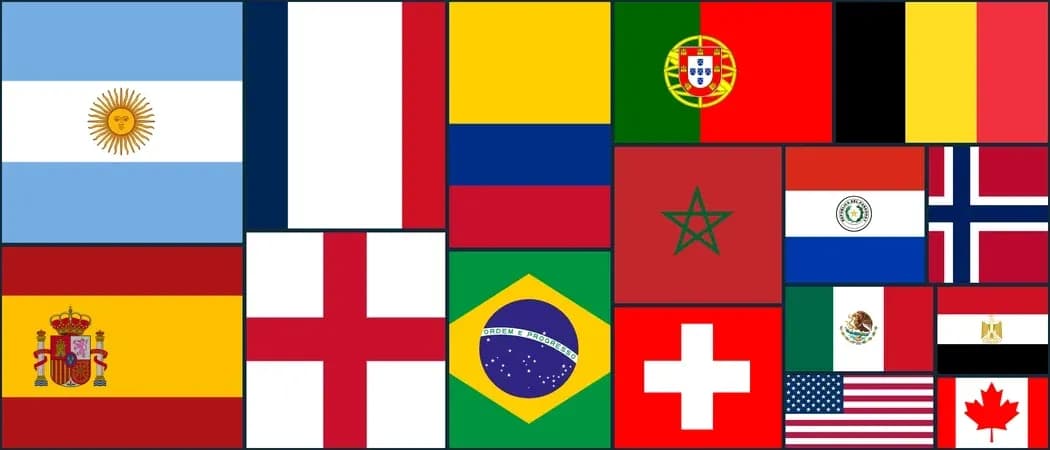
The cull has stripped away every Asian side and all but two African teams, leaving a last 16 that looks depressingly familiar: Europe and South America in command. Around them, a small band of outsiders hangs on. Canada, Egypt, Mexico, Morocco and the United States are the remaining interlopers from beyond the traditional power bases of World Cup success.
Collectively, those five nations carry only about a 3.5% chance of lifting the trophy. They are the long shots in a tournament now tilting back towards its usual aristocracy.
Argentina, bloodied but still breathing after extra time against Cape Verde, remain the team to beat. Their title probability sits at 28%, slightly down, their stumble punished by the model and by the reshaping of the draw. France, boosted by Germany’s early flight home, have climbed to a 14% chance of winning the World Cup. Spain, serene in dispatching Austria, now stand at 16%. France, similarly comfortable against Sweden, move on with barely a scratch.
England’s Mexican question
England’s position is more complicated. Their overall chance of going all the way rises to 12%, due less to dazzling form and more to simple arithmetic: there are fewer teams left.
But there is a wall between them and the trophy. Brazil and Argentina still loom in their path, assuming Gareth Southgate’s side first negotiate a last-16 tie against hosts Mexico in Mexico City.
On neutral ground, the numbers are blunt. Even when home advantage is baked in, the expected goals model gives Mexico just 0.6 goals to England’s 1.6. That translates to a 62% probability of an England win in normal time, 13% for Mexico, and a 25% chance of a draw and penalties. England have a clear edge.
Then comes the word that has stalked every conversation about this match: altitude.
Mexico City sits roughly 2,200 metres above sea level. Stories about visiting teams gasping for breath have been traded for decades. Yet when thousands of international matches played at different heights are examined and rounded to the nearest 500 metres, the headline is surprising: there is almost no simple, linear impact of altitude on the likelihood of the home side winning.
At sea level, where about a third of all internationals are staged, home teams win roughly 55% of the time. Between 250 and 750 metres, a band that covers about 6% of matches – close to 4,000 games – the pattern barely shifts. Even in the rarefied air between 2,000 and 2,250 metres, where Mexico City lies and only 265 matches have been played, home teams win 52% of the time. That is actually a lower raw home-win rate than at sea level.
Raw numbers, though, don’t tell the whole story.
When the mountains help the underdogs
To understand what altitude really does, you have to strip out team quality. The Economic Observatory Elo ratings, which track closely with FIFA’s rankings and have proved strong predictors of international results, offer that lens.
The model treats a home win as 1 and anything else as 0. Subtract the Elo-based expected probability of a home win from the actual outcome, then take the average, and you get a measure of how often home teams outperform expectations.
Do that across different altitude bands and a pattern appears. Below roughly 1,750 metres, home sides win about as often as the ratings say they should. Above that threshold, they start to overperform. The positive gap grows with height. High-altitude teams – Bolivia above 3,000 metres, Ecuador, Ethiopia and Mexico above 2,000 – do better at home than their Elo strength alone would suggest.
Even at the highest altitudes, though, the over-performance gap of around 20 percentage points sits within the margin of error. It hints at an advantage, not a guarantee.
So what does that mean for England in Mexico City? The data does not support the idea of a huge, unbridgeable edge for the hosts. It does, however, leave room for Mexico to gain something from conditions England have had little time to adjust to.
Run a simple thought experiment. If altitude were to shave 0.25 expected goals off England and hand 0.25 to Mexico, the picture changes. England’s win probability drops from 62% to 48%. Mexico’s climbs from 13% to 24%. The chance of penalties rises accordingly. The better team, on paper and in transfer-market value, is still England. But the gap narrows enough to make nerves entirely reasonable.
The altitude will act as a leveller. It just may not level things all the way.
The rest of the bracket
Beyond Mexico City, the last 16 has a clear set of favourites according to the simulations and Elo-based team strengths.
Argentina are 77% likely to advance past Egypt. England, in the model’s raw form before any altitude tweaks, are given a 74% chance against Mexico. Morocco are 70% favourites to knock out Canada. Spain are rated 72% likely to come through an Iberian showdown with Portugal.
On the other side of the draw, Colombia carry a 70% chance against Switzerland. Brazil are at 69% to see off Norway. Belgium, who survived that scare against Senegal, have a 64% edge over the United States. France are 62% favourites against Paraguay.
That last number raises eyebrows. Free-scoring France, fresh from cutting through Sweden, are not expected to stroll. Paraguay, as flagged in the Group D preview, are stubborn and disciplined. Strip out their more open display in the opener against the United States and their tournament has been defined by defensive resilience.
The expected goals model reflects that. France are projected at just 1.1 expected goals, Paraguay at 0.6. It points to a tight, attritional contest – potentially France’s sternest test so far, and not the comfortable passage many would assume for a side now talked about as genuine contenders.
The field has thinned. The numbers favour the usual suspects. Yet Germany’s fall, Cape Verde’s defiance and the looming thin air of Mexico City all whisper the same thing: this World Cup is still looking for its next big shock.