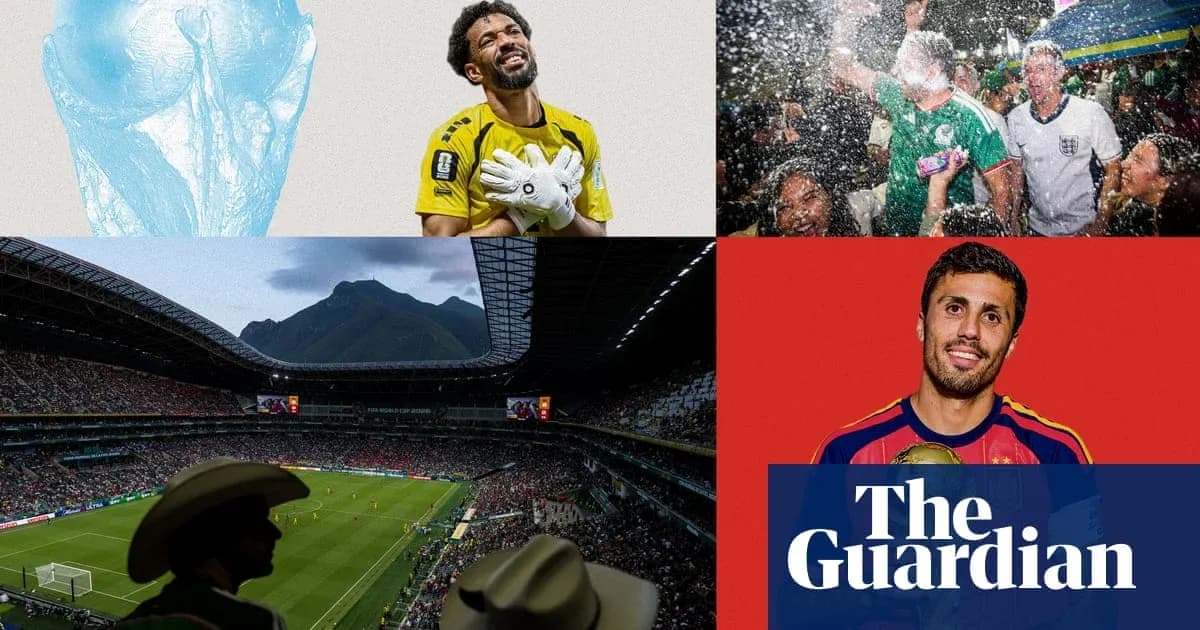
World Cup 2023: Drama, Giants, and a 40-Year-Old Hero
This was a World Cup that refused to behave. The goals poured in elsewhere, the stars turned up, the hosts mostly delivered – but the moments that will linger are the ones that felt slightly unhinged, as if the tournament had slipped its axis.
Matches that twisted the script
Start with a heresy: Germany lost a penalty shootout. Paraguay 1-1 Germany in the last 32 did not boast the wildest scoreline, yet nothing matched the raw theatre of those spot-kicks. Germany do not lose from 12 yards. They did here, and they did it in spectacular fashion.
Weirdness reached its peak in Algeria 3-3 Austria. On paper, it should have been a non-event, a classic biscotto: both sides knew a draw would send them through. For long stretches of the second half, it drifted exactly that way, a glorified training exercise. Then stoppage time detonated. Chaos, goals, and a match that felt as if it had been played on a different plane of reality.
Some games were less surreal, more operatic. Mexico 2-3 England at the Azteca had been circled from the moment the draw came out. The old bowl in Mexico City delivered on the hype. A thunderstorm pushed kick-off back, the noise bounced off the concrete, and Thomas Tuchel’s England walked into a cauldron and somehow walked out with a famous win. It was like drinking cortisol neat: a brilliant Jude Bellingham display, Mexico’s best first half of the tournament, and an England side hanging on at the end, drained but victorious. For many who were there – and plenty who weren’t – it was pure cinema.
England, of course, had form in the absurd. France 4-6 England was borderline slapstick, a scoreline from a video game. Egypt 1-1 Iran in Seattle packed its drama into the final minutes: Iran had a stoppage-time winner chalked off, then twice rattled the woodwork as their unbeaten run ended in heartbreak and elimination.
The defending champions supplied their own epics. Argentina 3-2 Egypt in the last 16 looked, for an hour, like the end of an era. Two down, thinking about flights home, Lionel Messi and company were staring at humiliation. Then came the late surge, Messi at the heart of it, and a two-goal deficit overturned in normal time despite a referee whose decisions left a bitter taste.
Argentina’s other great drama came against Cape Verde. Argentina 3-2 Cape Verde had improbable wonder written all over it, capped by Sidny Lopes Cabral bending a shot into the top right corner to stun the champions. For some, it was the match of the tournament. For others, it merely underlined how often Argentina seemed to live on a knife-edge.
There were quieter but no less telling nights. Cape Verde 2-2 Uruguay in Miami showcased a debutant with attitude and discipline, a team that refused to be overawed. England 1-2 Argentina tugged at something more familiar – a heavyweight rivalry that rarely disappoints, this time delivering a brutal, predictable sting.
Across more than 100 games, a pattern emerged. For sheer unpredictability, you turned to Mexico v England. For strangeness, Algeria v Austria. For a pure, distilled World Cup cocktail – jeopardy, controversy, genius – Argentina 3-2 Egypt sat near the top of almost every list.
Rodri, Vozinha and the men who owned the month
If Spain were the most complete side, Rodri was their compass. Tournament after tournament, teams search for control; Spain found it in the Manchester City midfielder. As they reverted to a possession-heavy model, he set the tempo, broke pressure, and made every transition look simple. He left as Golden Ball winner and, in many eyes, the outstanding player of the month.
He was not short of company. Kylian Mbappé took the Golden Boot, inflated by that chaotic third-place game, but for long stretches France looked the class of the field with their striker at full tilt. Erling Haaland dragged Norway into a first-ever quarter-final, built a credible Golden Boot chase of his own and, in the process, boosted his already vast global profile – particularly in the North American market the tournament courted so aggressively.
Lionel Messi, even short of his peak, still bent games to his will. That comeback against Egypt became another entry in a catalogue that needs no embellishment. Jude Bellingham drove England forward with a maturity that made earlier doubts over his selection look absurd. Michael Olise glided through games and might have left with a hat-trick against England on another night.
And then there was Vozinha. Cape Verde’s 40-year-old goalkeeper, without a club, became one of the tournament’s most compelling figures. He shut out or frustrated some of the biggest names in the game, his saves as sharp as his story was improbable. His performances felt like a fairytale that did not need a marketing department to sell it. At 40, he finally received the plaudits his admirers always felt he deserved.
Elsewhere, Pau Cubarsí announced himself at the back, Dani Olmo sparkled in Spain’s attack, and Pico Lopes threw his body in front of everything for Cape Verde, enhancing a reputation built far from the usual power centres. For some, he remains a Shamrock Rovers and Cape Verde legend; for others, he looked like a player who deserved one last big move.
Across the field, the same conclusion kept surfacing: when a match teetered – under pressure, in transition, in those 50-50s that decide tournaments – no one handled the moment with more authority than Rodri. Spain’s captain played like the kind of midfielder England still dream of producing.
A goal that stopped the world
This World Cup produced a catalogue of spectacular strikes, but one kept dragging the conversation back.
Sidny Lopes Cabral’s equaliser for Cape Verde against Argentina was the kind of goal that rearranges a stadium’s sound. A long-range hit from a full-back-cum-winger, audacious and pure, curling between a flying Emi Martínez and the far post in extra time of a knockout tie. For drama, for context, for sheer audacity, it ticked every box. His reaction – hands clasped to his head, then a beeline to his girlfriend in the stands – only deepened the imprint.
Some insisted on honourable mentions. Uzbekistan’s Eldor Shomurodov produced a delicate, instinctive lob from a tight angle against DR Congo, an oddly satisfying finish unlike anything else in the tournament. Julián Álvarez, quiet for much of Argentina’s campaign, unleashed a vicious, swerving drive from distance in extra time against Switzerland, igniting a cauldron in Kansas City.
Bosnia and Herzegovina’s Kerim Alajbegovic, just 18, slalomed past defenders before crashing one in off balance from the edge of the box against Qatar, a goal that justified the buzz around him. Johan Manzambi’s run and slide-rule pass for Breel Embolo’s opener against Algeria offered a reminder that some of the best goals start long before the finish.
Wilson Isidor’s long-range rocket for Haiti against Morocco, a strike that briefly put the Caribbean side 2-1 up, was as sweetly hit as anything all month. For some, it ranked alongside the great World Cup goals, regardless of the result. Erling Haaland’s second against Brazil – low, precise, from outside the box to seal a seismic upset – felt like a distillation of his game: ruthless, economical, devastating.
Some still talked wistfully about a disallowed thunderbolt – “was it Uzbekistan?” – smashed into the top corner and scrubbed from the record. But every time the debate opened up, it circled back to the same name. Sidny Lopes Cabral. That shot. That moment.
The little things that made it human
Away from the headlines and highlight reels, the tournament lived in smaller, stranger details.
Eloy Room, at 37, set a World Cup record for saves in a 90-minute match as Curaçao faced Ecuador, then joked he deserved a statue back home. Senegalese journalists passed around a packet of malted milk biscuits during the anthem before their side’s collapse against Belgium. Players warmed up to Scotland the Brave on bagpipes in Foxborough as the Tartan Army finally returned to a World Cup after 28 years, only for the football to fall short of the soundtrack.
In Mexico, the Azteca worked its old magic. Mexico’s win over Ecuador felt like a living, breathing monument, the noise like nothing some reporters had ever heard. Later, Mexico v England turned the same stadium into an epic stage: thunderstorm, delay, exhaustion, and a sense of being present for something that would be talked about for years.
There were Messi pilgrimages in Dallas as he broke records against Austria, scenes that already feel distant. Nestory Irankunda revived Tim Cahill’s iconic celebration for Australia, a ceremonial passing of the torch 26 minutes into their opening win over Turkey. In Kansas City, England’s base, locals embraced the team even as logistics frayed around them.
Cape Verde’s story kept tugging at the heart. Vozinha’s mother, against all odds, made the journey to see her son play at a World Cup. Pico Lopes, representing his father’s homeland, turned himself into a cult figure with every block and tackle.
Some memories came from beyond the pitch. Watching stadium workers, volunteers, security guards and low-level Fifa staff spill on to the grass after final whistles, grabbing selfies, having impromptu kickabouts, finally enjoying the turf they had spent weeks protecting. Standing knee-deep in floodwater in Monterrey waiting for a bus after retrieving a mislaid iPad – only to lose it again in Houston a week later. Explaining convoluted qualification permutations to a mariachi in a giant sombrero. Sharing a birthday with Martin Ainstein and Luis de la Fuente. Shouting “Paraguay. Number 10. Cover his mouth. Decision is RED CARD.” at a live show in Manhattan, then actually getting to say: “HELLO NEW YORK!”
For those who had spent years covering football in the US, the sheer volume of casual conversations about the sport felt almost surreal. After seasons of isolation and political rancour, strangers in host cities stopped to talk about formations, refereeing decisions and the merits of Haaland versus Mbappé. The World Cup, for a few weeks, became a common language.
Hosts under the spotlight
The three co-hosts carried very different expectations. All three left with credit, and questions.
The United States provided the bulk of the infrastructure and a patchwork of experiences. In cities such as Seattle and Vancouver, with downtown stadiums and established soccer cultures, the World Cup felt woven into daily life. Elsewhere – Dallas, San Francisco, parts of Florida – it sat more like a month-long novelty, accommodated rather than embraced. Public transport, or the lack of it, turned simple journeys into expeditions. Tipping culture, traffic, vast distances between venues: it all added up to a test of endurance for travelling fans and media alike.
On the pitch, the USA played some of the prettiest football their national team has ever produced, only to rue a missed chance to do something greater against Belgium. Off it, the country showed a warmth and openness that many visitors had hoped for but did not take for granted. The Balogun reprieve, brokered by the US administration and indulged by Fifa, left a sour note, a reminder of how politics can warp a tournament’s course.
Canada, in contrast, felt eager to prove it belonged. Toronto buzzed for the country’s first World Cup game on home soil, even as Bosnia and Herzegovina held them to a draw. A 6-0 demolition of Qatar at BC Place showcased a side playing with verve under Jesse Marsch, part coach, part hype man. Canadians wanted to be seen as a real football nation; by the end, they had made their point.
Mexico, in many ways, embodied what a World Cup can be. Fervent, febrile, fascinating. Their football culture deserved more prominence than a shared hosting plan allowed, yet the passion cut through. Mexico barnstormed Group A, outclassed an Ecuador side on the rise, and then pushed England to the brink at the Azteca before ideas – and legs – ran out in the final half-hour. Even in defeat, the hospitality endured. English visitors spoke of locals who stayed warm and generous despite the result.
All three co-hosts delivered in their own ways. All three exposed the gaps too: the US player-development system, the need for a coherent local organising committee, the balancing act of a tournament stretched across a continent.
The football, though, kept finding a way to the centre of the story. From Rodri’s quiet dominance to Sidny Lopes Cabral’s screaming equaliser, from Vozinha’s late-career heroics to Messi’s refusal to fade, this World Cup left a trail of images that will be hard to shake.
The question now is simple: after a month like this, where on earth does the next one go?