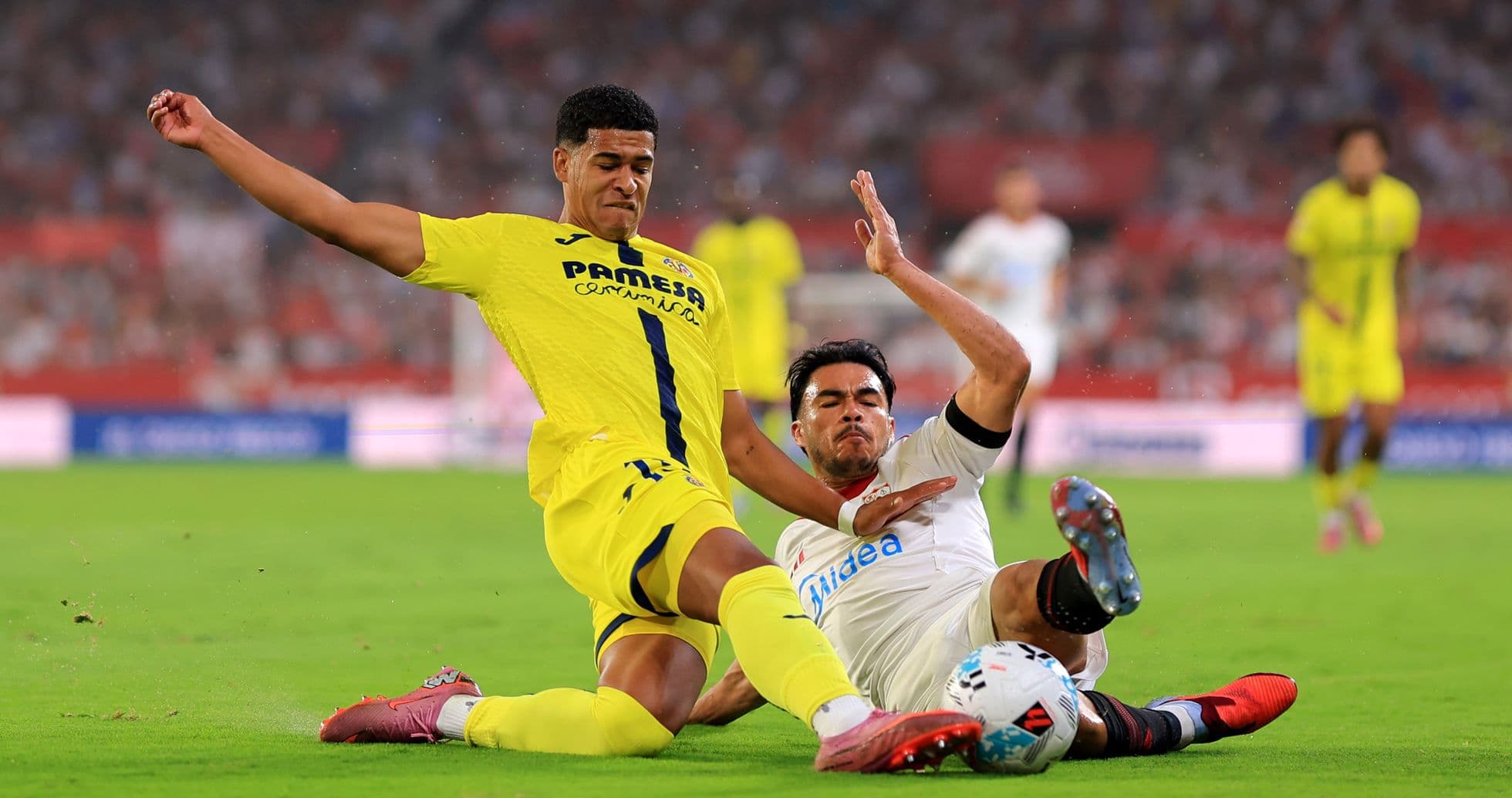
Villarreal vs Sevilla: Tactical Insights from a 2-3 Defeat
Villarreal’s 2-3 home defeat to Sevilla at Estadio de la Ceramica in La Liga’s Regular Season - 36 was shaped less by volume of control and more by how each side used its structure. Marcelino’s 4-4-2 produced early fluency and a 2-0 platform, but Luis Garcia Plaza’s 5-3-2 absorbed pressure, then gradually tilted the game through better box occupation and more incisive transitions. The match turned into a contrast between territorial dominance (Villarreal’s 63% possession) and penalty-area clarity (Sevilla’s 13 shots to 6 and three unanswered goals after the 20th minute).
I. Executive Summary
Villarreal started on the front foot, using their double striker system to stretch Sevilla’s back five and create central overloads through Dani Parejo and Pape Gueye early on. Two well-constructed attacks, finished by Gerard Moreno and Georges Mikautadze, appeared to put the hosts in full command. Sevilla, however, adjusted their pressing height and wing-back usage, finding a route back before half-time via Oso and Kike Salas. At 2-2 by the break, the second half became a test of in-game management. Sevilla’s compact 5-3-2, combined with superior timing of substitutions, culminated in a decisive strike from Andre Adams, turning Villarreal’s possession into sterile control.
II. Scoring Sequence & Disciplinary Log
The scoring opened on 13' when Gerard Moreno (Villarreal) converted after combining with strike partner Georges Mikautadze. Villarreal doubled their lead on 20': Mikautadze (Villarreal) finished a move engineered from the left, assisted by Alberto Moleiro, exploiting Sevilla’s back line before it could reset.
Sevilla’s response began on 36'. Oso (Sevilla), stepping out from the back five, capitalized on a second-phase situation, with Lucien Agoume providing the assist. The equalizer arrived at 45', again from a defender: Kike Salas (Sevilla) headed or finished from a delivery connected by Rodrigo Vargas. That made it Villarreal 2-2 Sevilla at half-time.
The winner came on 72'. Andre Adams (Sevilla), fed by Djibril Sow, struck to complete Sevilla’s turnaround, punishing Villarreal’s loosened rest-defense just after a Sevilla substitution phase. From that point, Sevilla managed the game to protect the 2-3 scoreline.
Card verification and full disciplinary log (chronological, with reasons):
- 81' Ayoze Pérez (Villarreal) — Foul
- 90+2' Renato Veiga (Villarreal) — Foul
- 90+3' José Ángel Carmona (Sevilla) — Time wasting
Totals: Villarreal: 2 yellow cards, Sevilla: 1 yellow card, Total: 3 cards.
III. Tactical Breakdown & Personnel
Marcelino set Villarreal in a 4-4-2 with A. Tenas in goal; a back four of A. Pedraza, Renato Veiga, P. Navarro, and A. Freeman; a midfield line of A. Moleiro, P. Gueye, Dani Parejo, and N. Pepe; and a front two of G. Mikautadze and G. Moreno. The structure aimed at classic Marcelino principles: full-backs advancing in staggered fashion, Parejo as the central distributor, and twin forwards working vertical channels.
Early on, this plan worked. Villarreal’s 63% possession and 554 passes (499 accurate, 90%) show their control of tempo. They frequently progressed via Parejo dropping between the centre-backs, drawing Sevilla’s first line out and then hitting quick diagonals to Moleiro and Pepe. The first goal stemmed from this pattern: Villarreal used the width to disorganize Sevilla’s 5-3-2, then penetrated centrally where Moreno and Mikautadze combined between lines.
Sevilla’s starting 5-3-2 had O. Vlachodimos in goal; a back five of Oso, G. Suazo, K. Salas, C. Azpilicueta, and J. A. Carmona; a midfield of D. Sow, L. Agoume, and R. Vargas; with N. Maupay and A. Adams up front. Initially, their block sat too deep, allowing Villarreal to pin them back and limit counterattacking lanes. However, once Sevilla raised their defensive line slightly and allowed wing-backs to step onto Villarreal’s wide midfielders, the dynamic shifted.
The equalizing phase highlighted Sevilla’s tactical adaptation. For Oso’s goal, Sevilla exploited the space just outside Villarreal’s box, with Agoume finding a seam between Villarreal’s midfield and defence. For Kike Salas’s strike, Sevilla’s set-piece and second-ball structure were superior: the back three attacked the box aggressively while Villarreal’s marking lost reference points.
Goalkeeper performance was pivotal. A. Tenas (Villarreal) registered 2 saves, with goals prevented at -0.22, indicating he conceded slightly more than the modelled expectation given the shots faced. O. Vlachodimos (Sevilla) made 1 save, also with goals prevented at -0.22, but crucially, Sevilla’s defensive unit limited Villarreal to just 6 total shots and 4 on target despite the territorial disadvantage.
Substitutions changed the game’s rhythm. At 60', T. Partey (IN) came on for P. Gueye (OUT), and T. Buchanan (IN) came on for N. Pepe (OUT), signalling Marcelino’s desire for more vertical thrust and line-breaking from midfield and the right flank. Yet these changes did not translate into higher shot volume; Sevilla’s compactness forced Villarreal into circulation rather than penetration.
Luis Garcia Plaza’s moves were more directly impactful. At 68', J. Sanchez (IN) came on for R. Vargas (OUT), refreshing energy in midfield. On 72', just as A. Sanchez (IN) replaced N. Maupay (OUT), Adams delivered the decisive goal, assisted by Sow, exploiting the slight disorganization in Villarreal’s rest-defense after their own attacking push. Later, N. Gudelj (IN) for D. Sow (OUT) and Castrin (IN) for A. Adams (OUT) at 86' consolidated Sevilla’s low block to protect the lead.
The late yellow for Ayoze Pérez on 81' for Foul reflected Villarreal’s growing frustration as Sevilla increasingly broke up rhythm. Renato Veiga’s 90+2' yellow, also for Foul, underlined Villarreal’s desperation to recover possession high. In contrast, José Ángel Carmona’s 90+3' yellow for Time wasting was emblematic of Sevilla’s game management once ahead.
IV. The Statistical Verdict
The xG figures underline how fine the margins were: Villarreal’s xG of 0.81 against Sevilla’s 0.88 suggests a near-even game in chance quality, but Sevilla’s extra volume (13 shots to 6, with 7 inside the box versus Villarreal’s 4) gave them more routes to goal. Villarreal’s overall form in possession looked strong — 554 passes, 499 accurate (90%) — yet their attacking efficiency lagged behind their control, with only 4 shots on target.
Defensively, Villarreal’s index was undermined by conceding 13 shots despite their dominance of the ball, pointing to structural vulnerabilities in transitions and set-piece phases. Sevilla, with just 37% possession and 325 passes (276 accurate, 85%), optimized their moments, turning a marginal xG edge into a 2-3 away win. Discipline also leaned slightly against Villarreal (2 yellows to 1), but more important was Sevilla’s superior adaptation: a flexible 5-3-2 that evolved from reactive to assertive, and ultimately decisive, in both boxes.