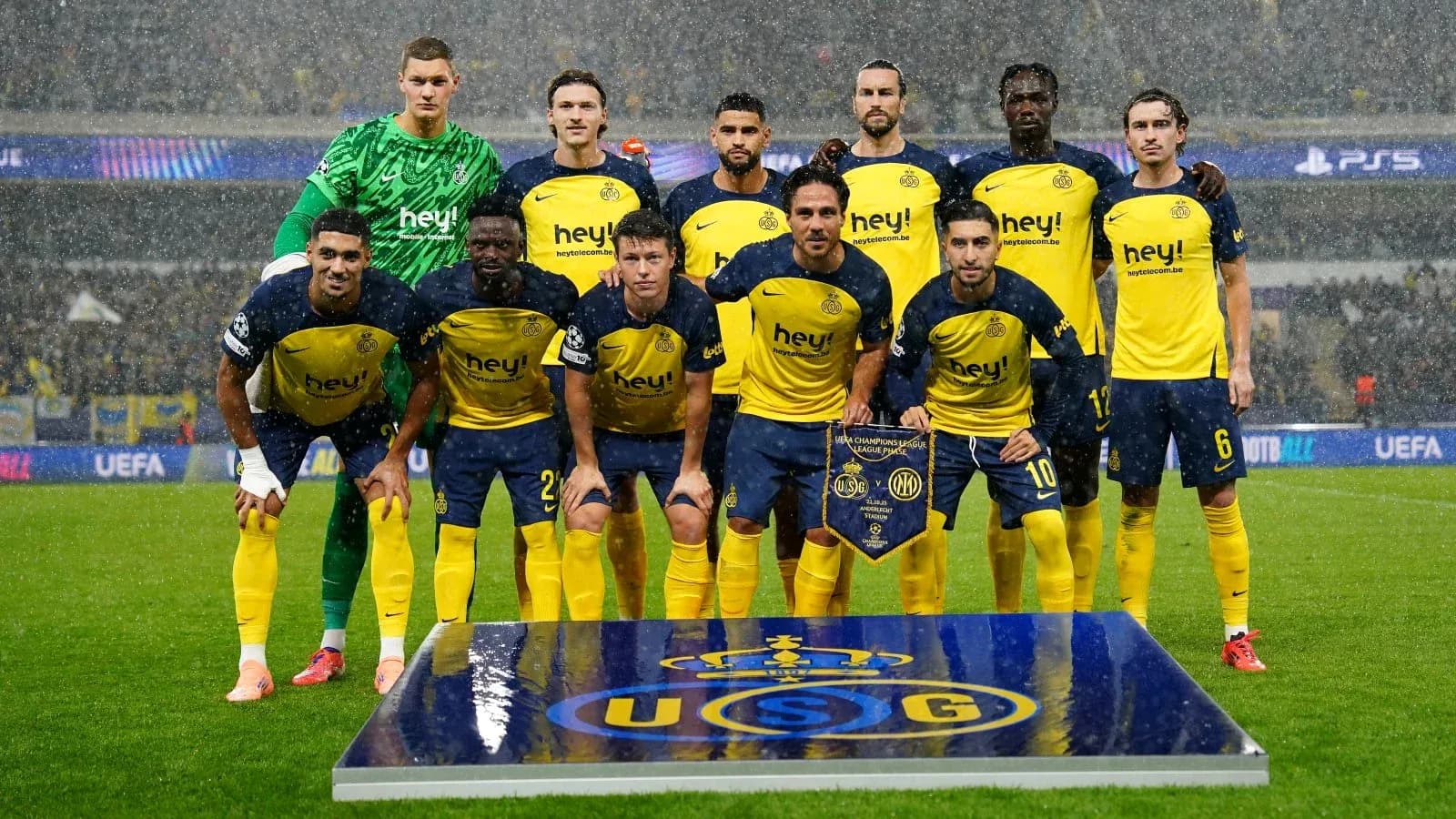
Union St. Gilloise vs Bodo/Glimt Betting Preview
Union St. Gilloise host Bodo/Glimt at AlbertPark in Oostende in the UEFA Champions League 3rd Qualifying Round, with both sides entering this tie at a statistical ground zero for the 2026 campaign. There is no competitive data yet for either team in this Champions League season, so market prices and the single recent head‑to‑head meeting become the primary anchors for any betting view.
From the official prediction feed, there is effectively no model edge: the algorithm returns “No predictions available” and assigns perfectly balanced probabilities of 33% home, 33% draw, and 33% away. That flat distribution underlines the high uncertainty and the lack of usable performance inputs (both teams show 0 matches played, 0 goals scored and conceded, and no recorded form). In other words, the raw prediction data is telling us this is a coin‑flip tie with no clear favourite on pure statistical grounds.
However, the bookmakers do not see it as perfectly even. Looking across the main firms for the Match Winner market:
- Home (Union St. Gilloise) odds range from 2.00 (Betfair) to 2.23 (Marathonbet).
- Draw odds range from 3.10 (SBO) to 3.80 (Marathonbet).
- Away (Bodo/Glimt) odds range from 2.75 (SBO) to 3.30 (Unibet).
Converting these to implied probabilities (1 ÷ odds × 100%):
- Home: roughly 44.8% (2.23) up to 50.0% (2.00).
- Draw: roughly 26.3% (3.80) up to 32.3% (3.10).
- Away: roughly 30.3% (3.30) up to 36.4% (2.75).
Even before adjusting for bookmaker margin, the market clearly leans towards a Union St. Gilloise home win, with the Belgians priced as modest favourites. After margin adjustment, a reasonable fair‑odds view would sit around something like 45–48% home, 26–29% draw, 26–29% away. This contrasts sharply with the model’s flat 33/33/33, indicating that traders are applying qualitative factors (home advantage, perceived squad strength, travel, and European pedigree) that the current numerical feed cannot capture.
In terms of recent head‑to‑head, the only recorded meeting in the data is from 3 October 2024 in the UEFA Europa League League Stage, played at Stade Roi Baudouin in Brussel. That match finished Union St. Gilloise 0–0 Bodo/Glimt. Neither side managed to break the deadlock, suggesting a relatively tight tactical battle when these clubs last met in European competition. With no other historical clashes in the feed and no goals scored in that encounter, it is difficult to derive a strong stylistic or goals‑based trend from head‑to‑head alone, but it does support the notion that these teams are fairly well‑matched.
The comparison block in the prediction data is also essentially neutral: form, attack, defense, goals and Poisson distribution all show 0 for both sides, and the overall comparison index sits at 50.0 for Union St. Gilloise and 50.0 for Bodo/Glimt. This is consistent with a pre‑competition state where no underlying numbers are yet available to tilt the model one way or the other.
Given this landscape, the most reliable quantitative signal is the betting market itself. With Union St. Gilloise trading as clear but not overwhelming favourites and the away side priced a little longer, the value question becomes whether the home odds adequately compensate for the inherent uncertainty. At around 2.15–2.23 with several bookmakers, the implied chance of a home win is in the mid‑40s percent. In a first‑leg qualifier at home, with travel and surface adaptation factors likely to weigh more on Bodo/Glimt, that looks broadly fair rather than obviously generous.
The official prediction advice states “No predictions available”, so any bet must be framed as a market‑based view rather than a model‑driven edge. Aligning with the odds and the slight home bias they imply, the most defensible stance is to side with the hosts but to acknowledge the risk profile.
Betting verdict: Union St. Gilloise to win in the Match Winner market is the logical primary pick, in line with the bookmakers’ pricing. For more cautious bettors, a draw‑no‑bet or double‑chance angle on Union St. Gilloise would also be consistent with the market‑implied edge while offering additional protection against another tight, low‑scoring stalemate similar to the 0–0 seen in October 2024.