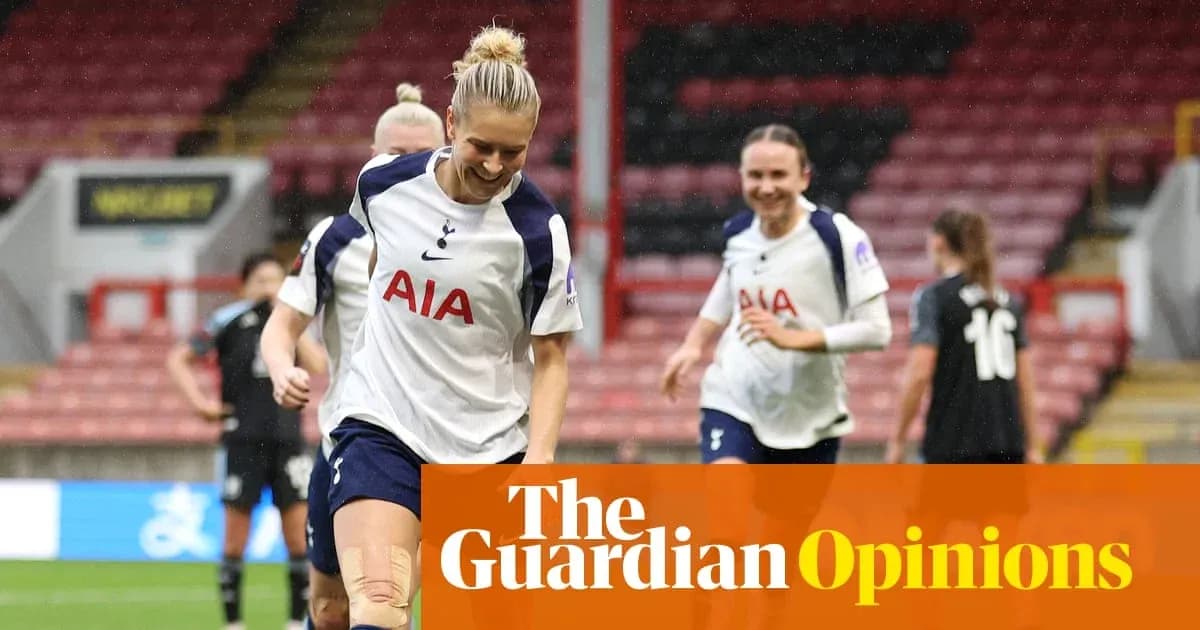
Tottenham Women: A Transformative Season in the WSL
For much of last season, Tottenham Hotspur felt like two different clubs sharing a badge. On one side, a men’s team that didn’t just flirt with relegation but practically picked out curtains with it. On the other, a women’s side playing with such freedom and joy that it became a weekly antidote to the gloom.
The men staggered over the line, Premier League status finally secured and “crisis hotline” WhatsApp groups quietening just enough for people to breathe again. The women? They quietly put together the best Women’s Super League campaign in the club’s history.
Seven goals past Aston Villa in a 7-2 shootout. A surreal FA Cup epic against London City Lionesses, where the first 17 penalties found the net before someone finally blinked. A 40-yard thunderbolt from Cathinka Tandberg that seemed to hang in the air long enough for fans to gasp, point and then erupt.
While the men shuffled passes around their own box and supporters asked, “Are all those passes really necessary?” the women’s side offered something that felt far more like Tottenham should.
A different kind of Spurs habit
Three years ago, a family decision quietly changed one fan’s relationship with the club. Inspired by England’s Lionesses reaching the World Cup final in 2023, he, his wife and son bought season tickets for Tottenham Women.
They had been in Australia during that World Cup, watching England edge Colombia 2-1 in the quarter-finals in Brisbane. In a fan zone dominated by Colombian supporters – roughly 2,000 of them to around 20 England fans – several Colombia fans still made the effort to walk over and shake English hands. That sense of warmth, of shared experience rather than tribal hostility, stuck.
“This,” he thought, “is the sort of football experience I want my son to enjoy.”
Tottenham Women have delivered exactly that. And the reasons for their rise are clear.
The Ho effect
The turning point came with the appointment of Martin Ho as head coach last year. His CV carried weight: assistant at Manchester United, head coach at Norwegian side Brann. The whispers around the training ground and stands said the same thing – the players liked him, and more importantly, respected him.
Ho didn’t hide in the dugout or behind press conferences. He wandered into the “Legends Lounge” at Leyton Orient, where Spurs Women play most of their home matches, chatting with supporters before kick-off. It sounds small. It isn’t. It builds a bridge.
On the pitch, his work has been transformative. Spurs play with attacking intent and clear structure. Every player seems to know her job and how to help the teammate next to her. This is not a side improvising its way through games; it’s a team with a plan and the confidence to execute it.
Recruitment backed that up. Olivia Holdt emerged as the club’s top scorer from midfield, a constant threat between the lines. Toko Koga anchored central defence with a reliability that settled everyone around her. Then January brought Signe Gaupset, a midfielder who doesn’t just carry the ball through the middle but drives through it, dragging the team up the pitch with her.
Ho also unlocked what was already there. The previous campaign had been grim: Spurs finished one place above relegation in 2024-25, a slump that cost Robert Vilahamn his job. Last season, with much of the same core, they won five of their first six games. Whatever Ho said in those early meetings, it clearly wasn’t an Igor Tudor-style demolition of his own squad, telling them they couldn’t attack, couldn’t defend and couldn’t run.
Tottenham did all three. Often brilliantly.
Eveliina Summanen’s industry, Amanda Nildén’s intelligence, Lize Kop’s presence in goal, Drew Spence’s experience and Clare Hunt’s authority at the back gave the side a spine that rarely bent.
They took a couple of heavy beatings from Manchester City, but there is context there too. City have Khadija “Bunny” Shaw, whose goals-per-game numbers outstrip even Erling Haaland’s. City went on to win the league, finishing ahead of Arsenal, Chelsea and Manchester United – the four clubs who have dominated the WSL era. Spurs finished fifth, the best of the rest. Suddenly, breaking into that elite top four doesn’t feel like fantasy. It feels like a timeline.
Building for the next step
Spurs have not waited around. Within days of the season ending, they moved to strengthen again. Netherlands international Caitlin Dijkstra arrived from Wolfsburg to bolster the defence. Germany forward Shekiera Martinez joined after showing she could score regularly in a struggling West Ham side. Kirsty Hanson came in from Aston Villa, Alice Sombath from OL Lyonnais – proven quality, not hopeful punts.
There has been pain too. Saying goodbye to Bethany England, the club’s record goalscorer, hurts. So does losing Ashleigh Neville, even if her desire to move closer to home with a transfer to Leicester makes sense. What stings is the sense that England, of all players, wasn’t handed at least a one-year extension. For many, that remains baffling.
The squad that walks out at the start of this season will look very different from the team that first captured a new wave of supporters three years ago. The constant is in the stands.
A different culture in the crowd
The regulars at Spurs Women games are not casual observers. Many have followed both the men’s and women’s teams for years. They write blogs, record podcasts, and have stood on open concourses at West Ham in the wind and rain because that’s what following Tottenham sometimes demands.
Some were there back when the women’s side played as Broxbourne Ladies, climbing through the divisions in front of a smattering of fans. They’ve watched the club grow from the fringes to the WSL, and they’ve brought that history with them.
The atmosphere reflects that depth of care. Frustration still bubbles up. Referees are still asked, with varying degrees of politeness, whether they’ve recently visited a certain high-street optician. But the toxic edge that can define some men’s fixtures – the relentless swearing, the simmering anger – is largely absent.
Instead, there are banners. Before each game, fans drape the stands with flags of Spurs players intertwined with the Progress Pride flag. It’s not decoration for decoration’s sake. It’s a statement: everyone is welcome here. For some supporters, it has been a quiet education in what football can be – not just a release, but a force for inclusion and change.
Football, stripped back
On the pitch, women’s football may be a fraction slower than the men’s game, but the matches themselves move quickly. No VAR. No interminable waits while someone in a remote room draws lines on a screen.
Yes, that means the occasional glaring refereeing mistake. But it also means you’re not standing there for five minutes, staring at a scoreboard and wondering what’s happening. The game breathes. The emotion is immediate. You live with the injustice and move on.
Tottenham Women have become the embodiment of that experience: fast, organised, ambitious, grounded in their community and unafraid of the heavyweights above them.
This season, the hope is simple. Bigger crowds. More people discovering what this side has become. More children growing up thinking of Spurs Women not as an add-on, but as part of the club’s beating heart.
With a fifth-place finish, smart recruitment and a clear identity, the question no longer is whether they belong among the WSL’s elite.
It’s how long those four giants at the top can keep them out.