St. Pauli's Ambitious Rebuild: New Coach, New Players, New Hope
The party didn’t last long at the Millerntor. After the emotional high of survival in 2024/25 – the club’s first successful top-flight stay since 1995/96 – St. Pauli’s return to the Bundesliga ended with a thud. Six wins, eight draws, 20 defeats. Bottom of the table. Straight back down.
Relegation always leaves scars. In Hamburg, it also left vacancies.
Head coach Alexander Blessin was dismissed within weeks of the season ending. A core that had dragged the club up and briefly kept it there has been broken apart. Yet as the dust settles, there’s a familiar hum around the Millerntor. New coach. New leaders. A squad still worth more than almost anyone else in the division.
This doesn’t feel like a club preparing to lick its wounds. It feels like one loading up for another swing.
The exodus: Irvine and the end of an era
The most painful goodbye came late. Jackson Irvine, captain, heartbeat, and face of the promotion side, asked to leave – and got his move to Cerezo Osaka less than a week before the new campaign kicks off.
The numbers only tell part of it: 153 appearances, 15 goals, 21 assists. He was St. Pauli’s longest-serving player in the squad, the man who wore the armband when the club stormed to promotion in 2023/24, and a figure who embedded himself in the neighbourhood as much as the team. Losing him is not just losing a midfielder; it’s losing a piece of identity.
Around him, more pillars crumbled.
- Goalkeeper Nikola Vasilj, 167 appearances and 43 clean sheets, left for Al-Diriyah on a free.
- Karol Mets, a fixture at the back with 91 games, joined Bochum, also for nothing.
- Manolis Saliakas moved to Olympiacos for €1.3 million after 120 appearances.
- Hauke Wahl, another defensive mainstay with 105 games, went to Wolfsburg for €2 million.
- Daniel Sinani, who featured 70 times, departed to Sampdoria on a free.
A spine, gone in one summer. Most clubs take years to assemble that sort of continuity. St. Pauli lost it in a single window.
Rebuild on the fly: Hrgota, Mathisen and Rapp
The response has not been timid.
Up front, the club moved quickly to bring in Branimir Hrgota from Fürth on a free transfer. On paper, it’s one of the shrewdest deals in the 2. Bundesliga this summer. Hrgota is Fürth’s all-time leading scorer across the top two tiers of German football: 69 goals, 41 assists in 238 appearances. He dragged them to the Bundesliga in 2020/21 with 16 goals and 7 assists, only the second top-flight promotion in their history.
He’s 29, battle-tested, and used to carrying expectation. At St. Pauli, he walks into a dressing room that has just lost its captain and emotional anchor. The club doesn’t just need his goals. It needs his voice.
At the back, Marcus Mathisen arrives from Magdeburg, again on a free. It’s not a headline signing, but it’s a necessary one. With Mets and Wahl gone, the defensive group needed both numbers and experience. Mathisen brings both.
The most important arrival, though, stands on the touchline.
Marcel Rapp, 47, joins from Holstein Kiel with his reputation sharply on the rise. Two years ago, in 2023/24, he coached Kiel to their first-ever promotion to the Bundesliga – in the same season St. Pauli won the league. Now he inherits a club that knows exactly what that level looks like and exactly how far short it fell.
Rapp has walked this road before. That alone gives supporters a reason to believe this reset might be faster than the last.
A pre-season with teeth – and a warning
Pre-season rarely tells the full story, but it does reveal tendencies. With Rapp, those tendencies look bold.
St. Pauli opened their tour with a local derby of sorts, hammering city neighbours Altona 93 by 6-2. Then came a 3-1 win over Regionalliga Nord side Kickers Emden. Routine results, yes, but the attacking patterns were sharp, the intent obvious.
The most eye-catching performance arrived against Babelsberg, a club whose supporters share a long-standing friendship with the St. Pauli fan base. On the pitch, there was no sentimentality: a 4-1 victory, lit up by a first-half hat-trick from Abdoulie Ceesay. It was the kind of display that makes a manager’s notebook suddenly messy with new ideas.
Then came the first European test, against Croatian side Gorica. A 2-1 win, goals from Louis Oppie and Ricky-Jade Jones, more evidence that Rapp’s front line can hurt teams in different ways.
But the night carried a sting. Ceesay, fresh off his hat-trick, suffered a capsule-ligament injury in his right ankle. For a player who looked ready to explode into the season, it’s a cruel interruption.
The penultimate friendly raised the first serious red flag. Against Premier League and Europa League outfit Bournemouth in Austria, St. Pauli started brightly, Kaars opening the scoring in the 22nd minute. Then the lights went out. Four goals conceded in 27 minutes, a 4-1 defeat, and a reminder of how quickly a game can unravel when concentration dips.
The final dress rehearsal came at the Millerntor against newly promoted LaLiga side Deportivo de La Coruña. Twice St. Pauli led – first through Taichi Hara, then again through Kaars – and twice they were pegged back, the second equaliser arriving in the 84th minute. A 2-2 draw, and a lesson in game management that Rapp will not have missed.
Across the summer, the pattern is clear: this team can score, and it can be scored on. For a club with promotion ambitions, that balance has to tilt.
Rapp’s shape: three at the back, options up front
Tactically, Rapp is not expected to tear everything up. The three-man back line should remain.
With Eric Smith’s fitness still uncertain ahead of the opener against Fürth, the early question is who fills the gap. Tomoya Ando and Adam Dzwigala are the leading candidates to slot into the back three alongside Nemeth and new signing Mathisen. Stability there will decide how much freedom the rest of the side can enjoy.
In midfield, the axis looks set around Fujita in the centre, likely partnered by either Rasmussen or Metcalfe. Out wide, Pyrka and Oppie are poised to operate as the wing-backs or wide midfielders, asked to provide both width and work rate. Behind them, Lars Ritzka and Erik Ahlstrand offer reliable cover, giving Rapp options if he wants to tweak roles or manage minutes.
The attack is where things get interesting.
Hrgota should be a nailed-on starter in one of the two supporting roles, with Jones, Hara, or – once fit again – Ceesay as potential partners in those half-spaces. Ahead of them, Kaars is expected to lead the line, the focal point in a 3-4-2-1 that can morph into a 3-4-3 when St. Pauli push on.
The projected XI for the early weeks looks something like this: Voll – Nemeth, Mathisen, Ando – Pyrka, Rasmussen, Fujita, Oppie – Hrgota, Jones – Kaars.
It’s not as star-studded as the side that went up. It doesn’t need to be. What it does have is structure, variety, and a clear hierarchy.
History’s weight – and why this time might be different
St. Pauli fans know better than most that relegation can drag on for years. The last time the club dropped from the Bundesliga before this recent stint, in 2010/11, it took 13 long seasons to return. The quickest bounce-back in their history? Four years, achieved twice in the 1990s and early 2000s.
Those numbers sit in the background of every conversation about this campaign. The fear is simple: that the club drifts again, that the glow of the 2023/24 title fades into another decade of “what ifs”.
Yet the present reality looks different.
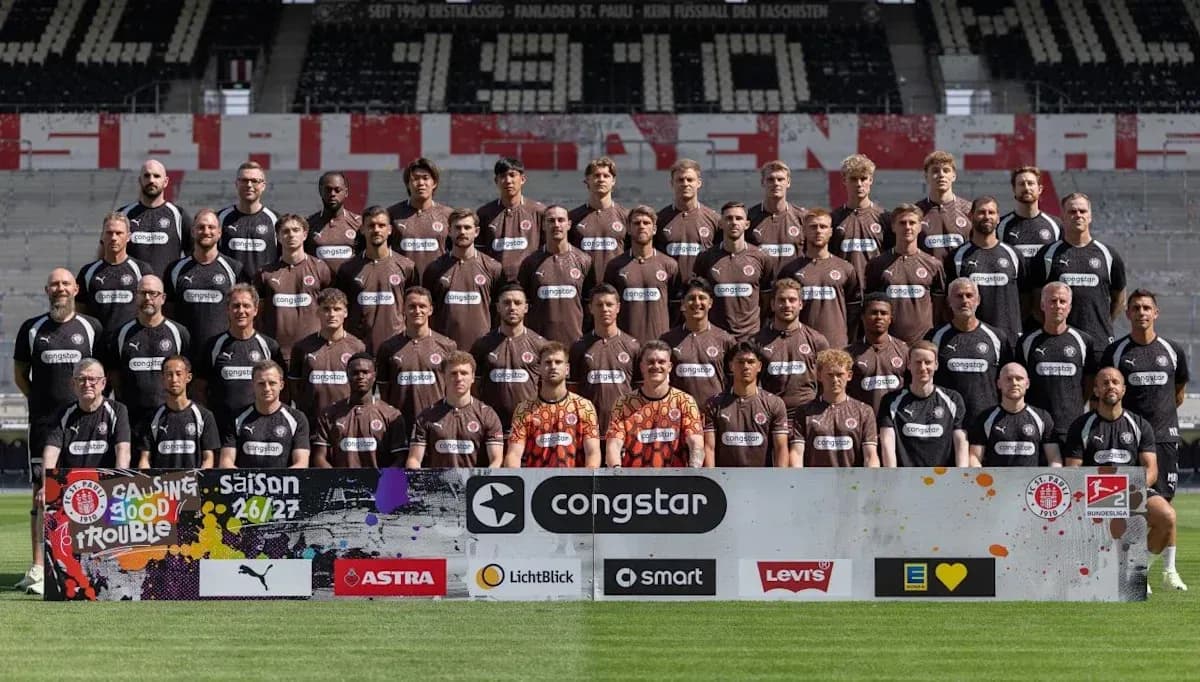
Despite the exits, St. Pauli still field one of the strongest squads in the division. In fact, by market value, only VfL Wolfsburg sit above them in the 2. Bundesliga – and by a huge margin of nearly €200 million. That gap underlines Wolfsburg’s status as the clear title favourite, but it also shows where St. Pauli stand in the chasing pack: not as plucky underdogs, but as a heavyweight expected to swing.
Pre-season has already shown they can punch above their weight on any given day. The question is consistency, not capability.
Wolfsburg should dominate the conversation at the top. Behind them, though, the race for second and third promises to be vicious. Hannover are building with intent. Heidenheim arrive from the Bundesliga with their own ambition and scars. Several others lurk, sensing a rare window of opportunity.
In that landscape, St. Pauli are not outsiders. They are one of the markers everyone else will measure themselves against.
A realistic floor? Somewhere in the top six. The ceiling? A genuine shot at the top three if Rapp’s ideas bed in quickly, if Hrgota hits stride, and if the patched-up defence holds.
The club has taken 13 years before to climb back. This time, with a proven promotion coach, a veteran goalscorer, and a squad still built to compete at the sharp end of the 2. Bundesliga, the clock doesn’t feel like an enemy yet.
The only real question is whether St. Pauli want to wait that long again.