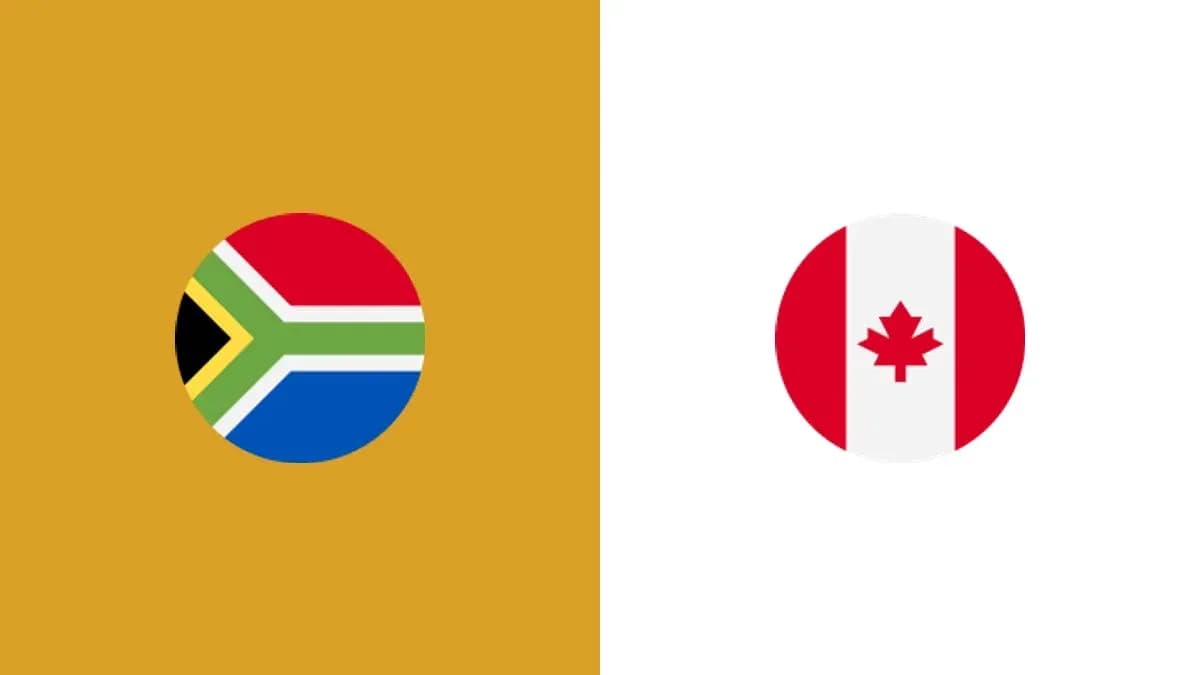
South Africa vs Canada: A Historic World Cup Knockout Clash
South Africa’s date with history meets Canada’s home ambition on Sunday in Los Angeles, a Round of 32 tie that feels far bigger than its billing.
At 15:00 EST, 20:00 GMT, Bafana Bafana walk into uncharted territory: the first men’s FIFA World Cup knockout match in the country’s history. Across from them, co-hosts Canada, bruised but still bristling with attacking threat, fight to keep their tournament alive on home soil.
It’s a collision of stories as much as styles.
Canada arrive tested, but still dangerous
Canada’s route here looked, for a while, like a co-host’s dream. Four points from their opening two Group B games set the tone: a solid 1-1 draw with Bosnia and Herzegovina, then a ruthless 6-0 demolition of Qatar that lit up the tournament and underlined Jonathan David’s status as the country’s leading man.
The Juventus forward helped himself to a hat-trick that night, a clinical display of movement and finishing that Qatar never came close to solving. The win, though, carried a heavy price. Ismael Kone, the Sassuolo midfielder who knits Canada’s play together, suffered a broken leg and saw his World Cup end just as it was taking off.
Their final group match, a 2-1 defeat to Switzerland, stung but changed little. Progress was already secured. The performance, not the mathematics, is what lingers: Canada showed they can be opened up, but they also showed they won’t go quietly against stronger opposition.
There is another shadow hanging over Jesse Marsch’s side. Alphonso Davies, the Bayern Munich star and face of Canadian football, has yet to play a minute at this World Cup after suffering a recurrence of the injury that interrupted his club season, even after returning in Bayern’s Champions League semi-final against PSG. His absence strips Canada of their most explosive outlet on the left and forces Marsch to lean harder on structure and collective effort.
So far, the defensive base has held. Maxime Crepeau has started every game in goal, shielded by a settled back four of Alistair Johnston, Luc De Fougerolles, Derek Cornelius and Richie Laryea. That continuity has given Canada a platform, even as the attack shifts around David’s finishing and the creativity of Stephen Eustaquio, Tajon Buchanan and Liam Millar.
They arrive with two wins, two draws and one defeat from their last five, nine goals scored and four conceded. Strip away the six against Qatar, though, and the numbers look more modest. Against South Africa’s organised, combative unit, they may need another big night from their No. 9.
Bafana Bafana’s wild ride to history
If Canada’s group stage was mostly calm, South Africa’s was a storm.
Hugo Broos watched his side freeze on opening day, a flat 2-0 defeat to Mexico that hurt not only on the scoreboard. Red cards to midfielders Themba Zwane and Sphephelo Sithole deepened the damage, leaving Bafana short of experience and composure in the very area they could least afford it.
Broos reacted. Three changes, a sharper edge, and a different South Africa emerged. Against the Czech Republic, they found their feet and their fight, earning a 1-1 draw through a Teboho Mokoena penalty. The Sundowns midfielder dictated the tempo and took responsibility from the spot, but his yellow card that day ruled him out of the decisive clash with South Korea.
That set the stage for Monterrey.
Needing a win to stay alive, South Africa stepped into a raucous Estadio Monterrey, the atmosphere cranked even higher as news filtered through of Mexico’s goals against the Czechs. The stakes were clear: beat South Korea or go home.
They chose to stay.
Bafana produced a defensive performance that will live long in South African football memory. Compact, disciplined, and utterly committed, they repelled wave after wave of Korean pressure. Every clearance, every tackle, every sprint back towards their own goal carried the urgency of a team that understood the moment.
And on the counter, they were razor sharp. Thapelo Maseko, operating as an inverted winger on the right, tormented the Korean backline. He finally broke through in the 63rd minute with the goal that sent South Africa through, but that single strike barely told the story. Maseko, fresh from a loan spell at AEL Limassol, could easily have walked away with a hat-trick.
Relebohile Mofokeng, the Orlando Pirates prodigy, matched him for impact. Quick thinking, incisive passing, direct running – he constantly dragged South Korea into uncomfortable positions. Between them, they gave a glimpse of a new, fearless Bafana front line.
Behind them, a back five that suddenly looks like the foundation of a new era. Ronwen Williams, the captain and goalkeeper, has started every game alongside full-backs Khuliso Mudau and Aubrey Modiba, with the young central pairing of Mbekezeli Mbokazi and Ime Okon growing with every minute. Mbokazi, just 20 and already based in the USA with Chicago Fire, is being talked about as a future national team captain. Okon, 22 and with Hannover, looks just as assured.
Mokoena’s return from suspension now adds a shield in front of that defence, likely at the expense of Sithole. His presence could be crucial against Canada’s central runners and David’s clever movement between the lines.
South Africa’s recent form reads W1 D1 L2 D1 over their last five, with only two goals scored and three conceded. It’s not a free-flowing attacking machine. It’s something else: a team that has learned how to suffer, how to stay in games, how to wait for their moment.
Tactical balance and likely line-ups
Both coaches have leaned on stability at the back, and the probable XIs reflect that.
For South Africa, a familiar shape:
Williams; Mudau, Okon, Mbokazi, Modiba; Mokoena, Thalente Mbatha; Maseko, Mofokeng, Oswin Appollis; Evidence Makgopa.
The spine is clear. Williams in goal, the young centre-backs in front of him, Mokoena anchoring midfield, and Makgopa offering a physical focal point up front. Around them, pace and guile from Maseko and Mofokeng, with Appollis adding another outlet in transition.
Canada are expected to answer with their own settled core:
Crepeau; Johnston, De Fougerolles, Cornelius, Laryea; Buchanan, Nathan Saliba, Eustaquio, Millar; David, Tani Oluwaseyi.
It’s a line-up built to stretch the pitch. Buchanan and Millar can pin full-backs deep, Eustaquio dictates from midfield, and David drifts into pockets where he’s hardest to track. Oluwaseyi offers energy and movement alongside him, giving Canada a second point of attack even without Davies.
On the benches, both coaches have options. South Africa can call on the experience of Lyle Foster, Zwane and Iqraam Rayners, or the energy of Tshepang Moremi. Canada have Cyle Larin, Jacob Shaffelburg and Jonathan Osorio to change the rhythm of the game.
A rare meeting, a massive stage
These two nations barely know each other on the pitch. Their only previous meeting came in a friendly back in November 2007, when South Africa won 2-0 at home. Nearly two decades later, the stakes could not be more different.
This time it’s a World Cup knockout tie in Los Angeles. South Africa, second in Group A, arrive with history already made and more within reach. Canada, second in Group B, carry the weight of co-host expectation and the knowledge that one bad night ends the party on their own continent.
Form, on paper, leans slightly toward Canada. Momentum, emotionally, may sit with Bafana Bafana after that defiant win over South Korea. The margins will be thin.
One side is chasing a deeper run on home soil. The other is chasing a new chapter for a footballing nation that has waited decades for a moment like this.
Only one will leave Los Angeles with their World Cup dream still alive.