Sevilla's Tactical Triumph Over Real Sociedad in La Liga Clash
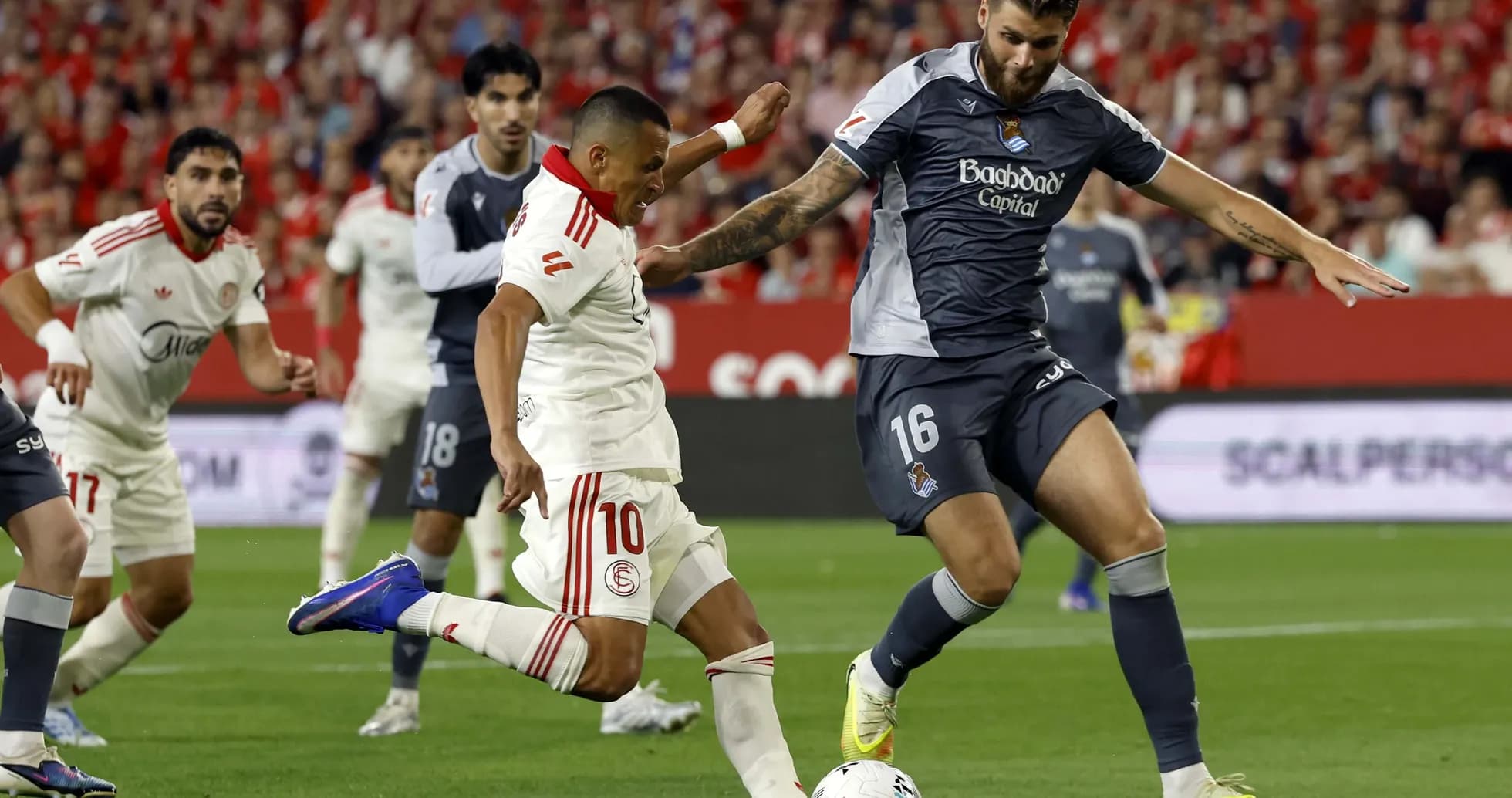
Under the lights of the Estadio Ramón Sánchez Pizjuán, this felt less like a mid-table La Liga clash and more like a survival statement. Following this result, Sevilla’s 1–0 win over Real Sociedad is a narrow scoreline wrapped around a much bigger tactical story: a team in 17th place, with a goal difference of -14 overall (41 scored, 55 conceded), choosing to suffer without the ball and trust a rugged structure; and a side sitting 9th, with a -1 goal difference (52 for, 53 against), unable to turn territorial control into incision.
I. The Big Picture – Sevilla’s pragmatic reset
This was Round 34 of the La Liga season, and the table framed everything. Sevilla, on 37 points from 34 matches, are still looking over their shoulder. At home they have been inconsistent: 6 wins, 4 draws, 7 defeats, scoring 22 and conceding 23. Their overall averages – 1.3 goals for and 1.4 against at home – tell of a side that rarely blows teams away but is almost always in jeopardy.
Real Sociedad arrived with more comfort but less clarity. On their travels they have 3 wins, 6 draws and 8 defeats, scoring 20 and conceding 28. Their away attacking average of 1.2 goals per game is decent, but the 1.6 goals conceded away mirrors Sevilla’s overall fragility. This was a meeting of two teams who concede too much to be truly secure.
Luis Garcia Plaza’s choice of a 4-4-2 was significant. Across the season Sevilla have mostly leaned on 4-2-3-1 (11 times) and three-at-the-back variants, with 4-4-2 used just 3 times before this. Here, it became a low, compact block designed to protect the central lanes and deny Real Sociedad’s 4-2-3-1 the space between the lines.
Opposite him, Pellegrino Matarazzo stayed faithful to Real Sociedad’s own 4-2-3-1, a shape they have also deployed 11 times this campaign. It put their best weapons – Mikel Oyarzabal as the lone forward, Ander Barrenetxea and Carlos Soler as advanced creators – in their natural zones, but it asked them to break down a Sevilla side that has learned, painfully, to live without the ball.
II. Tactical voids – absences and discipline
Both squads arrived with important absentees that reshaped the tactical chessboard.
Sevilla were without M. Bueno (knee injury), Marcao (wrist injury) and D. Sow (suspended for yellow cards). The loss of Sow in particular removed a ball-winning, box-to-box presence in midfield. In his place, Lucien Agoumé and Nemanja Gudelj formed a double pivot that leaned more toward positional discipline than disruptive aggression. It meant Sevilla could screen the back four, but transitions forward were more laboured.
Real Sociedad’s list was longer: G. Guedes (toe injury), J. Karrikaburu (ankle), A. Odriozola (knee) and I. Ruperez (knee) all missed out. The absence of Guedes, a vertical runner and one-vs-one threat, reduced their ability to stretch Sevilla’s back line. Without Odriozola, Jon Mikel Aramburu’s role as an aggressive right-back became even more central – but also more exposed.
Disciplinary trends added another layer. Heading into this game, Sevilla’s season data showed a clear late-game yellow card surge: 19 yellows in the 76–90 minute window, 19.79% of their total. Real Sociedad’s peak was slightly earlier, with 22.22% of their yellows between 46–60 minutes and 16.67% from 76–90. This match followed the pattern: as Sevilla dropped deeper to protect their lead, their tackles became riskier, while Real Sociedad, chasing the game, pushed Aramburu and the full-backs higher, increasing the likelihood of tactical fouls.
III. Key matchups – Hunter vs Shield, Engine Room
Hunter vs Shield: Mikel Oyarzabal vs Sevilla’s fragile defence
Oyarzabal entered as one of La Liga’s most efficient forwards: 14 goals and 3 assists in 30 appearances, with 58 shots and 34 on target. He is not a pure penalty-box poacher; he drifts, links and finishes. Against a Sevilla side conceding 1.6 goals per game overall, and 1.9 on their travels when they play away from home, this should have been a favourable matchup.
But the “shield” here was not just the back four – José Ángel Carmona, Castrin, Kike Salas and Gonzalo Suazo – it was the entire 4-4-2 block. Carmona, La Liga’s leading yellow-card magnet with 11 yellows, walked a familiar tightrope: aggressive in duels (290 total, 157 won this season) yet just controlled enough not to over-commit. His ability to step out and engage Barrenetxea or Oyarzabal without being dragged into wild challenges was key.
Engine Room: Agoumé and Gudelj vs Turrientes and Gorrotxategi
In the middle, the game’s rhythm was decided. Lucien Agoumé, with 1 goal, 2 assists and 1199 passes at 80% accuracy this season, was Sevilla’s metronome. He and Gudelj formed a double pivot whose first task was to deny B. Turrientes and J. Gorrotxategi the time to feed the three behind Oyarzabal.
For Real Sociedad, Turrientes wanted to progress the ball vertically, but too often he received it with his back to goal, pressed by Isaac Romero and Neal Maupay from the front. Sevilla’s 4-4-2 press was not high, but it was well-timed: triggers came when the ball went into the double pivot, forcing Real Sociedad to recycle wide rather than slice through the centre.
On the flanks, Barrenetxea – 3 goals, 5 assists, 42 key passes and 106 dribble attempts (50 successful) – was the away side’s most likely unlock. His duel with Carmona was a constant push-and-pull: Barrenetxea trying to isolate and dribble, Carmona stepping in, sometimes late, always on the edge. Sevilla accepted that Barrenetxea would beat the first man occasionally, but trusted their covering structure to absorb the second action.
IV. Statistical prognosis and narrative verdict
If we layer the season-long numbers onto this 1–0, the story clarifies. Sevilla, with only 6 clean sheets overall and 1.6 goals conceded per game, are not built to win by control; they are built, at this stage, to win by suffering. Their home attack, at 1.3 goals per game, is modest but just enough when the defensive line holds.
Real Sociedad’s profile is that of a side that creates but leaks: 1.5 goals scored per game overall, 1.6 conceded. Away from home, their defensive average of 1.6 against, combined with only 1.2 for, leaves them in a permanent knife-edge. In a tight match where xG likely tilted only slightly either way, the marginal gains – Sevilla’s compactness, their penalty reliability (5 from 5 overall, 100.00% with no misses), and the emotional charge of playing for survival – became decisive.
Following this result, the tactical verdict is clear. Sevilla’s 4-4-2, with Isaac Romero and Maupay working tirelessly ahead of a disciplined midfield, gave them a platform that belied their league position. Real Sociedad’s 4-2-3-1, despite the individual quality of Oyarzabal and Barrenetxea, lacked the structural aggression to break a low block and the defensive solidity to protect themselves from the one decisive moment.
In narrative terms, this was a night where the struggling giant embraced humility: less ball, more structure, and a single goal that might yet define their season.