Rodri's Future: Manchester City's Crossroads After Guardiola
Manchester City stand at a crossroads.
Ten years of one voice, one vision, one overarching idea have gone with Pep Guardiola’s departure. That alone would be seismic. But City are not just changing the manager. They are peeling away key layers of a Treble-winning side at the same time.
Manuel Akanji, Nathan Ake, Bernardo Silva and John Stones – four starters from that 2022-23 machine – have gone. In their place, the club have pushed £116m on Elliot Anderson and moved aggressively for 17-year-old Jeremy Monga. The dressing room is being rewritten while the ink on Enzo Maresca’s nameplate is barely dry.
And then there is Rodri.
Rodri: Centrepiece or final cash-out?
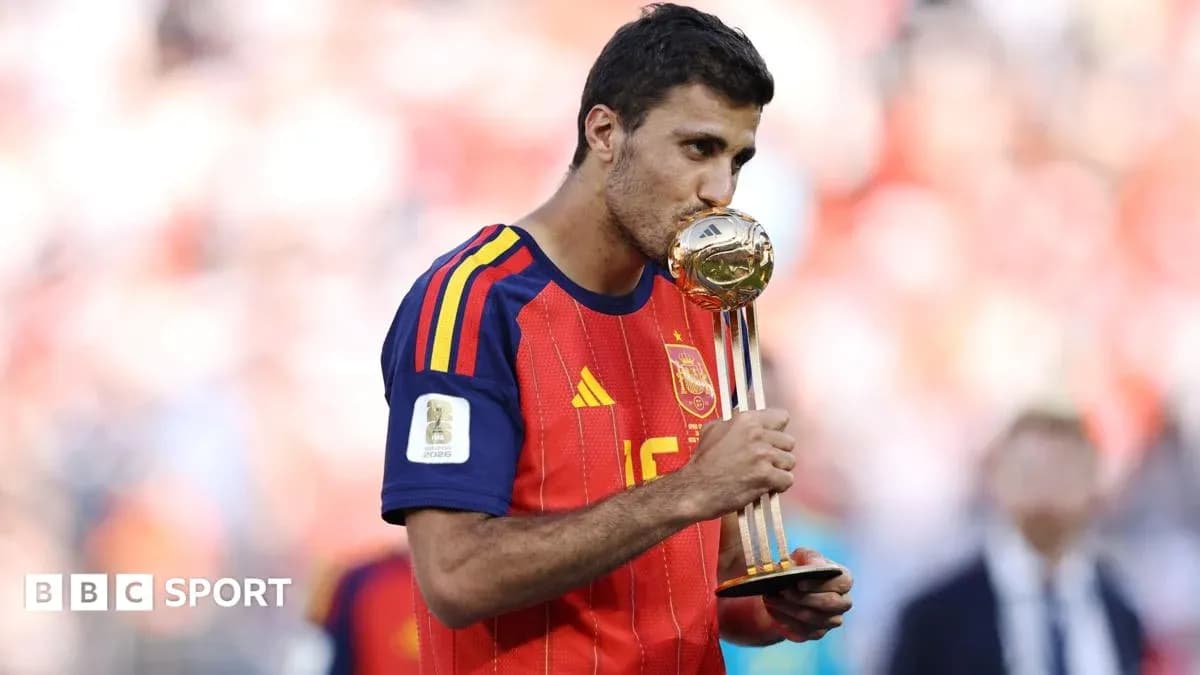
Fresh from lifting the World Cup as Spain’s captain and collecting the Golden Ball as the tournament’s best player, Rodri now heads not for a parade but for an operating theatre. Back surgery on Monday, a year left on his contract, and a swirl of noise around his future.
The timeline for his return is unclear. The stakes are not.
Maresca did not hesitate when asked about him in his first news conference. “I think every manager wants to have Rodri because he is a top player,” he said. “But now, surgery on Monday... he needs a holiday... he needs to rest and recover and then he will be back with us.”
The message was blunt: this is a player to build around, not a chip to cash in.
Yet the market does not always care about a manager’s ideal world. Reports in Spain suggest Real Madrid are “operating on the basis” that Rodri will eventually join them. City, for the first time in years, must seriously weigh up a question they have largely avoided with their core: do they sell a pillar at the peak of his powers, or fight to keep him and reshape the team around him again?
The decision will define Maresca’s first cycle at the club.
The brain of a chess player
To understand why Rodri matters so much to this new City, you have to start with Maresca’s idea of football.
A disciple of positional play, he talks about the game in the language of chess. “There are a lot of similarities,” he said. “The most important is positional play and strategy. For a coach, it's important to have the mentality of a chess player: develop a plan, study counter-moves, choose the arrangement of the pieces.”
His teams typically morph into a 3-2-2-3 with the ball. The structure is familiar to City fans: three at the back, two holding midfielders, two advanced midfielders, three across the front. The danger is not in the shape itself, but in the constant rotations that feed it.
This is where Rodri becomes more than a holding midfielder. He is the hinge.
During the World Cup, he repeatedly dropped into the back line when Aymeric Laporte surged forward, then stepped back into midfield as Spain recycled possession, and pushed into space when the game demanded it. The same elasticity underpinned City’s Treble season, when John Stones would leave centre-back to join Rodri as a double pivot, turning a defensive 4-4-2 into that 3-2-2-3 launchpad.
Rodri reads those shifts almost instinctively. He understands when to slow a game, when to risk a pass, when to plug a gap that nobody else has even spotted yet. That blend of positioning, tempo and risk management took years to develop under Fernandinho’s guidance. It is not easily replaced.
City know that. Maresca certainly does.
Life with, and without, the anchor
City’s plan, at least publicly, is to keep Rodri and build around him again. Yet the club are already sketching out contingencies.
Anderson arrives as a major investment, expected to grow into a key figure in the middle of the pitch. City are also tracking 18-year-old Lille midfielder Ayyoub Bouaddi, who caught the eye for Morocco at the World Cup. The idea is not to find a like-for-like Rodri – that would be futile – but to assemble a midfield that can share and reconfigure his responsibilities.
Maresca’s history offers clues. At City, he was on the staff when Stones stepped into midfield and changed the geometry of games. At Chelsea, he used Moises Caicedo at right-back, only for the Ecuadorian to slide infield when they attacked, again creating that 3-2-2-3 pattern from a different starting point. Marc Cucurella, once a full-back, found himself operating in attacking midfield zones under Maresca’s tweaks.
He has a clear habit: he sees positions players can move into before they ever get there.
If Rodri stays, Maresca gains a world-class reference point around which to rotate Anderson, Monga and any new arrivals. Rodri can drop into the back three, hold as a single pivot, or step into more advanced territory when the structure allows. The younger players can learn the nuances of positional play with a master alongside them rather than trying to replace him from day one.
If Rodri goes, the puzzle becomes harder but not unsolvable. The system would likely rely more on collective movement than one dominant organiser. Anderson could share the base with another midfielder, Bouaddi – if he arrives – could be groomed as a long-term conductor, and defenders may again be asked to step into midfield to compensate for the absence of a single commanding pivot.
It would be more chaotic. It might also be more experimental, which suits Maresca’s appetite for invention.
A bigger squad, a different City
One thing is already clear: this will not be Guardiola’s City 2.0.
Guardiola liked a tight, trusted group, often running with a smaller squad than his rivals. Maresca wants more pieces on his board, more combinations to test, more ways to reach that same 3-2-2-3 from different starting shapes.
Losing Akanji, Ake, Bernardo and Stones in one summer tears out a chunk of continuity. Bringing in Anderson, bedding in Monga, potentially adding Bouaddi and others, points to a broader, more malleable group. That carries risk. It also gives Maresca more chances to stumble upon a formula that works.
With Rodri, that search has a clear anchor. Without him, it becomes a far more open question.
Either way, City are no longer the settled, inevitable force of the past few years. They are something rarer in this era of financial dominance: a giant in transition, with a new strategist at the board and his most important piece either about to sign up for the next game – or preparing to leave it entirely.
The season will turn on which move they make.