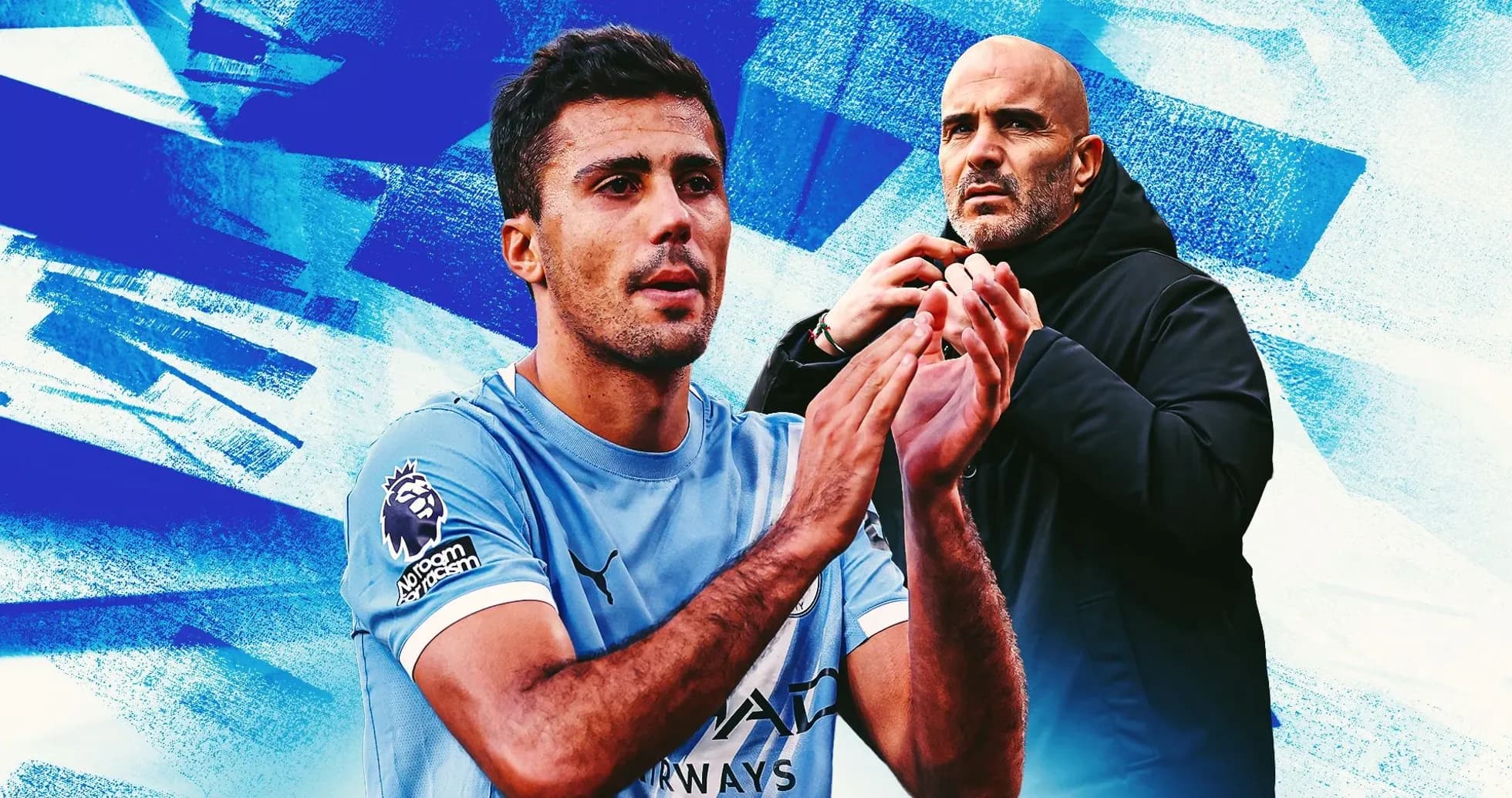
Rodri's Impact on Manchester City Amidst Transition
Rodri has lived through the nightmare every midfielder dreads. An ACL rupture in September 2024, the month before he walked onto the Paris stage to collect the Ballon d'Or, ripped a hole through a career that had been almost eerily uninterrupted. The injuries that followed were smaller, but no less disruptive, chipping away at his rhythm and City’s aura of control.
Before that? He was a constant. He had missed only seven games for the club. Seven. In an era defined by rotation and load management, Rodri was the metronome Guardiola refused to take off the pitch.
City will point to that sudden fragility as a defining reason why their domestic dominance stalled. Since the 2023-24 title, the league has slipped away. The midfield that once felt untouchable has spent two seasons patching itself together without its organiser-in-chief.
And yet, on the biggest stage of all, he came roaring back.
Rodri, restored on the world stage
Guardiola saw it coming. Back in October last year, still in the middle of the rehab and the doubt, he said: “In the World Cup, he will be the best Rodri, and next season he will be the best Rodri.” It sounded ambitious at the time. It ended up being prophetic.
At the World Cup in North America, the 30-year-old ran Spain’s tournament from the base of midfield. Luis de la Fuente built his structure around him and watched Rodri dictate the tempo, smother counters, and quietly erase danger before it became obvious to anyone in the stands. Spain lifted the trophy with a World Cup-winning captain who rarely raised his voice but never lost his grip on the game.
For City, it was both reassuring and alarming. Reassuring, because the old Rodri is still there. Alarming, because it underlined just how irreplaceable he has become at the Etihad, just as the club steps into life after Guardiola and just as his contract ticks towards its final year.
If he decides that Guardiola’s departure is the right moment to return to Spain, City may never truly replace him. They might simply have to learn to live without that level of certainty.
Maresca’s inheritance – and his biggest fear
Enzo Maresca knows exactly what he has walked into. A new manager, a new cycle, a dressing room stripped of some of its most experienced voices – and a midfield built around a player who might not be there for long.
He did not sound surprised by the noise around Rodri when he faced the media for the first time as City manager at the City Football Academy.
“First of all I have to say, that around big players there are always speculations so I am not worried about that,” he said. “I think it is normal, also because they won the World Cup, because he is one of the best players.
“I think every manager wants to have Rodri because he is a top player. But now, surgery on Monday [on his back]. He needs a holiday, he needs to rest and recover and then he will be back with us.”
Calm words. But the reality is stark. Maresca’s entire idea of football leans on a deep-lying organiser who can slide between roles, drop into the back line, step into midfield, and launch attacks from deep. In other words: someone who plays the game the way Rodri does.
Rodri is not just City’s No.6. He is their structure. Their safety net. Their on-field reference point in the post-Guardiola era.
Strip him out of that system and you are not just changing a player. You are changing the whole feel of the team.
A thin midfield and a looming hole
Look past Rodri and the new £116 million signing Elliot Anderson and the picture is nowhere near as comforting.
The supposed like-for-like cover, Nico Gonzalez, has never really arrived as a City player. Brought in partly to shield the team during Rodri’s ACL layoff, he ended up as one of the more forgettable faces in a lavish January 2025 window. Guardiola rarely trusted him in the second half of the season; he spent most of it watching from the bench. A sale has been openly suggested.
Tijjani Reijnders offers another case study. The Dutchman flew out of the blocks after his £46m move from AC Milan last summer, then faded badly. Once the calendar flipped, his minutes did too, shrinking into a bit-part role. The hope, and it really is hope, is that a year’s adaptation to English football will unlock a more consistent version next season.
Behind them, the depth chart looks brutal. Mateo Kovacic, Rico Lewis and Kalvin Phillips have all reportedly been told they can go. Take Rodri out of that group as well, and the midfield stops being a puzzle and becomes an emergency.
Maresca would not just be tweaking his options. He would be staring at a rebuild in the most important area of the pitch.
Elliot Anderson, waiting in the wings
If Rodri does leave, one player stands to gain more than anyone: Elliot Anderson.
Signed from Nottingham Forest after a rapid rise that also carried him into Thomas Tuchel’s England plans, the 23-year-old is not a pure destroyer, nor just a passer. He is both, and that’s why City paid so heavily for him. A combative, deep-lying playmaker who relishes duels but can also thread the first pass that breaks a press.
The numbers from last season are not the numbers of a prospect. They are the numbers of a ready-made Premier League engine.
No player in the division won possession more often than Anderson (306 times). No one won more duels (297). Even with Morgan Gibbs-White on the pitch, he still topped Forest’s creativity charts, creating 54 chances, nine of them categorised as big chances. At the 2026 World Cup, he finished with the joint-most tackles (18) – sharing that title with Rodri himself.
He can tackle, he can pass, he can carry, he can create. If City do lose their Ballon d'Or-winning pivot to Madrid, Anderson will expect – and demand – the chance to become the new No.6.
Bouaddi, youth, and the risk of fast-tracking
He might not have to carry the burden alone. Inside the club, there is already a plan for the next defensive midfielder: Ayyoub Bouaddi.
The 18-year-old Lille talent exploded onto the global scene with Morocco at the World Cup, instantly marking himself out as a future holding midfielder at the highest level. City have been circling, with an initial idea to sign him and loan him straight back to Ligue 1.
That plan may not survive the summer. If Rodri goes, Bouaddi’s timeline changes. Reports suggest City could bring him in immediately and keep him, accelerating his development in Manchester instead of watching from afar.
It would be bold. It might also be necessary. But asking a teenager to learn the demands of a new league, a new club and a new tactical framework while replacing Rodri in a post-Guardiola season is a gamble of the highest order.
Leaders gone, certainties gone
The turbulence is not confined to the base of midfield.
Bernardo Silva, captain last season and one of the dressing room’s most enduring voices, has gone to Madrid. John Stones, another serial winner and a key figure in Guardiola’s hybrid back line, has left for Inter at the end of his contract.
Add Guardiola’s emotional exit to that list and you have a club shedding not just a manager, but a generation. The culture he built is still there in the walls and the training pitches, but the people who lived it every week are slowly walking away.
Rodri’s presence would offer at least one familiar anchor in the middle of all that change. The idea of him leaving does not just weaken the starting XI. It underlines the scale of the reset.
City’s hierarchy know exactly what happens when a legacy manager leaves and the succession plan stumbles. They have watched Manchester United and Arsenal spend years trying to reconnect the dots after Sir Alex Ferguson and Arsène Wenger stepped aside. They are desperate to avoid the same fate.
Maresca’s mixed spell at Chelsea will not quiet the doubters. His footballing ideas are admired inside the game, but admiration does not automatically translate into trophies. Continuity around him – and on the pitch in the form of players like Rodri – could make the difference between a smooth transition and a spiral.
A move to Real Madrid for their midfield general would tilt that balance towards chaos.
Maresca’s calm in the storm
For now, the Italian is refusing to blink.
“I want to say it is a privilege because the reason why the club decided to go for me, that is a privilege,” he said, when asked about stepping into Guardiola’s shadow. “I have said many times, I consider Pep the best coach in the world in the last 20-25 years. It is a challenge.
“Also the history of the manager with many years in the same club, they struggle a bit. Sir Alex, Arsene. But it is also a challenge to do the right things.”
He knows he will need time, and he believes City’s structure will give it to him.
“Whatever happens, time is important. I know the organisation quite well and the people inside the club from years ago. I just said before that when a club has three managers in almost 20 years, it shows how serious they are. The structure understands to give time for everything.
The organisation is the main thing. This club and organisation has had three managers in 17 years. That is not normal and has not happened often. I am confident that we can continue to do a great job and continue to do the job that has been done in the last 14, 15 years since Roberto Mancini was here.”
The words are measured, the faith in the club clear. But the reality of next season will not be gentle.
City are about to step into a campaign without Guardiola, without Bernardo Silva, without John Stones, and possibly without the midfielder who has held them together for half a decade.
Maresca can talk about time and structure. He can lean on Anderson’s numbers and Bouaddi’s potential. Yet as the new era begins at the Etihad, one question will hover over everything: can Manchester City really afford to lose Rodri now?