Pau Cubarsí: The Teenage Centre-Back Redefining Spain's Defence
Luis de la Fuente insisted last summer that Pau Cubarsí’s omission from Spain’s Euro 2024 squad had nothing to do with age. He said he simply had four centre-backs he rated higher at that moment.
That hierarchy has been ripped up in North America.
Right now, there are not many defenders at this World Cup operating on Cubarsí’s level. At any age.
A defence that doesn’t blink
Spain have marched into the quarter-finals without conceding a goal. That kind of record never belongs to one man.
Mikel Oyarzabal sets the tone from the front, harrying defenders and closing passing lanes. Rodri patrols in front of the back four with his usual authority, dictating tempo and snuffing out danger before it reaches the area. Around them, every piece of the defensive unit has clicked.
Marc Cucurella is playing like a full-back who just cost Real Madrid €60 million from Chelsea, justifying every euro with his blend of aggression and precision. Unai Simón has silenced debate over David Raya and Joan Garcia with five straight clean sheets. Aymeric Laporte, at 32, looks as assured as at any point in his career.
And Pedro Porro? In a Spain shirt he bears no resemblance to the erratic full-back Tottenham fans know. For his country, he’s disciplined, sharp, reliable.
Inside that structure, though, one figure stands out. Cubarsí has turned a rock-solid defence into something close to flawless.
The kid who looks born for this
Maybe nobody should be shocked that Cubarsí looks this serene on the biggest stage.
He has been a regular for Barcelona since 17, moulded by La Masia to treat the ball as an ally, not a burden. Xavi labelled him “an era-defining player”, the same phrase he used for Lamine Yamal. Carles Puyol went even further, predicting Cubarsí would be Barça’s first-choice centre-back for the next 15 years.
Cubarsí himself insists he doesn’t feel pressure on the pitch. Watching him, you believe it. But that doesn’t make what he is doing at a World Cup at 19 any less staggering.
Defensively, he has barely put a foot wrong. His positioning is mature, his timing in the tackle precise, his reading of the game almost eerie for someone who should still be learning his trade. Laporte’s presence beside him has clearly helped. The veteran guides, the teenager anticipates, and together they have become a wall.
“At crucial moments, a player like Laporte brings that experience Cuba needs [alongside him], and they complement each other fantastically,” De la Fuente said. “We’ve achieved a phenomenal balance in the centre of defence.”
Spain have more than balance there, though. They have another playmaker.
A centre-back who runs the game
Cubarsí is not just defending Spain’s goal; he is shaping their attacks. A La Masia graduate schooled in building from the back, he steps into midfield lines, breaks presses with one pass, and refuses to panic when pressure closes in.
Only Rodri has played more passes than Cubarsí at this World Cup so far. That statistic underlines his role: not just a stopper, but a hub. Every move seems to run through his boots at some point.
De la Fuente has responded by making him untouchable. Cubarsí is one of only four players in the squad to have played every minute of Spain’s campaign. At 19, he has become indispensable.
And he is not the only teenager carrying the weight of expectation.
Yamal waiting to explode
Lamine Yamal arrived in North America with a question mark hanging over him. A hamstring injury had cut short his 2025-26 season with Barcelona and cast doubt on his World Cup participation.
He missed both of Spain’s warm-up matches and only managed a 19-minute cameo in the shock 0-0 draw with Cape Verde. When he finally started, in the 4-0 demolition of Saudi Arabia in Atlanta, Spain suddenly looked like a different team.
Yamal opened the scoring and transformed the right flank, stretching defenders, demanding the ball, forcing panic. La Roja’s attack gained an extra gear the moment he stepped on the pitch.
Since then, the ride has been bumpier. His dribbling lit up the round-of-32 thrashing of Austria, a game that saw Spain become the first team since Brazil in 1958 to start two teenagers in a World Cup knockout match. But against Portugal, the old duel returned.
Nuno Mendes, his nemesis, shackled him again in the 1-0 win. Yamal probed, feinted, tried to twist free. He rarely did.
So the most feared winger in football goes into Friday’s quarter-final against Belgium still waiting for his first assist of the tournament, with just five chances created so far. On paper, that looks underwhelming.
Yamal doesn’t see it that way.
“I’m very demanding of myself,” he told Mundo Deportivo. “I’m never satisfied with what I’m doing. Besides that, I just need to keep playing. I was out for almost two months, and it’s not the same as when you’ve already played seven games in a row.
“Keep touching the ball, keep playing, keep adding minutes and, obviously, that [big] match will come. In the end, people remember these moments, from the round of 16 and the quarter-finals onwards. That’s when I’m most motivated.
“I’ve taken this whole process calmly so I can arrive at this point in good shape. I feel great, eager to show what we are as Spain and what I am.
“I’ve never been the best player in the group stage. The closer the important matches get, the semi-finals or the final, the better I play.”
For Belgium, that is a chilling message.
Two era-defining pillars
Yamal already proved at Euro 2024 that he can bend a major tournament to his will when the stakes rise. His surge in the knockout rounds dragged Spain towards the trophy. There is no reason history cannot repeat itself on an even bigger stage.
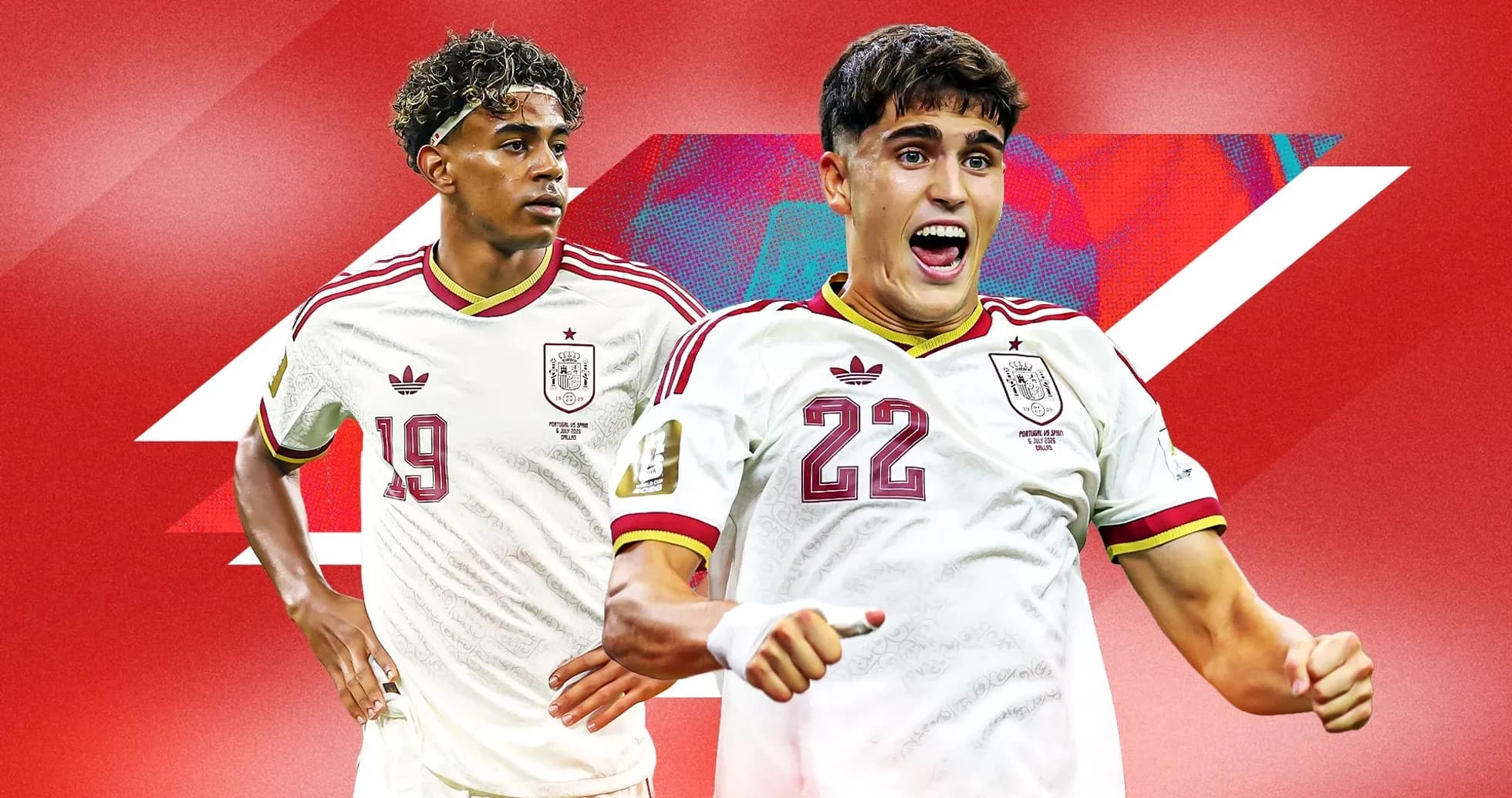
Only this time, he is not alone as the face of Spain’s new era. Behind him, Cubarsí is quietly redefining what a teenage centre-back can be at a World Cup: calm, commanding, relentlessly involved.
Spain arrived in North America with a reputation for technical brilliance and a question mark over their steel. They now stand on the brink of the semi-finals with a spotless defensive record, a 19-year-old dictating games from centre-back, and an 18-year-old winger promising that his real tournament has yet to begin.
If Yamal catches fire while Cubarsí keeps locking the back door, this World Cup may end the same way as Euro 2024 did — with Spain’s new generation standing on top of the world, and the rest of football wondering how long this era is going to last.