Norway Defeats Brazil in Round of 16 Clash
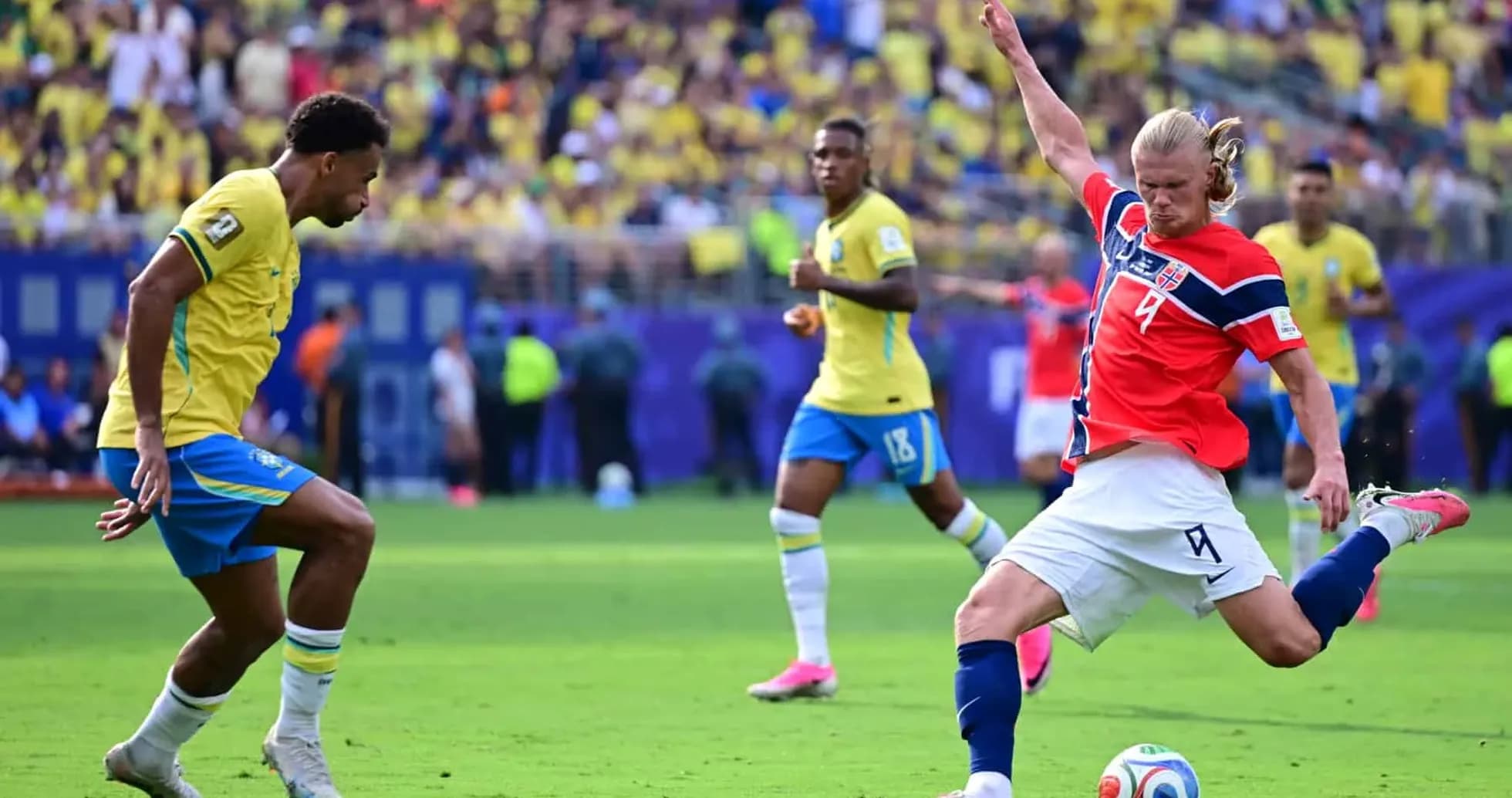
Brazil’s Round of 16 exit at MetLife Stadium was defined by a stark contrast between territorial control and chance quality. Norway owned the ball with 66% possession and a 680–329 passing advantage, yet it was Brazil who generated the higher attacking threat, posting 14 shots to 9 and a significant xG edge of 2.73 to 0.84. Tactically, this was a game where Stale Solbakken’s Norway accepted a deeper, more controlled structure and then ruthlessly exploited transition and penalty-box presence through Erling Haaland, while Carlo Ancelotti’s Brazil oscillated between incisive verticality and disjointed second-half reshaping.
Norway's Midfield Dominance
Norway’s midfield triad of Martin Ødegaard, Sander Berge and Patrick Berg underpinned their dominance of the ball. With 91% passing accuracy (617 accurate from 680 total), Norway circulated possession methodically, using the full width through Julian Ryerson and David Møller Wolfe and repeatedly drawing Brazil’s midfield into lateral shifts. Ødegaard operated as the primary connector between lines, dropping alongside the pivots to help build, then stepping into the right half-space to combine with Antonio Nusa and Alexander Sørloth before his withdrawal. This structure allowed Norway to compress Brazil into longer defensive phases, even if their final-third shot volume remained modest.
Brazil's Direct Approach
Brazil, by contrast, were far more direct and event-focused. Despite only 34% possession, they produced 10 shots inside the box from 14 total attempts, highlighting how often their attacks culminated close to Ørjan Nyland’s goal. The early VAR-confirmed penalty for Matheus Cunha at 12 minutes, followed by Bruno Guimarães’ missed spot-kick at 14’, encapsulated the approach: rapid vertical entries, heavy occupation of central channels, and a willingness to attack Norway’s back line aggressively whenever turnovers occurred. The 4 blocked shots underscore how frequently Norwegian defenders had to throw bodies in front of efforts after Brazil had already broken into dangerous zones.
Norway's Defensive Compactness
Out of possession, Norway’s compactness was notable. With only 6 fouls and no yellow cards, they defended more by positioning than by repeated tactical fouling. The back four stayed narrow to protect the central lane against Vinícius Júnior and Matheus Cunha, trusting the full-backs to time their pressure on wide players. The midfield three screened Casemiro and Bruno Guimarães, limiting Brazil’s ability to construct sustained short-passing sequences; Brazil’s 85% pass completion (279 accurate from 329) is solid, but the volume shows how often they were forced into quicker, riskier progressions rather than patient circulation.
Brazil's Defensive Scheme
Brazil’s defensive scheme was more front-footed but less controlled. With 7 fouls and a late yellow card for Neymar (reason: “Foul”), they alternated between aggressive pressing triggers and deeper blocks. Casemiro anchored the midfield, with Rayan and Bruno Guimarães tasked with stepping out to Norway’s pivots. However, as Norway’s passing rhythm increased, those jumps occasionally left pockets between midfield and defence, areas Ødegaard and later substitutes like Andreas Schjelderup could exploit. The fact Norway only needed 9 shots to score twice, both through Haaland, points to the efficiency with which they reached optimal finishing zones rather than peppering the goal from distance.
Goalkeeper Performances
In goal, Alisson (Brazil) was central to keeping the tie alive as long as it was. He recorded 3 saves and, crucially, his goals prevented value of 0.76 suggests he outperformed the quality of chances faced, denying Norway from turning their territorial dominance into a larger margin. His interventions, especially against close-range efforts, allowed Brazil to gamble later with more attacking substitutions. At the other end, Ørjan Nyland (Norway) made 4 saves and matched Alisson’s 0.76 goals prevented, a key factor given Brazil’s significantly higher xG. Nyland’s shot-stopping, particularly against Brazil’s box-heavy attacks and the late penalty phase, underpinned Norway’s ability to withstand pressure even when their structure was briefly compromised.
Substitution Patterns
The substitution pattern shifted the tactical landscape after half-time. Solbakken’s double change at 46 minutes — Andreas Schjelderup (IN) came on for Antonio Nusa (OUT) and Oscar Bobb (IN) came on for Alexander Sørloth (OUT) — recalibrated Norway’s front line. Schjelderup’s ability to drop and link play gave Ødegaard a secondary creative outlet, while Bobb’s movement between lines created new angles against Brazil’s midfield. Later, Fredrik Aursnes (IN) came on for Julian Ryerson (OUT) at 63’, adding more control and defensive awareness on the flank as Norway prepared to protect a lead.
Ancelotti’s changes were more reactive and aimed at injecting direct threat. Endrick (IN) came on for Matheus Cunha (OUT) at 58’, adding fresh depth running against a tiring Norwegian back line. Danilo Santos (IN) came on for Rayan (OUT) and Neymar (IN) came on for Gabriel Martinelli (OUT) at 68’, moves that reoriented Brazil’s attack around Neymar’s ability to carry and draw fouls between the lines. Finally, Éderson (IN) came on for Bruno Guimarães (OUT) at 79’, sacrificing some passing range for additional energy and box-arrival from midfield as Brazil chased the game.
Key Scoring Moments
The timing and impact of these changes intersected directly with the key scoring moments. Norway’s opener at 80 minutes, finished by Haaland from an Andreas Schjelderup assist, was the product of their more fluid, substitution-driven attacking shape. With Schjelderup operating intelligently between Brazil’s lines, Norway could find Haaland earlier and with better body orientation. Brazil’s late penalty, converted by Neymar at 90+9’, came after a sustained period of pressure in which the reconfigured front line overloaded central spaces and forced Norway deeper. Yet, Haaland’s earlier second goal at 90 minutes, again assisted by Schjelderup, ultimately defined the tactical verdict: Norway’s lower-volume, high-lethality approach trumped Brazil’s higher xG but less efficient finishing.
Statistical Overview
Statistically, the match paints a clear strategic picture. Norway’s 66% possession and 680 passes at 91% accuracy reflect a team comfortable dictating tempo and rhythm, even if they accepted fewer shots (9) and only 1 blocked effort. Brazil, with 34% possession and 329 passes at 85%, were structurally more reliant on transitions and individual quality to generate their 14 attempts and 10 efforts inside the box. The xG split — 2.73 for Brazil versus 0.84 for Norway — underlines that Ancelotti’s side created more and better chances, but Norway’s finishing, coupled with equal excellence in goal prevention from Nyland and Alisson, flipped the scoreboard to 2-1 in Norway’s favour.
Tactical Reflection
From a tactical lens, Brazil exit the World Cup having shown they can manufacture high-quality chances even against a possession-dominant opponent, but their game management after substitutions and vulnerability to elite penalty-box forwards proved costly. Norway, meanwhile, advance from the Round of 16 as a side whose structural control, passing security, and ruthless exploitation of Haaland’s strengths can overcome even a statistically superior opponent on the day.