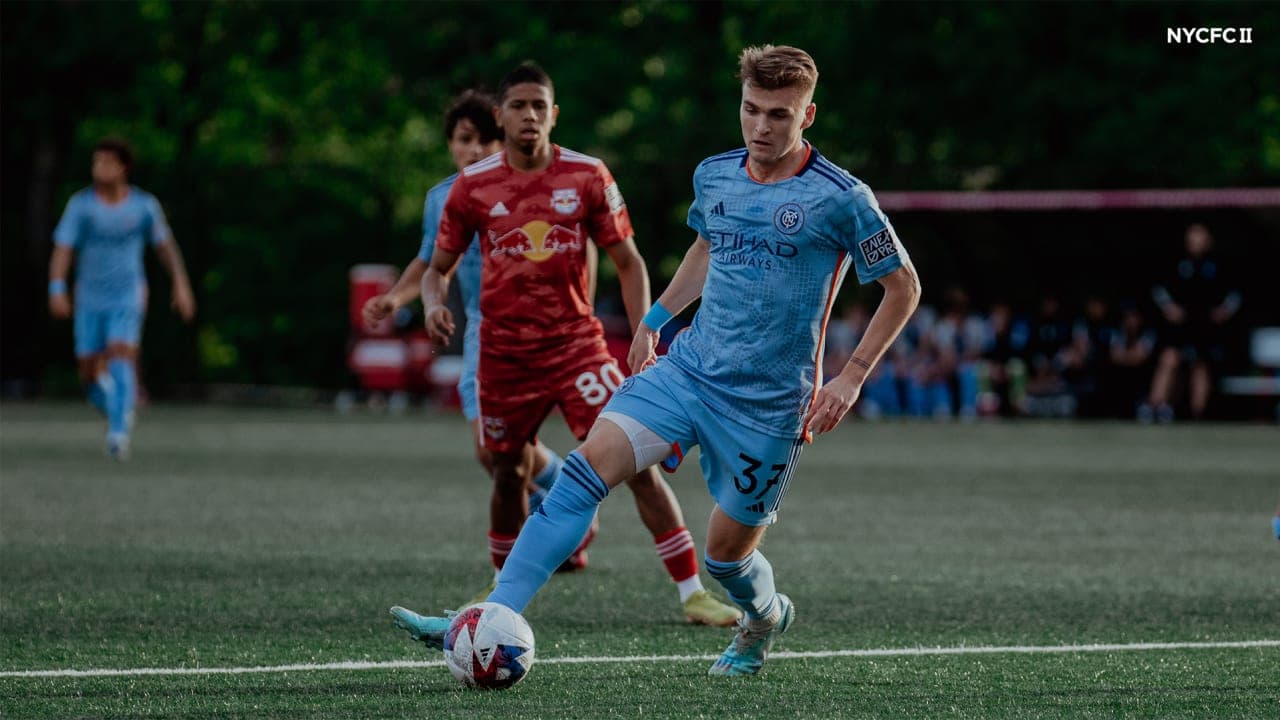
New York City II Upsets RB II in MLS Next Pro Derby
Under the lights at MSU Soccer Park, this MLS Next Pro derby between New York RB II and New York City II finished 3–2 to the visitors, a result that bent the narrative of the Eastern Conference without quite breaking RB II’s emerging dominance. Following this result, the league table still paints RB II as a powerhouse: in total this campaign they have 23 points from 10 matches, with a goal difference of 12 built on 24 goals for and 12 against. New York City II, meanwhile, remain a volatile proposition, sitting 12th in the Eastern Conference with 12 points from 9 games and a goal difference of -5 (11 scored, 16 conceded before this fixture).
Yet the 90 minutes told a subtler story about structures, mentality, and where each squad stands in its development arc.
I. The Big Picture: Contrasting Identities
Heading into this game, RB II were one of the league’s most assertive sides. At home they had scored 17 goals in 6 matches, an average of 2.8 per game, while conceding 9 at an average of 1.5. On their travels, New York City II were far more fragile: 6 goals scored and 8 conceded in 5 away games, with away averages of 1.2 for and 1.8 against. On paper, this was a home banker for the division leaders.
RB II’s season-long DNA is built on front-foot football and risk tolerance. In total this campaign they had failed to score in exactly zero matches, and their biggest home win of 4–1 underlines a willingness to stretch games. They even carry a clean penalty record: 1 penalty taken, 1 scored, 0 missed.
City II, by contrast, are a team of extremes. In total this campaign they had lost 5 of 9, including a brutal 0–5 home defeat, yet they also own a wild 2–3 away win as their biggest road statement. They never draw; it is all-or-nothing football, and at MSU Soccer Park that chaos tilted in their favour.
II. Tactical Voids and Discipline
The lineups revealed a derby stripped of star billing but rich in developmental intrigue. For City II, coach Matt Pilkington trusted a young core: M. Learned, K. Acito, K. Smith, and the attacking trio of D. Duque, D. Kerr, and C. Danquah formed the spine. On the bench, the likes of B. Klein, D. McDermott, and E. Samb offered late-game energy rather than seasoned control.
RB II, without a listed coach in the data, leaned on a balanced XI: A. Stokes and C. Faello anchoring the back line, with C. Harper and D. Gjengaar providing width and thrust, and a forward cast including A. Rojas and M. Jimenez. The bench was deep: A. Causey, A. Modelo, M. Morigi, and others gave them more options than their rivals.
Where RB II did carry a clear tactical void was discipline. Heading into this game, their yellow-card profile was heavily back-loaded: 40.00% of their cautions came between 76–90 minutes, with another 20.00% between 61–75. They also had a single red card this season, shown in the 61–75 minute window. This is a side that plays on the edge late on, often when legs and minds are tired.
City II’s disciplinary pattern is different but equally volatile. In total this campaign, 33.33% of their yellow cards have arrived between 16–30 minutes and another 33.33% between 76–90, with a red card also in that 76–90 window. They tend to start edgy, calm slightly, then boil again as the game stretches. In a derby context, those patterns almost guarantee periods of chaos.
III. Key Matchups: Hunter vs Shield, Engine Room vs Press
Without a defined statistical “top scorer” in the JSON, the Hunter vs Shield narrative becomes unit versus unit rather than individual versus individual.
For RB II, the attacking “Hunter” is collective: in total this campaign they average 2.4 goals per match, built on aggressive wide play and constant penalty-box occupation. At home, that figure rises to 2.8, a number that usually overwhelms visiting defences. Up against them was a City II “Shield” that, heading into this game, conceded 1.8 away goals per match and had never kept a clean sheet in any venue. The raw defensive metrics screamed mismatch.
Yet City II’s own Hunter had teeth. In total this campaign they averaged 1.3 goals per match, but the split is telling: 1.5 at home, 1.2 away. They are not prolific, but they are opportunistic, and their biggest away win of 2–3 hinted at a team that thrives in broken, transitional games—exactly the kind RB II often invite.
In the engine room, the battle was less about a single playmaker and more about structures. For City II, midfielders like C. Flax and J. Suchecki were tasked with resisting RB II’s press and finding early passes into Duque, Kerr, and Danquah. For RB II, the central cluster of S. Kone, D. Cadigan, and A. Sanchez had to compress space, win second balls, and protect a back line that, in total this campaign, conceded 1.4 goals per match despite their dominance.
The substitutions—though not timestamped in the data—offered another layer. City II’s bench options such as E. Martin and S. Musu are archetypal “chaos agents,” suited to late transitions. RB II’s deeper bench, including B. Rodriguez and S. Baitinger, was built for sustained pressure rather than pure counter-attacking.
IV. Statistical Prognosis and What the 3–2 Tells Us
From a pure numbers perspective, any xG model would have leaned heavily towards RB II pre-match. A home side averaging 2.8 goals for and 1.5 against at MSU Soccer Park, undefeated by the scoreboard in terms of failing to score, facing an away team conceding 1.8 per game and carrying no clean sheets, is usually a recipe for a comfortable home win.
The 3–2 scoreline in favour of New York City II therefore feels like a classic case of volatility beating structure on the night. RB II’s attacking output held up—they still hit twice, in line with their seasonal averages—but their defensive regression was stark. Conceding three at home to a side that, on their travels, had averaged only 1.2 goals for, suggests either individual errors, transition vulnerability, or a tactical over-commitment in pursuit of control.
For City II, the win is entirely on brand. This is a team whose biggest away result heading into the game was a 2–3 victory; they are comfortable living on the knife-edge of 3–2s and 3–2 losses. Their inability to keep clean sheets remains a structural concern, but their capacity to turn chaotic game states into points is a weapon in itself.
Looking forward, the prognosis is nuanced. RB II’s underlying numbers—high scoring, positive goal difference, a perfect penalty record, and only 1 clean sheet in total—suggest they will continue to be a high-xG, high-concession side. Over a season, that profile still projects as a contender, especially given their position at the top of the Northeast Division and second in the Eastern Conference.
City II, meanwhile, will likely ride variance all year. Their negative goal difference, lack of clean sheets, and streaky form (“LWLLWLWLW” heading into this game) point to a team that will hover around the playoff periphery rather than storm it. But as this 3–2 derby win shows, in one-off fixtures—especially under the emotional charge of a rivalry—they have enough attacking punch and psychological resilience to overturn the statistical script.
In tactical terms, the lesson is clear: RB II’s relentless front-foot identity makes them formidable over 10, 20, or 30 matches, but in the 90 minutes of a derby, a team like New York City II, built for chaos, can still walk out of MSU Soccer Park with the points.