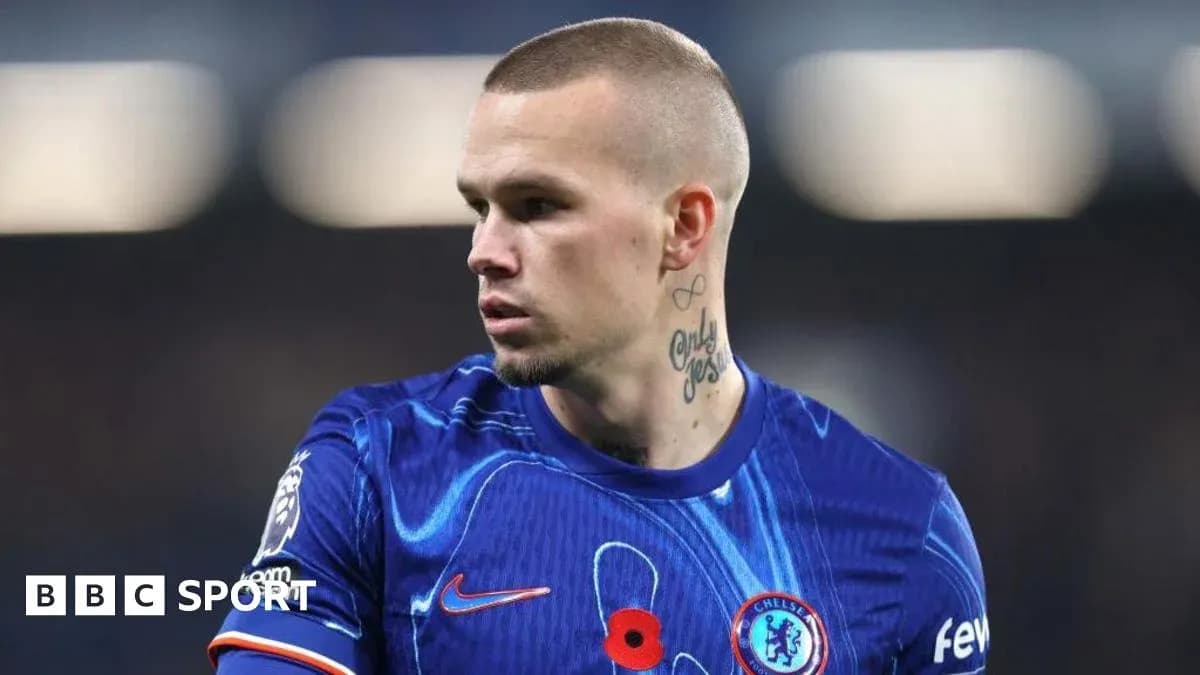
Mykhailo Mudryk Returns to Football After Doping Ban
Mykhailo Mudryk has his boots back.
After 20 months in limbo, the Chelsea winger is free to play again with immediate effect, his long-running doping case finally resolved and his four-year ban effectively wiped away by time already served.
From four-year exile to instant return
Mudryk, 25, had not kicked a ball in a competitive match since November 2024. An out-of-competition test while on international duty with Ukraine in October that year produced an “adverse finding” for meldonium, a prohibited cardiovascular medication known to boost stamina and respiratory capacity.
The Football Association initially came down hard. In January this year he received the maximum four-year suspension for an anti-doping rule violation, a sanction that would have kept him out until roughly December 2028 and cast a shadow over the prime of his career. The case only became public in April, once Mudryk had appealed to the Court of Arbitration for Sport (CAS).
Now the landscape has changed.
The FA confirmed that its anti-doping disciplinary proceedings with Mudryk are over. He has accepted breaking anti-doping rules and agreed to a punishment equal to the time he has already spent on the sidelines. The result: he can return to competition “with immediate effect”.
The governing body also revealed key details it had previously kept under wraps under the strict confidentiality of its anti-doping programme. The meldonium detected in Mudryk’s sample was present at a “low concentration”. Since that test, the World Anti-Doping Agency has updated its technical document on meldonium. Those changes do not apply retrospectively, but the FA noted that had the same sample been taken today, “the concentration of meldonium in the sample would not have been reported” and no adverse finding would have been recorded.
In short, under current rules, there would have been no case.
With WADA’s agreement, Mudryk and the FA have now settled the appeal. The legal fight is over; the footballer returns.
“The most difficult period” – and a way back
Mudryk described the saga as “the most difficult period” of his career and said he was “grateful” to be able to play again. He has consistently insisted he never knowingly or intentionally took a banned substance, a stance he repeated as the case closed.
Chelsea, who signed him from Shakhtar Donetsk in 2022 for £61m on a long-term deal running to 2031, stood by him from a distance. The club stressed it had always supported “Misha” while respecting the integrity of the anti-doping system and the legal process. Now, with the matter concluded, they say they are pleased he can return to football immediately and are “looking forward” to helping him regain full fitness, rejoin the squad and step back onto the pitch. He will be part of their pre-season tour.
The Blues also highlighted the evolution in testing standards, pointing out that under current guidelines “no anti-doping rule violation would have resulted” from Mudryk’s sample. For them, that context matters. It does not erase the past 20 months, but it explains why all parties were willing to draw a line under the case.
Mudryk, for his part, has spoken of his “deep gratitude” to everyone at Chelsea and his excitement for the “next chapter” of his career.
Training in exile
Behind the statements lies a stark reality: Mudryk has been living like a professional in everything but name.
Under the terms of his suspension, he could not enter Chelsea’s training ground or work with club staff. He was effectively cut off from the daily rhythm of elite football. His only known public contact with the first team came when he joined the celebrations at the Conference League final in May 2025.
So he built his own programme.
He paid for private coaching. He hired goalkeepers for one-on-one sessions. He used a pitch at non-league Uxbridge FC in west London to keep his sharpness, then organised a training camp in Austria, where footage showed him scoring, sprinting, and running through attacking drills as if preparing for a Champions League night rather than an uncertain future.
Those close to him acknowledge that none of it can truly replicate the intensity of training and competing alongside top-level players every day. They also say he is realistic about the size of the task ahead after nearly two years out. But they insist he is confident he can climb back to his best, pointing to the work he has done to maintain his fitness and mentality while suspended.
Chelsea’s next move
Now comes the football decision.
Chelsea are ready to offer a pathway back into the professional game, but the form that takes is still open. Reintegration into the first team is one option. A loan move is another, with sister club Strasbourg a natural candidate if the club decide he needs a softer landing. A permanent transfer cannot be ruled out either, given the constant churn of a squad built on long contracts and amortised fees.
What is clear is that Mudryk remains a significant asset on the books, tied to Stamford Bridge until 2031 as part of the ownership’s strategy of spreading transfer costs over lengthy deals. A four-year ban would have left Chelsea carrying a sizeable contract for a player unable to contribute on the pitch. The resolution changes that equation completely.
The winger who arrived in one of the most closely watched transfer tussles of 2023 now has something he has not had for a long time: agency. His case is closed. His name is cleared under today’s testing standards. His career, once seemingly stalled until the end of the decade, is suddenly back in motion.
What he and Chelsea choose to do with that second chance will define whether his story in west London becomes a tale of redemption – or a what-if that never quite came to life.