Martin O’Neill Returns as Celtic's Permanent Manager After 26 Years
Celtic are poised to confirm Martin O’Neill as their permanent manager once again, after the 74-year-old agreed a one-year deal to stay in Glasgow with an option for a second season.
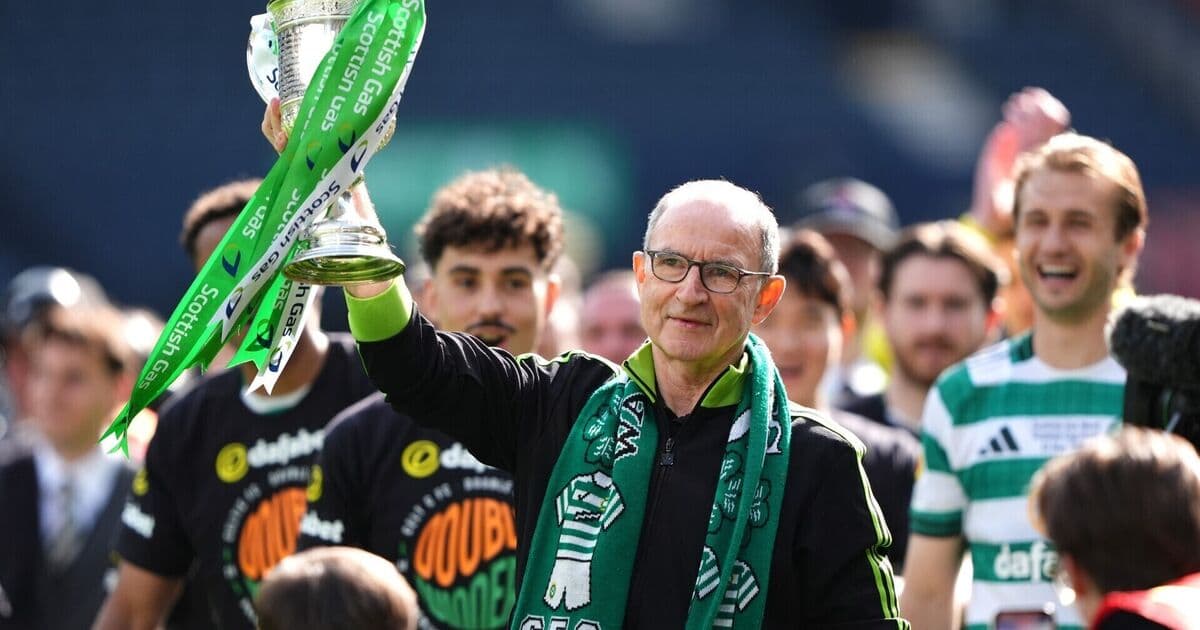
The decision restores one of the club’s most successful modern-era figures to the helm on a formal basis, after he stepped in twice this season as interim boss and still found a way to deliver a domestic double.
From caretaker to kingmaker again
O’Neill’s latest stint began in crisis. Brendan Rodgers walked away last October, leaving Celtic scrambling mid-season. The board turned to a familiar face, and O’Neill steadied the ship long enough for Wilfried Nancy to be appointed.
That move quickly unravelled. Nancy’s reign lasted just eight games and never looked like catching fire. Performances dipped, pressure rose, and Celtic’s season threatened to drift.
So the club went back to O’Neill. Again. This time, he did more than just plug gaps. He reclaimed the Premiership title and added the Scottish Cup, beating Dunfermline in the final to complete a domestic double that felt improbable only months earlier.
After that Hampden win, O’Neill did not rush into a decision. He asked for time, weighing up whether he wanted the strain and scrutiny of the job on a longer-term basis. Inside the club, though, there was a quiet confidence: the Northern Irishman still relished the fight.
The contract now on the table confirms it. One year, with an option of a second. Celtic get continuity and authority; O’Neill gets control and a clear horizon.
Keane talk, Keane backlash
The path back to O’Neill was not entirely straight. Robbie Keane emerged as a serious contender and held talks this week with Dermot Desmond, Celtic’s principal shareholder.
Keane’s name carries weight at Celtic Park from his playing days, and the idea of a young, modern coach had obvious appeal for some in the boardroom. But the reaction outside those walls was anything but unanimous.
A section of the Celtic support reacted furiously to the prospect, focusing on Keane’s managerial spell in Israel with Maccabi Tel Aviv. His subsequent move to Ferencvaros in Hungary, and resignation at the end of May, did little to soften the mood. For many fans, the optics mattered as much as the tactics.
The noise around Keane only sharpened the contrast with O’Neill: a manager with deep roots in the club’s modern history, a proven record in Glasgow, and none of the political baggage.
The pressure finally told. Celtic turned back to the man they knew.
A circle completed
Desmond’s role in this story stretches back more than a quarter of a century. It was in 2000 that he first persuaded O’Neill to leave Leicester City for Celtic, a move that transformed the club’s trajectory.
What followed is etched into Celtic folklore: three Scottish titles, three Scottish Cups, two Scottish League Cups and a run to the 2003 Uefa Cup final, where Celtic fell to José Mourinho’s Porto after an epic night in Seville.
O’Neill’s teams played with edge and ambition. They restored Celtic as a serious force at home and abroad. That legacy still shapes how supporters judge managers today.
Now, 26 years on from that first appointment, Desmond has gone back to the same well. Different era, different pressures, but the same calculation: when Celtic need a standard-bearer, O’Neill delivers.
What comes next
This is not a romantic testimonial. It is a hard-nosed decision in the middle of a fiercely contested landscape. Celtic have just watched Rangers grow bolder, and the margin for error shrinks with every season.
O’Neill walks back into a club he knows intimately but a league that has changed. Recruitment will be sharper, the fixture list more unforgiving, the demands from supporters as loud as ever.
Yet he returns with fresh proof that he can still win when the stakes are highest. A domestic double from two interim spells is not a nostalgia act; it is a statement.
Now, with the ink drying on a one-year deal and the option of another, Celtic have thrown their weight behind a familiar figure. The question is no longer whether Martin O’Neill can rescue a season.
It is whether, one more time, he can build something lasting.