Marc Cucurella’s Impact on Real Madrid
Real Madrid signed Marc Cucurella this summer to strengthen the left flank. On paper, it looked like a smart, functional move. In reality, it is fast turning into one of the most efficient pieces of business the club has done in years.
Start with the obvious. By bringing in the fullback, Madrid suddenly had a face in Spain’s squad for the 2026 World Cup. Before his arrival, Luis de la Fuente’s list did not include a single Real Madrid player. Not one. For a club that has long seen the national team as part of its identity, that absence was striking.
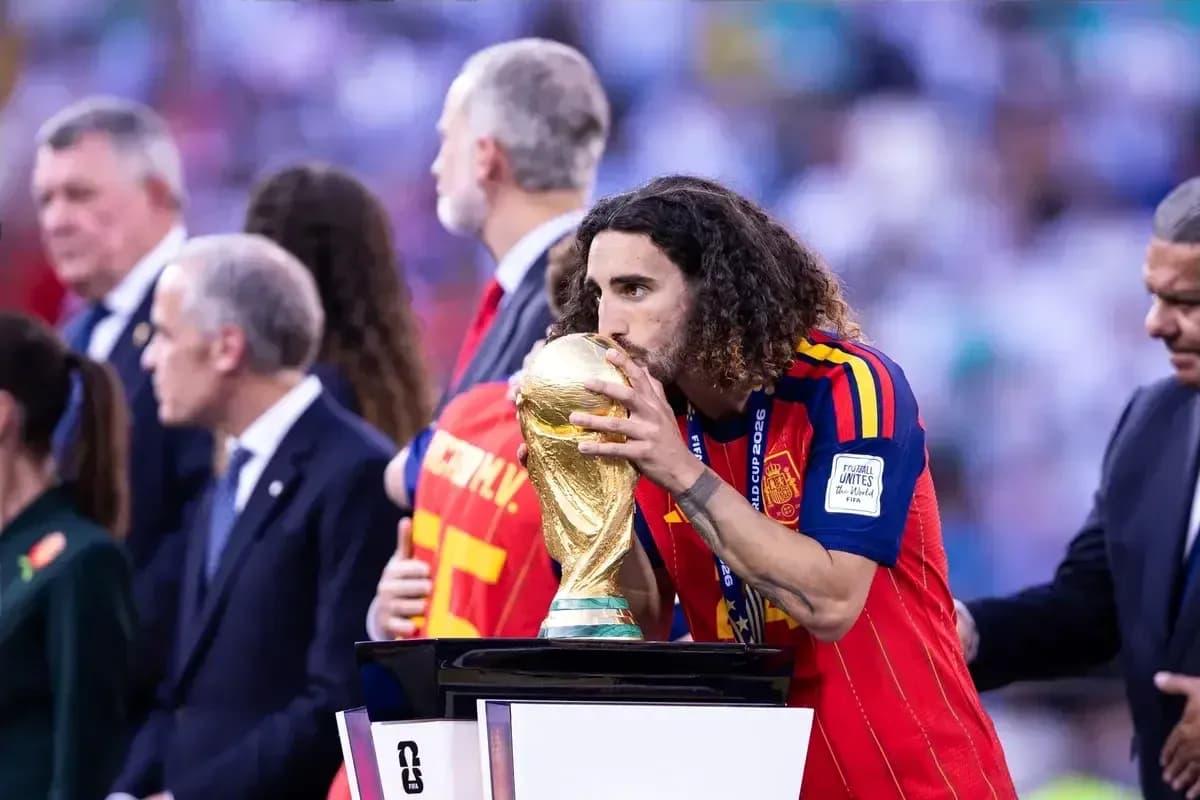
Cucurella changed that in an instant. He went to the World Cup, Spain went all the way, and the trophy lifted in celebration also reflected back on the Bernabéu. Madrid, without a player in the squad weeks earlier, could now legitimately claim a slice of World Cup glory through their new signing.
The impact did not stop with the medals.
The left-back’s performances in the tournament resonated with fans across the globe. He was voted into the FIFA World Cup Best XI, one of three Real Madrid players to make that fan-selected team. For a player who had only just arrived, it was a powerful early statement: this was not a depth signing, this was a headline act.
Markets reacted just as sharply. After the World Cup, Cucurella’s valuation on Transfermarkt climbed to €60 million. Madrid had acquired him only days earlier; almost immediately, the value of their asset rose. In an era where every euro on the balance sheet is scrutinized, that kind of instant appreciation is exactly what top clubs chase.
But this transfer is not only about prestige and numbers. It solves a very practical problem for Real Madrid in Europe.
UEFA rules are clear. From a 25-man squad, at least eight players must be locally trained to be eligible for the Champions League and other UEFA competitions. For Madrid, “locally trained” means players developed either at their own academy or at any Spanish club between the ages of 15 and 21.
Cucurella ticks that box perfectly.
He came through La Masia at Barcelona, continued his development at Eibar and Getafe, and only then crossed to the Premier League with Chelsea. His footballing education is entirely Spanish. On UEFA’s paperwork, that matters as much as his pressing, crossing, and defensive bite.
With his arrival, as highlighted by Mundo Deportivo, Real Madrid now comfortably meet the requirement of eight locally trained players in their European squad. That gives the club room to maneuver. They can fill the remaining slots with foreign stars without worrying about late-window headaches or last-minute reshuffles to satisfy the regulations.
So Cucurella arrives as more than just a new left-back. He is a World Cup winner linked to Spain’s triumph, a freshly revalued asset on Madrid’s books, and a key piece in the puzzle that keeps the club compliant in UEFA competition.
One signing, three problems solved.