Liverpool's Season Ends in Defiance as Anfield Sings Bob Marley
They sang about not worrying. About every little thing being alright. It sounded more like defiance than belief.
As Bob Marley rang out from The Kop on the final day, Liverpool’s 2025/26 season staggered to its close with a flat 1-1 draw against Brentford. Champions League football was secured, technically. Emotionally, it felt like something much bigger had slipped away.
This was the end of a season, yes. It also felt like the end of an era.
Two more pillars of the most successful Liverpool side in a generation have gone. Half of the squad Arne Slot inherited just two years ago has already departed. More are expected to follow Mo Salah and Andy Robertson through the exit door before the summer is out. The churn is starting to resemble the Graeme Souness years, when the Scot dismantled Kenny Dalglish’s ageing title-winners and never found a way back.
Those who lived through the 1990s know exactly how dangerous this moment can be.
A failure, no matter the spin
Strip away the excuses. The injuries. The adaptation. The “transition”. The league table is blunt.
Sixty points. Fifth place.
By any Liverpool standard, that is a failure.
In each of the previous three seasons, 60 points would have left them outside the Champions League places. Ninth last year. Seventh the year before. Ninth again three years ago. This time, the expanded format opens the back door to Europe’s top competition, but the number doesn’t lie.
This is the lowest points total to qualify for the Champions League since 2003/04, the campaign that ended with Gerard Houllier’s carefully choreographed farewell on the Anfield turf. That was framed as a gentle parting of ways. This feels far more jagged.
Liverpool ended the league season without a win in their final four games. Across their last 14 matches in all competitions, they managed just four victories. The limp draw with Brentford summed it up: a team running on fumes, a crowd watching through narrowed eyes.
Salah, never one to stir the pot without purpose, has already voiced his concerns in public. Nine years, every major honour, and he leaves warning that standards are slipping. When he speaks, people listen.
Slot stays seated as the Kop stands
Slot insists he can win the fans back next season. On the evidence of the final whistle, he has work to do.
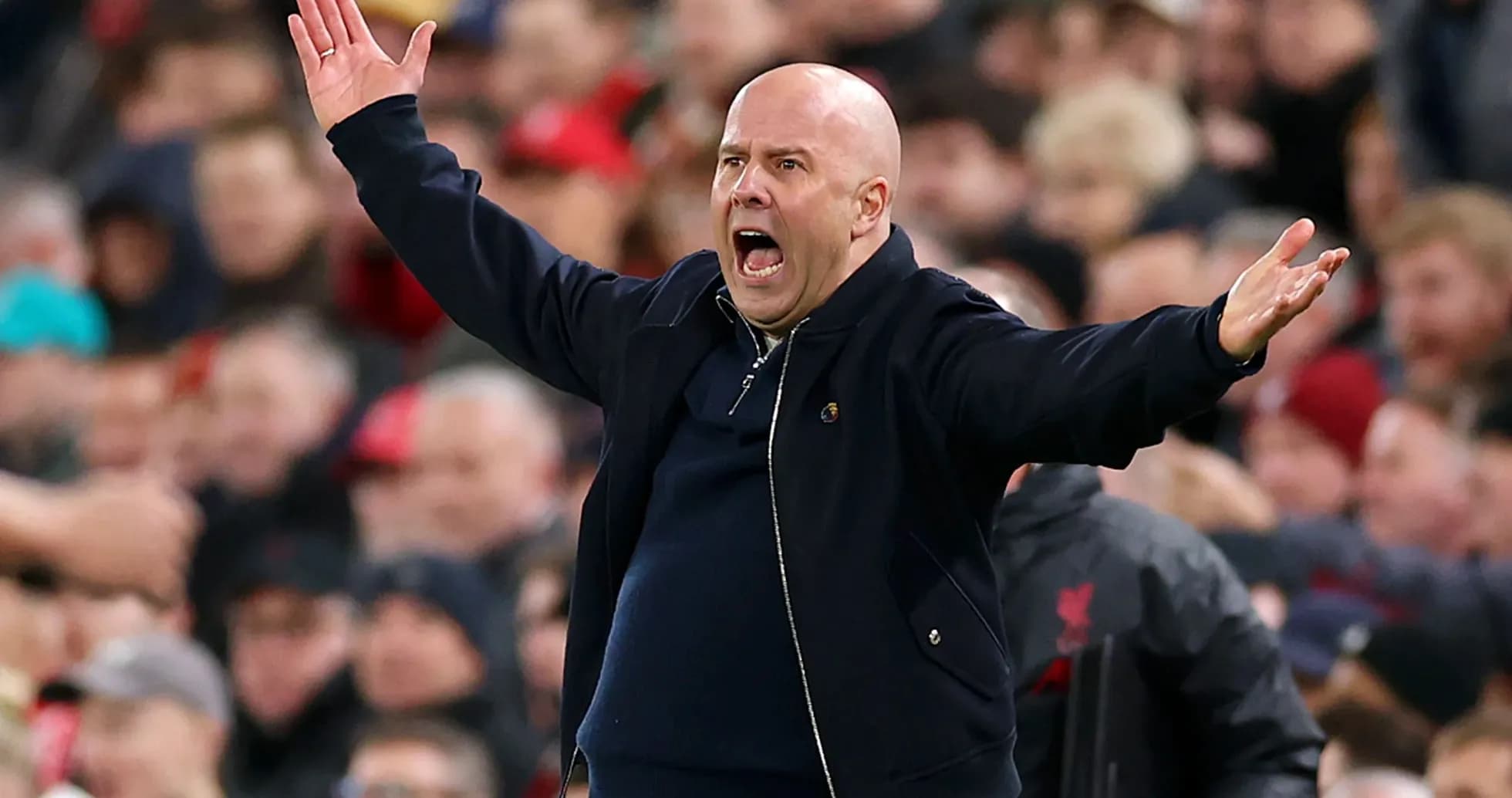
As players walked the traditional end-of-season lap of appreciation, the Dutchman stayed rooted to the bench, looking grim and distant. It may have been nothing more than a manager lost in his thoughts. It did not look that way from the stands.
The walk is not a meaningless ritual at this club. It is a shared nod between those on the pitch and those who follow them around the country. A chance to say: we saw what you gave, we’ll be back, and so will you.
Instead, the head coach sat alone, separated from his players and from the people he needs most. On a day that should have been about connection, it underlined the sense of disconnect.
Salah, by contrast, understood the moment instinctively. Speaking to Sky Sports, he cut straight to the core of what the club demands.
“They [the fans] don’t care that much about the result as long as you sweat and give your blood here, they’ll love you forever,” he said.
That is the Liverpool compact. You walk through the storm, but you do it together. This club has had more than its share of storms this season, not least the grief and shock that followed Diogo Jota’s death in pre-season. The expectation, always, is that you stand shoulder to shoulder and fight.
Injuries, small squads and big contradictions
Slot’s explanation for this campaign? One word, he said in his press conference.
“Injury.”
On the surface, it is a fair complaint. Liverpool have been stretched, patched up, and patched up again. But it jars with his own words from October, when he defended the decision to go with a lean group.
“This is a decision we have made together, I completely believe in this, because if you have 25 [players] it’s very hard to manage your squad,” he said then.
You cannot celebrate a small squad in autumn and lament its limitations in spring. Not when you spend months highlighting the strain of midweek and weekend football, the lack of options from the bench, the late goals conceded as legs and minds fade.
The modern Champions League is bigger and more draining. The Premier League has never been more intense. If you know your new signings cannot play 90 minutes twice a week, how do you go into a season with so little depth?
Slot even spelled out the risk: “If we end up with two, three or four injuries, 15 or 16 players, where Rio and Trey are two of these 15 or 16, then need to play almost all the minutes and then things can become complicated.”
Complicated is exactly what it became. Trey Nyoni, the highly rated midfielder who debuted under Jurgen Klopp at 16, finished the league season with just 21 minutes. Federico Chiesa, sidelined again, played only 318 league minutes. Wataru Endo saw 170.
Kieran Morrison, captain and standout for the Under-21s, made the bench 13 times and saw the pitch just once, for five minutes in an FA Cup tie at Wolves.
On paper, Liverpool had a squad. In practice, Slot barely used chunks of it. That is before you even reach the Harvey Elliott saga, a farcical failure to agree a January return when the bench was crying out for quality. The head coach can point to injuries, but he must also look in the mirror.
Heavy defeats, heavier questions
Slot has tried to add context to Liverpool’s cup exits. Both the FA Cup and Champions League campaigns ended with 4-0 defeats, to Manchester City and PSG respectively. City went on to lift the FA Cup. PSG have not lost a two-legged European tie in two seasons.
Those are strong opponents. The manner of defeat still matters.
Liverpool supporters have grown used to a team that goes toe-to-toe with the best, not one that collapses against them. Van Dijk, Robertson, Salah and Curtis Jones have all been blunt: this season has fallen short of what Liverpool Football Club should accept.
Salah’s parting message to his team-mates at the AXA Training Centre cut through any dressing-room spin: “Being in Liverpool, winning something for Liverpool and winning games is the best thing that could happen to you all.”
Slot’s own framing raised more eyebrows. He called Champions League qualification “our lowest base,” then pointed to Chelsea and Tottenham as “big clubs” who missed out on Europe altogether. For a support that has watched this club conquer England and Europe in recent years, that sounded suspiciously like moving the goalposts.
Liverpool do not measure themselves against who failed. They measure themselves against who won.
Even the season’s best spell carried asterisks. A 13-game unbeaten run followed a humbling 4-1 home defeat to PSV, arguably the campaign’s lowest point. It looked like a response. Under the surface, it was less convincing.
Draws against Leeds (twice), Burnley and Fulham. Seven wins, including Barnsley in the FA Cup and a West Ham side that would later be relegated. The numbers said “unbeaten”. The performances told a different story.
A summer of surgery, not tweaks
The word around Anfield is “transition”. It has been for a while. The reality is more brutal. This is not a light refresh. It is major surgery.
Slot’s own future is not entirely clear, with only a year left on his contract. The same goes for key decision-makers Richard Hughes and Michael Edwards. When the men in the dugout and the men in the boardroom all have the same ticking clock, long-term planning becomes a theory rather than a certainty.
On the pitch, the potential exodus is stark. Up to nine first-team players could move on: Salah, Robertson, Ibrahima Konate, Chiesa, Endo, Jones, Alisson, Joe Gomez and Alexis Mac Allister are all in varying degrees of flux, whether out of contract, wanted elsewhere or available at the right price.
If that list becomes reality, Liverpool will walk into next season with Cody Gakpo as their leading current scorer for the club. Behind him, a centre-back, Van Dijk, as the next most prolific.
Slot has tried to downplay the scale, promising “a little transition” and insisting it will not be as “drastic” as last summer. The names on the potential departures board suggest otherwise. This is not a tweak. It is a rebuild.
So The Kop sang about not worrying. About every little thing being alright. It was loyal, loud and laced with anxiety.
Because as this broken season disappears in the rear-view mirror, the real question hangs over what comes next: is this just a stumble, or the start of another long walk through mediocrity?