Lise Klaveness: The Reluctant Rebel Challenging FIFA
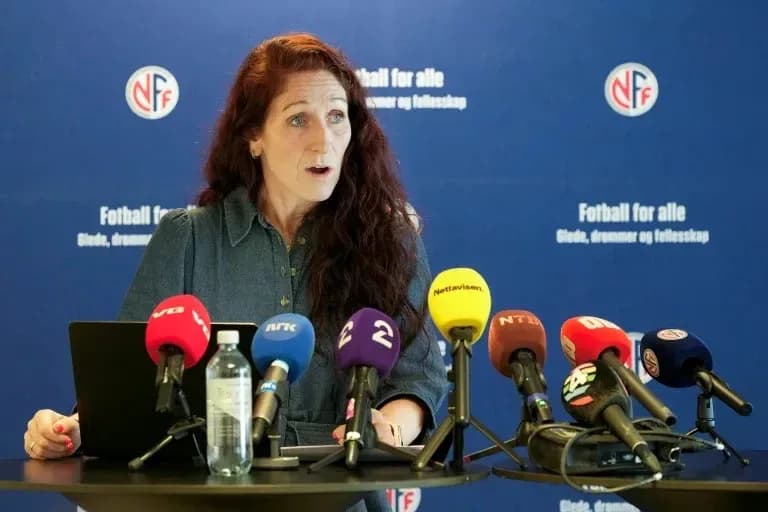
Lise Klaveness has spent the past few years doing what very few people in world football dare to do: standing up to FIFA while still sitting at the table.
Now, as Gianni Infantino fights off the biggest backlash of his presidency, some in the game are daring to imagine something once unthinkable — the Norwegian federation chief in the sport’s top job.
A Rare Voice at the Top
At 45, Klaveness cuts an unusual figure in football’s corridors of power. A former midfielder with 73 caps for Norway and a trained lawyer, she is one of the very few women operating at the highest political level of the sport.
She is also one of the very few who has consistently, publicly, and relentlessly challenged Infantino.
When he swept into office in 2016, Infantino sold himself as the reformer-in-chief, promising transparency and good governance. Klaveness remembers that pitch clearly. Speaking to AFP, she recalled that he was elected “on a reform programme focused on good governance.”
Then, in her view, came the slide.
“Things quickly deteriorated,” she said. Distance from power brokers disappeared, replaced by what she describes as capitulation and backtracking, with FIFA growing ever more entangled with heads of state and influential figures — especially from World Cup host nations.
On Friday, she went further than ever before. She called for Infantino to resign.
From Doha to Direct Confrontation
Klaveness did not tiptoe into this fight. She walked straight into it.
In 2022, shortly after taking over as president of the Norwegian Football Federation, she travelled to Doha and used the World Cup stage to attack the very foundations on which that tournament had been built. In a room where most chose diplomacy, she chose blunt honesty, lamenting that “human rights, equality, democracy, the core interests of football, were not in the starting 11.”
It was a shot across FIFA’s bow, delivered from inside the World Cup host city.
Norway followed words with action. In 2023, the federation refused to support Infantino’s re-election, a symbolic but pointed rebuke at a time when most associations fell into line.
Mina Finsted Berg, sports commentator for Norwegian broadcaster TV2, sees Klaveness as a forerunner of the current wave of criticism.
“She was in a way the first standard-bearer for much of this criticism that many others now share when it comes to the way Infantino runs FIFA,” Berg said, describing her as someone “very committed to ensuring that rules and decisions are respected.”
Trump, Balogun, Investors – and a Growing Dossier
The list of grievances has grown rapidly in recent months.
- First, FIFA’s decision to award a so-called “Peace Prize” to US President Donald Trump, a leader with whom Infantino has cultivated a conspicuously close relationship.
- Then came the lifting of US forward Folarin Balogun’s suspension for the 2026 World Cup after an intervention by Trump.
- Finally, there was the explosive plan to open FIFA competitions, including the World Cup, to private investors — a proposal that was swiftly rejected last week and left Infantino badly exposed.
For Klaveness, these were not isolated missteps. They were symptoms of a deeper sickness in the way world football is governed.
Norway has now decided to take all three issues — the Trump prize, the Balogun intervention, and the investor plan — to FIFA’s Ethics Committee. It is a direct challenge to the president’s authority, launched not from a rival confederation but from within his own sport’s inner machinery.
Her stance carries more weight than it might have a few years ago. Norway, long absent from the sharp end of major tournaments, produced an eye-catching run at this year’s World Cup before losing to England in the quarter-finals. Success on the pitch has amplified her influence off it.
Internationally, pundits and observers have begun to describe her as a figure with a “strong moral compass” and, crucially, as a serious contender to replace Infantino if he were to step aside.
For now, he has no intention of doing so. Infantino is standing for a fourth and final term next March and remains the only declared candidate.
A Woman in a Man’s Game
That has not stopped the speculation. Nor has it stopped some high-profile figures from breaking ranks.
Sepp Blatter, the former FIFA president who left office disgraced by a corruption scandal, has publicly endorsed the idea of a woman taking over. Writing on X, he said Klaveness “was the only one who always took a clear stand and did not go along with the mainstream. And at FIFA, the time is right for a woman to take the lead.”
The irony is inescapable: the man whose downfall triggered FIFA’s last great crisis now praising a woman who is helping to drive the next reckoning.
Klaveness, though, resists being cast as a character in a power drama.
She has repeatedly warned against framing the turmoil at FIFA as a “Game of Thrones” battle for the presidency and insists the debate must return to governance, accountability, and the integrity of decision-making.
“For us, it has never been a personal issue against Gianni Infantino,” she told AFP. “The problems go beyond the person of the president.”
She acknowledges, coolly, that her name is circulating as a possible successor. She refuses to play along with the speculation. “We’re not there yet,” is her line. No campaign. No manifesto. Not yet.
The Ballot Box Reality
Even if the mood music around FIFA is changing, the electoral maths is brutal.
Klaveness is seen as “extremely radical” in many parts of the world, especially outside Europe, Berg notes. That label alone is enough to sink candidacies in regions where challenging authority is frowned upon. Then there is the other, unavoidable fact: “she is a woman.” In large parts of the football map, that still counts against her.
Her own record at the polls underlines the scale of the challenge. Within UEFA — the very confederation where she might expect the strongest backing — she failed to win a seat on the Executive Committee in 2023. She only joined in 2025, and then only as the sole candidate for the seat reserved for women.
Former Norway goalkeeper and now commentator Erik Thorstvedt put the dilemma bluntly: “If she already has such a hard time getting elected in Europe, how could she convince Africans and South Americans?”
It is the question that hangs over every whisper of a Klaveness candidacy.
For now, she remains what she has been from the start: FIFA’s most persistent internal critic, a federation president who refuses to stay quiet, and a reminder that the battle for football’s soul will not be settled by slogans or ceremonies — but by who dares to vote for real change when the doors finally close and the ballots are handed out.