Lionel Messi Shines Again as Argentina Beats Cape Verde 3-2
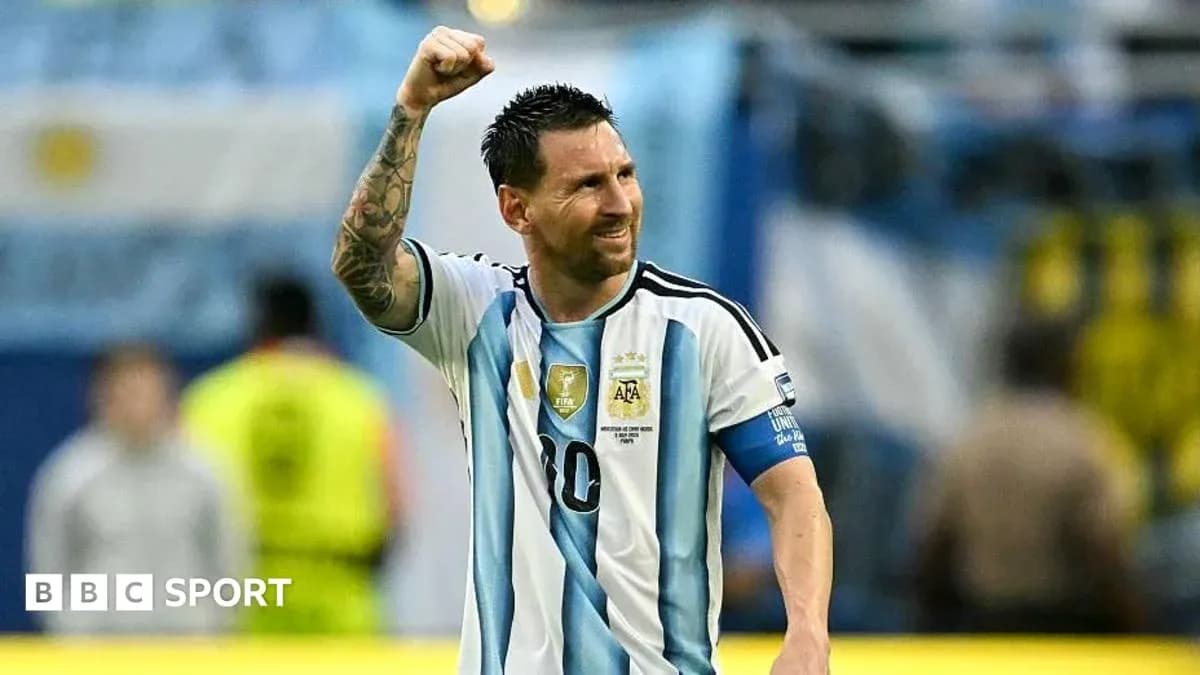
Lionel Messi did it again.
Three against Algeria, two against Austria, one against Jordan – and now another in Miami as Argentina squeezed past Cape Verde 3-2 in a last-32 tie that crackled with tension and disbelief in equal measure.
This one mattered for more than the scoreline. His opener was his 20th goal at World Cup finals, stretching a record he had already torn from history’s grip during the group stage in the United States. It was his seventh of this tournament alone.
A city painted in sky blue and white
Miami had been humming for hours before kick-off. Streets around the stadium turned into a moving river of sky blue and white: drums beating, songs rolling off balconies, kids wrapped in flags almost bigger than themselves. Giant Argentina banners hung from lampposts and railings; car horns joined in as an improvised brass section.
Inside, the stands looked less like a neutral World Cup venue and more like an annex of Buenos Aires. Blue and white shirts everywhere. Number 10 everywhere. Messi’s name on the back of jerseys worn by toddlers, teenagers, grandparents.
One banner cut through the noise. Draped over the railings, it showed Messi and Diego Maradona rendered as saint-like icons, halos of light around them. For many here, that is not exaggeration. It is doctrine.
“He’s our hero. He’s like our God,” one Argentina fan said before the game, clutching a flag as if it were a relic. Another smiled and summed up the mood with a simple line: “He has aged like fine wine. The older he gets, the better he gets.”
The talk around the concourses drifted to the Golden Boot. Could he win it again? The answer, from those who had followed him across continents, was almost dismissive. Of course he could – if Argentina go all the way.
“We’ve already had so much from him,” another supporter said. “If he wins it, fantastic, but everything he’s already done for Argentina is enough. He is incredible.”
A quiet night, then the moment
By his outrageous standards, this was not a night when Messi bent the entire match to his will. Cape Verde refused to play the role of grateful guests. Ranked outside the world’s top 60, they showed little respect for the numbers, pressing bravely, keeping the ball, and at times frustrating the world’s No. 2 side into hurried passes and impatient shots.
Argentina huffed. Cape Verde held. The noise swelled, dipped, then grew edgy.
Then came the moment.
It looked simple, which is usually a sign that Messi is involved. He timed his run off the shoulder of the defence, slipped beyond the back line just as Lisandro Martínez threaded a pass into the gap. First touch: cushioned, in stride, no panic. Second touch: a deft lift over the advancing goalkeeper, the ball hanging in the Miami night for a heartbeat before dropping into the net.
Seven for the tournament. Twenty in World Cup finals.
To put that in context: since 1978, there have been 13 World Cups. Messi’s current tally of seven in this edition would have made him top scorer in all but two of them. Across the entire history of the competition, no man and no woman has reached 20 goals at the finals. He stands alone.
On BBC Radio 5 Live, James McFadden could only shake his head in admiration. The former Scotland forward called the finish “just incredible”, before breaking it down like a coach rewinding a masterclass.
“The run he makes is beyond the backline and the timing is excellent,” he said. “The weight of the pass into him is outstanding and his first touch is exquisite.”
On ITV, Ally McCoist reached for the only phrase that really fits: “genius at work”. Then came the line that has started to feel like a weekly update: “It’s just one record after another. It’s amazing.”
The numbers keep piling up. Messi is the first player to score 20 World Cup goals. He has now found the net in eight consecutive World Cup appearances, another mark no one else has touched. He is also the first to score seven or more at two separate tournaments, having hit the same figure in 2022.
The art of doing less, then doing everything
What separates him now is not a relentless sprint count. At 39, he does not race around chasing lost causes. He doesn’t need to.
While others chase the game, Messi studies it.
He walks, scans, waits. He looks over both shoulders before the ball comes near him, storing pictures of where everyone stands. He conserves energy, then spends it in a single, devastating burst – a run into space, a disguised pass, a finish that seems pre-ordained.
Yet this World Cup has shown another side. The old stereotype of Messi drifting on the edge of games, saving himself for the decisive touch, no longer tells the full story.
“Throughout the years, Messi has walked at times in games to assess what is happening,” McFadden noted. “But here he is getting back to try and win the ball and is leading the press. It’s not a full, high-energy press, but he is leading it.”
He will never be the one flying into every duel, but the sight of him stepping forward to trigger Argentina’s press, closing angles, nudging team-mates higher up the pitch, speaks to a player who has adapted not only his body but his responsibility.
The genius has become the general.
Miami, capital of Messi mania
If there is any city outside Argentina that feels like Messi’s natural territory, it is Miami.
Since his arrival at Inter Miami in 2023, the city has wrapped itself around him. His face is painted on walls from Wynwood to Little Havana. Murals show him in pink, in blue and white, lifting trophies, roaring into the night. Shop windows are filled with his shirts, his boots, his image frozen in mid-dribble.
Walk along the beach and you will see his legacy in motion: children in Argentina No. 10 shirts playing barefoot football in the sand, shouting his name as they shoot. Inside and outside stadiums, his chant starts long before kick-off and lingers long after the final whistle.
Even the city’s food has absorbed him. Argentine restaurants proudly plate up milanesa – the breaded beef or chicken dish believed to be among his favourites. Some have gone further, naming the dish after him, a small culinary tribute to the man who has made their city a global football stop.
Then there is the media circus. In the mixed zone after matches, the atmosphere shifts the moment he appears. Conversations stop mid-sentence. Journalists crush together, arms raised, microphones stretched out in a forest of black foam and wire. Camera operators climb on tiptoes or stand on cases to steal a clear shot as he walks past.
He rarely stays long. A few words, a brief pause, and he is gone down the corridor. Yet the scramble repeats every time, because every appearance feels like another scene in a story the world refuses to stop watching.
Whole digital platforms now exist simply to track him. Every training drill, every goal, every smile in a warm-up is clipped, shared, dissected. His career is being chronicled in real time by millions of hands.
More than one nation’s dream
The fascination stretches far beyond the Argentina end of any stadium. When Messi plays, the World Cup bends around him. For some, this tournament is about whether Argentina can lift the trophy again. For many others, it is about witnessing how far he can push the limits of his own legend.
Cape Verde felt that up close in Miami. They pushed Argentina hard, refused to bow to the rankings, and still left with the familiar story line hanging over them: Messi scored, Messi broke records, Messi walked away with the spotlight.
He is 39. He moves less. He runs smarter. And he keeps writing chapters that no one else can match.
How many more can he squeeze into this World Cup?