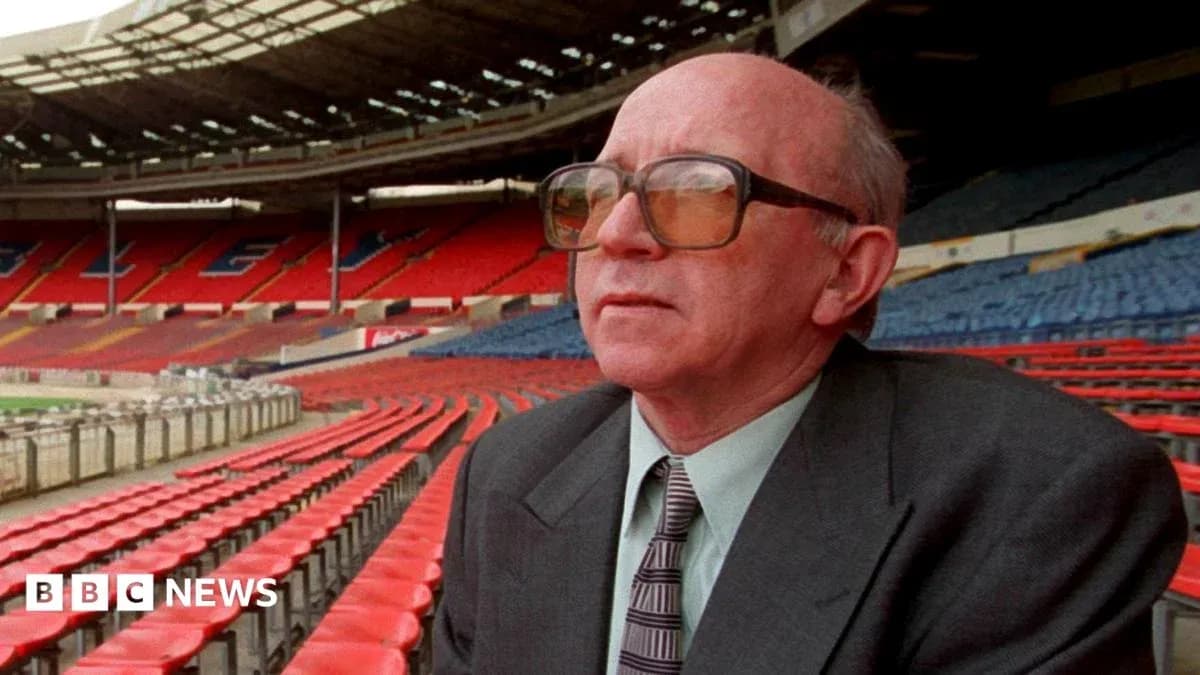
Inquest into Nobby Stiles’ Death Due to Brain Injury
The image of Nobby Stiles dancing on the Wembley turf in 1966, teeth missing and Jules Rimet trophy in hand, is stitched into English football history. Now, four years after his death, that same sport stands accused of having helped destroy him.
A coroner has ruled that an inquest must be held into the death of the former Manchester United and England midfielder, after medical evidence confirmed he was suffering from a traumatic brain injury.
Chris Morris, area coroner for Greater Manchester South, told Stockport coroner’s court that Stiles died with chronic traumatic encephalopathy (CTE) – the degenerative brain disease long associated with repeated head trauma – as well as Alzheimer’s disease. He said the presence of a traumatic injury in the cause of death left him “satisfied an inquest is required into the sad death of Mr Stiles.”
Stiles died in 2020 at the age of 78. Only now will his death be formally examined.
A World Cup Hero at the Heart of Football’s Brain Injury Battle
Norbert “Nobby” Stiles, born in Manchester in 1942, embodied the hard edge of English football’s golden age. A ferocious, tough-tackling defensive midfielder, he won 28 caps for England, played nearly 400 games for Manchester United and stood at the heart of both club and country’s greatest triumphs.
That same tenacity, his family believes, came at a terrible cost.
His brain was examined by neuropathology expert Dr Daniel du Plessis, who reviewed both the tissue and Stiles’s medical records. Dr du Plessis concluded that the primary cause of death was Alzheimer’s disease, but that it had been contributed to by high-stage CTE, “stage three limbic predominant age related TDP-43,” and small vessel cerebrovascular disease.
Those words now carry legal weight. They move Stiles from being simply another tragic case of dementia into the centre of a formal inquiry into whether football’s repeated heading and collisions left lasting damage.
Morris also revealed that Stiles’s death had not been reported to the coroner’s office at the time, “for reasons not entirely clear to me,” and that the investigation only began after information was provided by the family. A full inquest hearing will take place on Wednesday at the same court.
“Football Killed My Father”
For Stiles’s son John, the ruling is another step in a fight he has waged in public for years.
He has said bluntly that football “killed” his father. Not just the disease, but the culture and structures that, in his view, failed to protect those who built the game’s modern wealth.
John Stiles now heads Football Families for Justice (FFJ), a group demanding that football’s authorities provide far greater support to ex-players living with neurodegenerative conditions they believe were caused by their careers. The personal cost has been stark. Nobby Stiles was forced to sell his World Cup winner’s medal to pay for his dementia care.
The family is part of a growing legal action. Dozens of former professionals and their relatives are suing the Football Association, the Football Association of Wales and the English Football League. Their claim is that these bodies were “negligent and in breach of their duty of care,” arguing that the risks of repeated heading and concussive blows were known, or should have been known, for decades.
Lawyers acting for the families say football’s rulers failed to act on those risks and did not put proper protections in place in training or matches.
Football’s Defence – and the Science in Question
The sport’s governing bodies are pushing back.
In March, lawyers for The Football Association told the High Court that it has “not been established by science” that heading a ball or “occasional” concussion leads to permanent brain damage. That line goes to the heart of the legal battle: what did the authorities know, when did they know it, and what does the science actually prove?
Evidence is building. In January, an inquest into the death of Gordon McQueen, the former Scotland, Manchester United and Leeds United defender, found that heading the ball was “likely” to have contributed to a brain injury that was a factor in his death. McQueen, like Stiles, had been diagnosed with CTE.
His daughter, TV presenter Hayley McQueen, has spoken with painful clarity about the toll on a generation. She said England’s 1966 World Cup-winning team had now been “pretty much wiped out” by neurodegenerative disease.
Numbers back up the anecdotes. A 2019 study co-funded by the FA and the Professional Footballers’ Association (PFA) found that former professional footballers were three-and-a-half times more likely to die of neurodegenerative disease than members of the general population of a similar age.
When you set that statistic against the roll call of names – Stiles, McQueen and many others – the pattern is hard to ignore.
A Game Forced to Look at Itself
Under pressure from families, campaigners and its own research, the FA has begun to adjust. It is phasing out all heading in youth football up to under-11 level by 2026, a move that would have been unthinkable in Stiles’s era.
Yet the inquest into his death promises to reopen the most uncomfortable questions of all. Not about the modern academy player, but about the men who headed heavy, often waterlogged leather balls hundreds of times a week, with no concussion protocols and little medical oversight.
Stiles was once the enforcer in England’s midfield, the man who made sure others could play. Now his name sits on the front line of a different contest – one that will help decide how football treats its past, and how much it is willing to change to protect its future.