Infantino’s $20 Billion Gamble Threatens World Cup Integrity
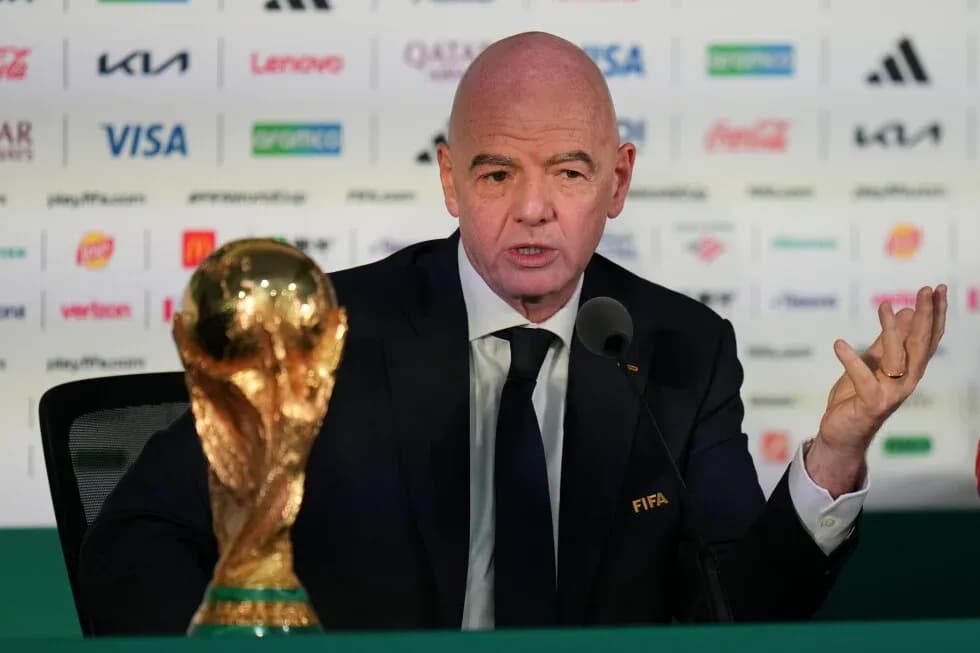
Gianni Infantino has drawn a line in the sand. Now the rest of world football has less than two months to decide whether to cross it.
In a letter sent to FIFA’s 211 member federations and seen by The Associated Press, the FIFA president laid out what he calls a “singular and unique funding opportunity”: a $20 billion subsidiary that would effectively sell a slice of the World Cup and other flagship competitions to private investors for the next 12 years.
The price of admission for each federation: a one-off $20 million payday. The deadline: Sept. 19. The stakes: the future shape — and ownership — of the world’s biggest sporting event.
A World Cup for Sale?
At the heart of the plan is a new entity, FIFA Forward Enterprise, valued at $20 billion. Private investors would take a 20% stake, with Joshua Kushner’s Thrive Capital lined up as anchor investor and J.P. Morgan leading the process. The new company would run FIFA’s competitions and events, including World Cups and Club World Cups for men and women.
Infantino’s pitch is simple and blunt. Approve the deal, and each federation gets $20 million from the commercial cycle tied to the 2030 men’s World Cup. Reject it, and they fall back on the previously promised $10 million over the next four years.
Over a 12-year span, the difference is stark. The letter outlines a potential $86 million per federation under the new model, compared with about $36 million if they turn it down.
“It is my duty and responsibility as FIFA president to present such game-changing opportunities to you, our members,” Infantino wrote.
But to many inside the game, this doesn’t feel like opportunity. It feels like a fire sale.
UEFA Leads the Revolt
The backlash was instant and ferocious, led by UEFA. The European body, already at odds with Infantino over his attempts to reshape the international calendar, condemned the plan in uncompromising terms.
“The World Cup is not FIFA’s to sell,” UEFA said, announcing an emergency online meeting of its 55 member federations, likely on Thursday. It warned that the rushed Sept. 19 deadline “says everything you need to know about this plan,” accusing FIFA of trying to “enrich themselves and their friends.”
One weapon is already on the table. European federations could threaten to boycott FIFA competitions, a tactic that helped derail Infantino’s push in 2021 to stage the World Cup every two years instead of four.
The influential European Football Clubs group, which jointly manages the Champions League with UEFA, said it found out about the proposal “in the same way as most global football stakeholders — without warning and through the media.” For organizations used to being in the room when the biggest decisions are made, that stung.
Growing Unease Across Continents
This isn’t just a European mutiny. From Kuala Lumpur to Miami, nerves are fraying.
CONCACAF, representing North and Central America and the Caribbean, issued a sharp statement: “We are deeply concerned by the lack of due process.” The Asian Football Confederation said it was “disappointed that a matter of such significance entered the public domain before the AFC family had been afforded the opportunity to examine and discuss it.”
The pattern is familiar. A major structural change, floated late, with limited consultation, and framed as an urgent, once-in-a-lifetime chance.
For the continental bodies that run their own competitions — the Champions League, European Championship, Copa America and others — the alarm is obvious. A more frequent World Cup and expanded Club World Cups threaten to cannibalize their own tournaments, their calendar space, and their commercial value.
Private equity only sharpens those fears. As sports governance expert Antoine Duval warned, inviting investors into FIFA “incentivize[s] FIFA to further commodify the World Cup (think more hydration breaks and dynamic pricing) in a drive to increase its revenue.”
The message is clear: if investors buy in, the World Cup stops being just a tournament. It becomes an asset to be sweated.
Politics, Power and the Kushner Connection
This deal is not happening in a vacuum. It fits a broader pattern in Infantino’s tenure: big-money schemes, close ties to political power, and a willingness to push through resistance.
The proposed FIFA subsidiary would be bankrolled initially by Joshua Kushner’s Thrive Capital. Kushner is the brother of Jared Kushner, a key figure in the orbit of former U.S. President Donald Trump. It’s another point of contact between Infantino and that circle.
He has already created a FIFA Peace Prize — awarded to Trump at the World Cup draw in December — and allowed Trump to intervene in the process that led to United States forward Folarin Balogun playing at the World Cup. Now comes a 12-year ownership deal tying the game’s governing body to Kushner’s investment firm.
For critics, the optics are glaring: a Switzerland-based not-for-profit body opening its most precious property to Wall Street-style capital, with political connections never far away.
A President Who Stops Asking Permission
Infantino is deep into his 11th year in charge and, increasingly, he behaves like a chief executive who answers to a board, not a president accountable to a global membership.
This is not the first time he has pushed an opaque, high-value private equity project. In 2018, he tried to advance a secretive $25 billion plan to create new and bigger men’s competitions. UEFA resisted, and the plan died.
He has also used the World Cup stage to launch the FIFA Peace Prize, again without broad consensus. Each time, the same concern emerges: that the most powerful man in football is acting first, and asking questions later — if at all.
This latest move has gone further. It has angered not only the usual skeptics in Europe but also allies in other regions, and it has done so at a delicate moment in Infantino’s own political calendar.
One Member, One Vote — and a Tempting Offer
Behind the noise from UEFA and the major clubs lies a harder reality: FIFA’s voting system. One member, one vote. Germany and Gibraltar carry the same weight. Brazil and Bhutan. England and Eritrea.
Many of those 211 federations rely heavily on FIFA funding. Their national teams rarely get close to a World Cup. Their best players seldom reach the top European clubs. For them, $20 million is transformational money — for infrastructure, grassroots programs, even basic operations.
Infantino knows this. His promise of more funding was decisive in his initial election in 2016 and in his unopposed re-elections in 2019 and 2023. The new offer — an extra $10 million in the short term, and potentially $50 million more over 12 years — is tailored to that electorate.
UEFA can shout. The big clubs can complain. But they do not control the ballot box.
Britain Draws Its Own Red Line
One voice cut through the financial jargon with unusual clarity: British Prime Minister Andy Burnham.
Burnham, whose government is backing a joint bid by England, Scotland, Wales and Ireland to host the 2035 Women’s World Cup, did not mince his words.
“Football does not belong to investors,” he said in a video message. “Once you have sold a piece of (the World Cup), you have sold out. Football belongs to the fans. It always has, and it always will.”
British politicians have form when it comes to intervening in football’s power plays. In 2021, threats of legislation from then-Prime Minister Boris Johnson helped crush the European Super League, a project that posed an existential threat to the Champions League and which Infantino had discreetly supported.
Now, with FIFA expected to confirm the 2035 Women’s World Cup bid at an online meeting in November, Burnham has made clear that political scrutiny will follow any move to carve up the World Cup for investors.
Infantino’s Future on the Line
Until this week, Infantino looked to be cruising toward a fourth and final term as FIFA president, running unopposed through 2031. His alliance-building, backed by cash promises, had kept serious challengers at bay.
This proposal has changed the mood. Frustration has spilled beyond the usual European critics. Anger is no longer confined to private conversations in hotel lobbies and committee rooms.
There are still almost four months for a rival to emerge. The deadline for candidates is Nov. 18, with the election set for March 18 in Rabat, Morocco — a country that has become a key Infantino ally and will co-host the 2030 World Cup.
Some in the game have long suspected Infantino harbors ambitions beyond a standard presidential term. A CEO or commissioner role at a powerful, semi-independent FIFA subsidiary like FFE would offer exactly that: long-term control over the sport’s commercial engine, even as presidential limits loom.
The question now is whether the federations — especially those who stand to gain most financially — are prepared to trade a piece of the World Cup, and a slice of their game’s soul, to keep that vision alive.
On Sept. 19, the numbers will be clear. The choice will not.