Henrik Larsson: Celtic's King of Kings
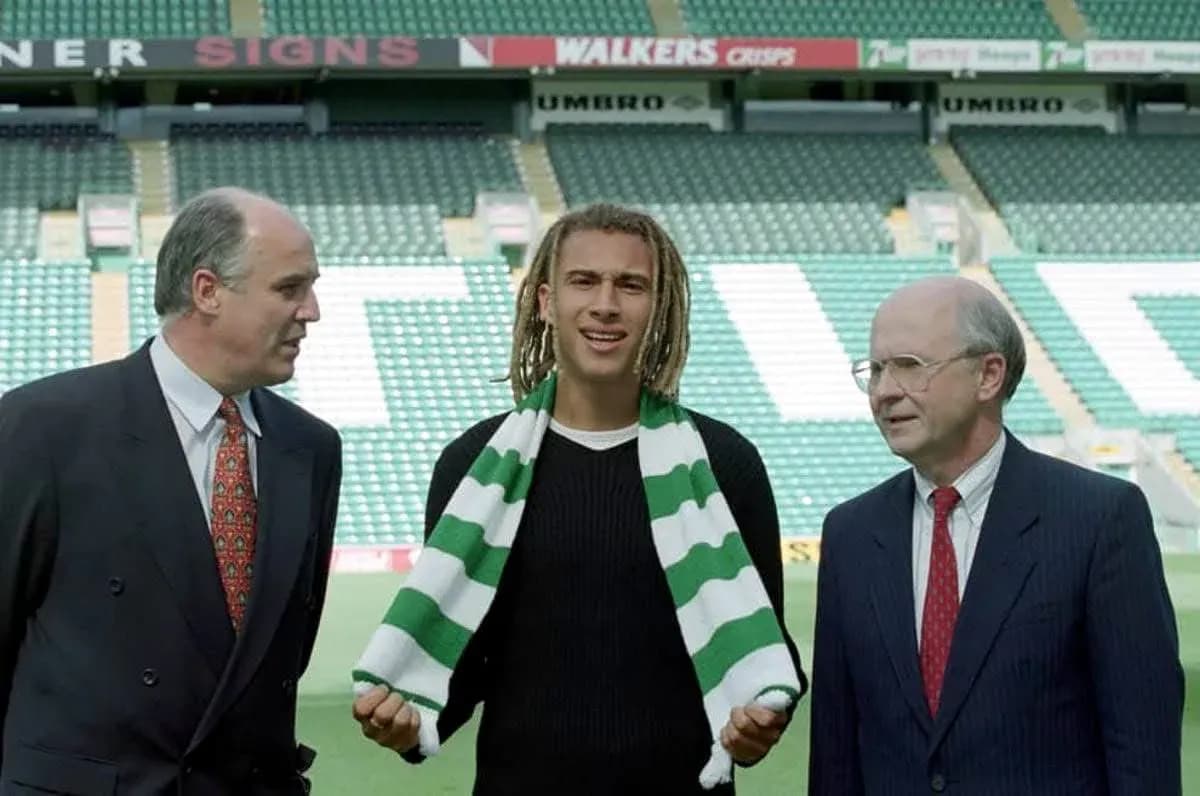
On a warm July day in 1997, a slim, dreadlocked Swede in a Hoops top and denim strolled onto the Celtic Park pitch and into club folklore.
Henrik Larsson had arrived.
Signed from Feyenoord for just £650,000, he was a shrewd piece of business driven by new manager Wim Jansen, who knew the forward’s contract situation inside out from their time together in the Netherlands. It felt like a gamble. It turned into one of the greatest bargains in Celtic’s unbroken history.
From shaky start to instant talisman
It did not begin like a fairytale. Larsson’s first competitive outing included a misplaced pass that helped Hibernian to an opening-day win. For a moment, the doubts flickered. Was this the man to help stop Rangers’ march towards ten in a row?
He answered that question quickly.
Game by game, he worked his way into the hearts of the Celtic support. The work-rate. The intelligence. The goals. A League Cup triumph in that first season and, more importantly, the title that “stopped the ten” transformed him from intriguing signing to indispensable figure. Celtic had their first league crown in a decade, and their new No.7 was at the centre of it.
Under Dr Jozef Venglos, Larsson went up another gear. He hit 38 goals in his second campaign, morphing from clever forward into complete striker: predator in the box, creator outside it, relentless in his movement. Celtic had seen great forwards before. This felt different. This felt like the start of an era.
The broken leg that didn’t break him
Then came Lyon.
A horrific leg break in European competition threatened to derail everything. The images were gruesome, the prognosis grim. For many players, that kind of injury ends careers or, at the very least, blunts them. Larsson refused to be diminished.
His recovery became a story in itself, a display of the mental strength that would define him as much as his finishing. When he returned, he didn’t just get back to his level. He surpassed it. Celtic’s form under John Barnes never recovered from the period without him, and the Englishman’s reign at the club ended quickly. Larsson, though, emerged from that dark spell even more central to what Celtic were and what they wanted to be.
O’Neill, Sutton and a supercharged Celtic
If Jansen brought him in and Venglos refined him, Martin O’Neill unleashed him.
With O’Neill in the dugout and Chris Sutton alongside him, Larsson reached a peak that would echo through the decades. In the Irishman’s first season, Celtic stormed to a domestic treble – their first clean sweep in 32 years – and Larsson plundered 53 goals. Fifty-three. It was a number that felt almost absurd, yet week after week he made it look routine.
He scored every type of goal. Near-post flicks, towering headers, curled finishes, volleys taken early before defenders could set themselves. Sutton’s physical presence and intelligence dovetailed perfectly with Larsson’s movement and ruthlessness. Defenders knew what was coming. They still couldn’t stop it.
Europe takes notice
The domestic dominance was impressive. The European stage, though, is where reputations travel. Larsson made sure his did.
His goals powered Celtic to the UEFA Cup Final, a run that re-established the club as a serious continental force. In Seville, against Porto, he delivered two world-class finishes in a breathless extra-time defeat that still stings for the support. Both goals underlined his quality on the biggest stage: timing, composure, execution under pressure. On a night when Celtic fell short, their No.7 stood tall.
Those European nights, the noise, the floodlights, the sense that Celtic could take on anyone – Larsson was at the heart of it all. He didn’t just score; he led.
A record that speaks for itself
By the time he left in 2004, the numbers were staggering.
- 242 goals in 313 appearances.
- Third on Celtic’s all-time scoring list.
He had become far more than a prolific forward. He was a symbol of a generation, a player whose presence alone seemed to lift the stadium. For younger supporters, he was the benchmark, the standard by which every new signing in attack would inevitably be judged.
Older fans will always have Jimmy Johnstone and the Lisbon Lions. Those who watched the 1970s will rightly talk about Kenny Dalglish, another “King” who went on to be crowned Liverpool’s greatest ever player. Those legends are untouchable in their own right.
Yet ask the majority of Celtic supporters who have filled the stands over the past three decades, and the answer comes back with remarkable consistency: Henrik Larsson is the best they have seen in the Hoops.
He is, to them, and to many beyond Glasgow’s East End, exactly what the song calls him.
The King of Kings.