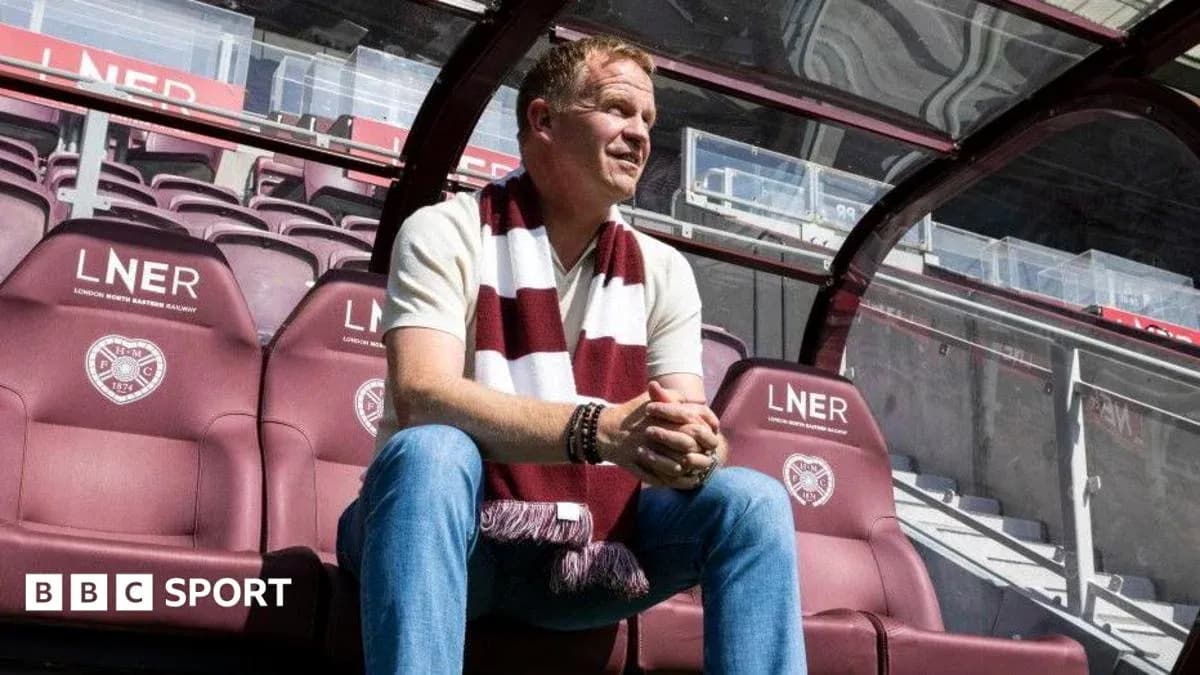
Hearts Appoint Wouter Vrancken as New Head Coach
Six weeks ago, Hearts were a couple of moments from a first Scottish Premiership title in over half a century. Since then, the club has shed its captain, waved goodbye to several key figures, ushered in seven new signings and now unveiled a new head coach.
For a support still catching its breath, Wouter Vrancken’s arrival marks not just a change of face in the dugout, but a hard reset in how Hearts intend to operate.
A Belgian at the wheel of the data machine
The 47-year-old Belgian walked into his first media conference at Tynecastle as the embodiment of a project that has been building in the background. Tony Bloom and his analytics operation have been shaping Hearts’ thinking for well over a year; replacing Derek McInnes with Vrancken is the moment that influence steps fully into the spotlight.
Sporting director Graeme Jones made it clear the numbers led them here. In the data, the former Sint-Truiden and Genk boss was “a standout”. His track record in Belgium – coaxing his teams to punch above their weight – backed up what the spreadsheets were screaming.
Crucially, he also fits the model. Vrancken is a head coach in the purest modern sense: he works inside a collaborative recruitment structure, not above it. That is a marked shift from McInnes’ more traditional, manager-led approach.
Hearts have already been recruiting to a plan. Seven players came through the door before Vrancken even signed his contract. He walks into a dressing room assembled by committee and guided by data, not by his own wishlist.
He is comfortable with that. More than that, he wanted it.
“I always wanted to look behind the curtain, actually,” he said. “So maybe this is an opportunity to do it. I have a lot of confidence or trust in the way the recruitment works because I was confronted with it in Belgium. And now from the other side, I want to be part of it.”
He already has a friend inside the same ecosystem. Vrancken knows Chris O’Loughlin, sporting director at Union Saint-Gilloise, another club in which Bloom holds a stake and a rival he faced during his time in Belgium. Hearts are plugging themselves into a wider, data-heavy network. Vrancken arrives knowing how that world works.
High turnover, high stakes
The cost of that model is churn. Hearts fans have felt it keenly this summer.
- Captain Lawrence Shankland has gone.
- Midfield anchor Beni Beningime has gone.
- Cammy Devlin, all energy and edge, is yet to decide whether to sign a new deal.
- Michael Steinwender and Frankie Kent are out the door, Craig Halkett will miss the start of the season, and reports point towards Claudio Braga and winger Alexandros Kyziridis as the next likely sales.
This is not gentle evolution. It is rapid reassembly around a clear, numbers-led idea of what a Hearts player should be.
Vrancken, though, does not sound rattled. If anything, he sounds intrigued.
“It’s already a good, big squad and they did very well last year,” he said. “So I don’t think it’s needed for me to change a lot, just to have maybe other talents for the players that I need more than the previous coach, who did really great.
“You respect a lot the work that he did here, it’s incredible. But you’re never the same, two coaches are never the same, working on other things. I saw also with the squad who was playing last year that there are a lot of qualities that I can use in my way of playing.”
He will not close the door on further additions. The squad is large, but not yet fully his. The key, in his mind, is not volume. It is profile.
Four weeks to flip the script
If the scale of the rebuild is daunting, the timescale is brutal. Vrancken has four weeks to imprint his ideas before his first competitive match: a Champions League qualifier against Sturm Graz.
His football in Belgium earned a reputation: aggressive, front-foot, intent on taking games to the opposition. He wants Hearts to look the same, and he wants it quickly.
“I like to have the ball,” he said. “I like to be positive and constructive and also a lot of joy in the game. So I think always players, when they want to reach their full potential, they have to enjoy the game and enjoy what they’re doing.
“We try to create this with a positive kind of play, as offensive as possible, with a lot of pressure, with a lot of intensity, energy.”
That is an ambitious blueprint for a group still learning each other’s names. Yet it also taps into something that tends to travel well in Scottish football: intensity, aggression, and a willingness to run over the top of teams.
The challenge is obvious. Can he turn a squad assembled at speed into a side that can dominate the ball, press high and still survive the physical demands of the Premiership and Europe?
Shared scars from title heartbreak
If anyone understands the emotional baggage Hearts carry into this season, it is Vrancken.
The Tynecastle club lost the title in the dying moments of a wild campaign. The pain of that collapse still hangs in the air. Vrancken has lived that same nightmare.
In 2023, his Gent side were on the brink of glory when a late Royal Antwerp goal on the final day ripped the title from their grasp. He knows how long those wounds take to close.
“It takes time [to get over] for sure,” he admitted. “But with aiming on the new season and working for the new goals, that’s the only way to get over it and to work for it.
“I hope that we’re on the good side of the story, let’s say, the next time. I think it’s just putting the energy in it and what’s left to come and not looking back too much.”
That line could be pinned to the dressing-room wall. For a club that came so close and then watched its squad be dismantled, the temptation is to mourn what has been lost. Vrancken is here to drag focus forward.
Ambition without a safety net
There is no attempt to play down expectations. Hearts’ remit for their new head coach is not consolidation. It is progression. They want to go again at the top of the table, to prove last season was not a one-off surge but the start of a sustained challenge.
Vrancken does not flinch from that.
“The best clubs to work in are those that have ambitions,” he said. “I think this is a good ambition, it’s a good point of focus, a good goal to have. And then we have to work for it and aim as high as possible and then we’ll see where we’ll end.”
That is the job in front of him: harness a big, evolving squad; align it with a data-driven recruitment machine; impose a demanding, attacking style; and do it all in time to survive a Champions League qualifier and another tilt at the title.
Hearts have chosen risk over comfort, disruption over continuity. The analytics say Vrancken is the man to make that gamble pay.
Now the numbers give way to the only metric that matters at Tynecastle: what the scoreboard says when the late goals start flying in again.