Pep Guardiola’s Warning to Manchester City: Recruitment is Key
Pep Guardiola has never been one for comforting illusions, and he’s not starting now.
From a distance, the former Manchester City manager has delivered a sharp, almost stinging reality check to the club’s new power axis of Enzo Maresca and sporting director Hugo Viana, just as they embark on one of the most delicate rebuilds of the Etihad era.
This is not nostalgia. It’s a manual – and a warning.
A decade of dominance, and the scars that came with it
Guardiola’s words carry the weight of a man who spent ten years living the pressures that now sit on Maresca’s shoulders.
Four consecutive Premier League titles. Three FA Cups. A first UEFA Champions League in the club’s history. Domestic domination, European vindication, and a standard that now defines what success at City is supposed to look like.
But behind the trophies lay a constant, grinding problem: too many elite players, not enough minutes. Too many young talents promised a pathway, then confronted with the reality of a world-class XI that barely changes.
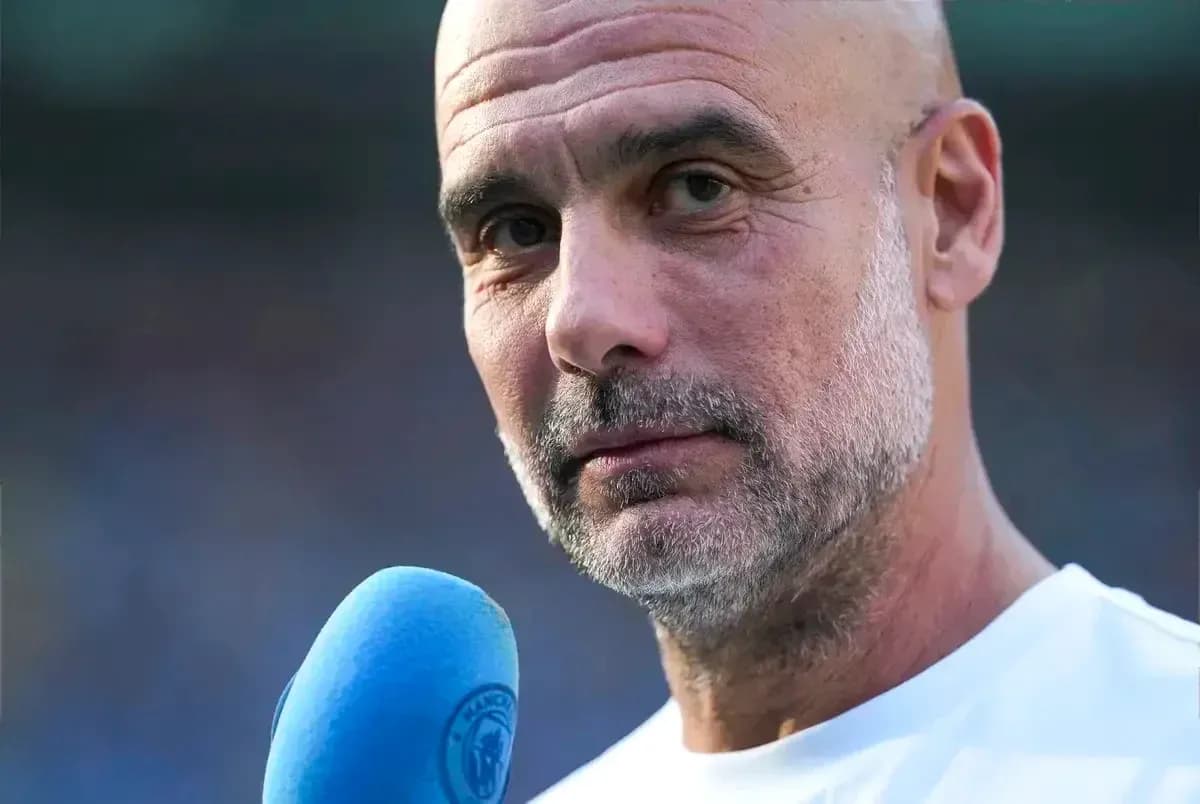
Guardiola, speaking in a new interview with OKX, chose to address that problem head-on – and he did it by going straight to the heart of City’s current project.
“Now we have a young team”… except you don’t
Guardiola recalled conversations with former sporting director Txiki Begiristain and current incumbent Hugo Viana, and he stripped away one of football’s most convenient myths: the idea that building a young squad guarantees stability.
“I spoke many times with the Manchester City sporting director(s) (former) Txiki Begiristain and (current) Hugo Viana, and said, ‘Now we have a young team for the next three or four years!’” he said.
Then he cut the idea down.
“It’s not true. You don’t know why, but it doesn’t work. A lot of players, young players, don’t play and say, ‘I want to leave! I’m here in cold Manchester, not playing, I want to leave!’ And you have to replace those guys.”
There it is. The central tension of City’s summer, laid bare by the man who lived it longest.
Young players don’t just sit and wait. Not in a squad this deep. Not in a city where the weather is unforgiving and the competition for minutes is even harsher. If they don’t see a route into the team, they push. And if they push hard enough, they go.
The real “big task” for Hugo Viana
This is where Guardiola sharpened the point. For all the talk of systems and style, he framed City’s future around one thing: recruitment, and the margin for error.
“But the big task is how the club, organisation, sporting director, manager, CEO, hierarchy recruit the right players you need – everyone makes mistakes, but make as few as possible. That’s the key point.”
No hiding places. No suggestion that this is simply Viana’s problem, or Maresca’s alone. Guardiola named the structure: sporting director, manager, CEO, hierarchy. Recruitment as a collective duty, not a convenient scapegoat when a signing fails.
That message lands at a moment when Viana is under intense scrutiny. This is his first major summer window in charge of one of Europe’s most complex squads, and it comes with a backdrop of restlessness. Several players are already understood to be exploring moves away, their roles uncertain as Maresca runs through his first pre-season assessments.
The pressure is obvious: keep enough of the core to maintain City’s level, refresh aggressively enough to avoid stagnation, and somehow persuade ambitious young players that their future lies in waiting for chances that might never come.
A rebuild in real time
Guardiola’s counsel doesn’t float in a vacuum. It lands in the middle of a live operation.
Maresca is only just beginning his first pre-season as City manager. Viana is presiding over what is shaping up to be one of the most significant overhauls since Guardiola himself arrived. Every decision on loans, sales and contract renewals now carries the extra weight of his predecessor’s warning.
This is the tightrope: loan out a player and risk never seeing him in a City shirt again. Keep him, limit his minutes, and watch his camp push for a permanent exit. The club’s ability to manage those fault lines will define not just this window, but the next three or four.
On the incoming side, Guardiola’s mantra – “make as few mistakes as possible” – is already being tested.
The headline move so far, the club record £116 million signing of Elliot Anderson from Nottingham Forest, looks like the kind of transfer Guardiola was alluding to: long-tracked, heavily analysed, and anything but a panic reaction. A calculated bet on a player identified well in advance, not a short-term patch.
It is exactly the sort of move that has to land. At that price, and in this squad, there is no room for half-measures.
Cold reality, clear message
Strip away the sentiment and Guardiola’s intervention is brutally simple.
There is no such thing as a “safe” young squad at a club like Manchester City. There is no guarantee that a group built to last three or four years will stay together that long. Not when the bench is full of internationals. Not when the climate, the competition and the expectations all push in the same direction: play now, or go.
For Maresca and Viana, the message is unmistakable. The trophies have set the standard. The churn of talent is the price. Their job is to live in that tension and, as Guardiola puts it, make as few mistakes as possible.
Because at this level, one bad window can echo for years. One good one can keep a dynasty alive.