Future Stars of Football: The Next Generation for 2030
The World Cup is barely in the rear-view mirror, but 2030 is already taking shape.
Brazil’s bruises and the boy they missed
Brazil’s exit to Norway in the last 16 – their earliest since 1990 – will be filed under collective failure. Tactical questions, individual errors, a sense of drift. But one absence hung over Carlo Ancelotti’s squad like a cloud: Estevao.
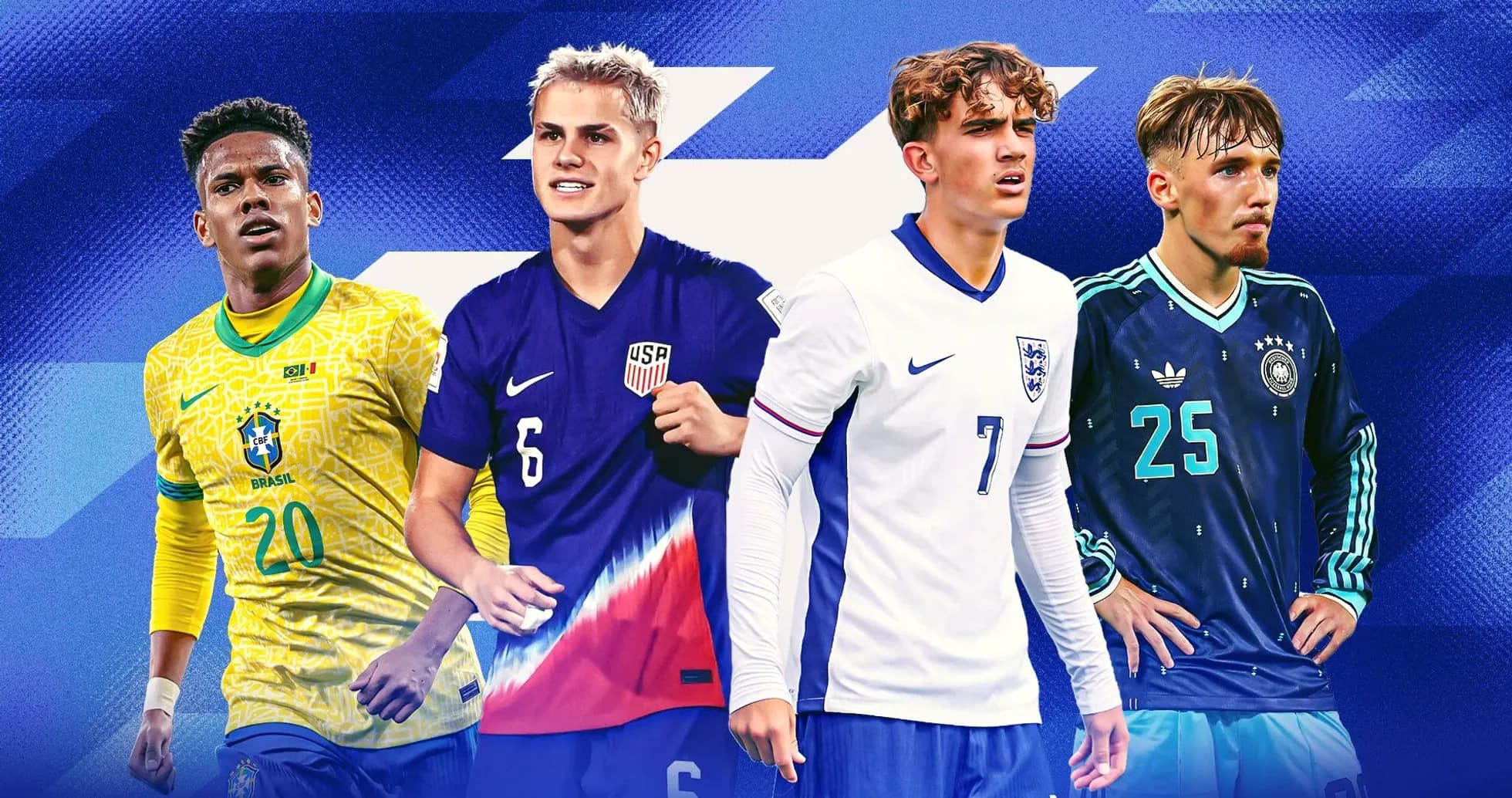
The Chelsea winger had ripped through the early stages of his Brazil career, five goals in six caps between September and November 2025 forcing his way into Ancelotti’s preferred XI opposite Vinicius Jr. Then came April, a serious hamstring injury, and the end of his dream of a first major tournament before it had even begun.
He is only 19. Time is his ally, his ceiling obvious. If his body holds up to the grind of the Premier League, Estevao has the tools not just to reclaim a spot in the Selecao, but to become one of its standard-bearers by 2030. That “if” will define his next four years.
Behind him, the Palmeiras conveyor belt keeps spitting out hope. Eduardo Conceicao is the next to step off.
Approaching his 17th birthday, the left-sided winger is already pushing for first-team minutes in Sao Paulo. Manchester United, Manchester City, Barcelona and Paris Saint-Germain are circling. For Brazil’s staff, the equation is simple: if Conceicao lands at one of those giants and adapts quickly, he will be hard to ignore when the next World Cup comes around.
Germany’s missing edge – and the kids who must fix it
Germany’s campaign unravelled before it really started. Lennart Karl, the Bayern Munich attacker tipped to start for Julian Nagelsmann, pulled out with a thigh problem a week before kick-off. An 18-year-old with quick feet and a quicker brain, Karl had already changed the tempo of games at senior level. Without him, Germany lost incision and crashed out in the last 32.
Jurgen Klopp will walk into that job knowing exactly what Karl can give him. Expect the teenager to sit at the heart of Germany’s 2030 blueprint.
He will not be alone. Kennet Eichhorn, still only 16, has already seen more of professional football than many twice his age. He broke through at Hertha Berlin and chose Bayer Leverkusen over Liverpool and others this summer, backing himself in the Bundesliga.
At home, they call him the next Toni Kroos. That comparison is a weight and a compliment in equal measure. If Eichhorn handles both, Germany’s midfield problem may solve itself.
Spain’s present glory and the next wave
While Brazil and Germany lick their wounds, Spain are still dancing. World champions again after beating Argentina in Sunday’s final, La Roja did it with one of the youngest squads in the tournament. The scary part? There is more coming.
One looming question is Rodri. The Manchester City midfielder won the Golden Ball as the tournament’s best player, a towering presence in Spain’s midfield. But his club season told a different story, his form and fitness dented by recovery from an ACL injury. He turns 30 as the next cycle begins. Can he keep this level?
Spain already have a contingency plan: Marc Bernal.
The Barcelona midfielder has long carried the Sergio Busquets tag, but last season he showed another layer. He shielded the defence, yes, but he also stepped forward, knitting attacks together and offering a threat in the final third. At 19, he looks ready to force his way into Luis de la Fuente’s thoughts, even in a crowded midfield.
Success is running through every age group. Spain’s Under-19s lifted the European Championship in Wales, and Xavi Espart emerged as the standout. A 19-year-old at Barcelona, he can anchor midfield or slide out to full-back, prompting inevitable Joshua Kimmich comparisons. He debuted for Barca last season; Hansi Flick is expected to hand him more minutes in 2026-27. Keep that trajectory and a senior call-up is only a matter of timing.
He is not alone. Real Madrid’s Thiago Pitarch has already started Champions League knockout games for Los Blancos. Quim Junyet, once of Barca and now at Almeria in the second division, has taken a step back in profile to move forward in minutes. Both could easily be in the 2030 conversation.
Drop down another age group and the production line still hums. Spain’s U17s did not win their Euros in Estonia, but Ebrima Tunkara walked away as Player of the Tournament. At 16, the attacking midfielder – comfortable centrally or out wide – is being talked about as the brightest La Masia attacker since Lamine Yamal.
Barcelona hope the pair will terrorise defences together for the next decade. Tunkara will join the senior squad for pre-season this summer. Maintain his curve, and he will be fighting for a place in Spain’s title defence on home soil in 2030.
Argentina beyond Messi
Argentina’s defeat in the final marked more than the end of a tournament. It signalled the beginning of the post-Lionel Messi era. That sentence alone will unsettle a nation.
Among those tasked with softening the landing is Franco Mastantuono. The Real Madrid teenager became the youngest player to appear for Argentina in a competitive match when he debuted in June 2025. He was still in Lionel Scaloni’s squad as recently as March, but missed out on the 2026 World Cup after an underwhelming first season at the Bernabeu.
He can operate as a No.10 or from the wing, and his story is a familiar one in Madrid: a teenager struggles to impose himself at first, then grows into the shirt. If Mastantuono follows that path, he has the quality to become a key figure for both club and country by 2030.
England’s next golden gamble
England walked away from another semi-final, another near-miss, and another extension of a wait that stretches back to 1966. Euro 2028, at home, now looms as the great opportunity. The World Cup beyond that may well rest on the shoulders of a teenager.
Max Dowman has already been labelled a “generational talent” at Arsenal. He became the youngest goalscorer in Premier League history with a strike against Everton in March and has quickly shown he is most dangerous in an advanced midfield role.
That creates a delicious headache: how do you fit Dowman and Jude Bellingham into the same England side? That argument will rage for years. For now, England supporters can simply enjoy the prospect of another game-changer emerging.
Rio Ngumoha is slightly further along the international track. The Liverpool winger impressed on his England debut in a pre-tournament friendly against New Zealand, catching Thomas Tuchel’s eye. Reports already suggest another call-up for the Nations League in September and October.
At Anfield, Ngumoha is expected to see more of the pitch under new manager Andoni Iraola. At 17, he has already shown he can torment full-backs with direct dribbling, quick feet and ruthless finishing. If his rise continues, he will be an England regular long before 2030.
Behind them is a deeper pool. Manchester City defender Stephen Mfuni, and Chelsea forwards Shim Mheuka and Ryan Kavuma-McQueen, are all tipped for senior breakthroughs. Yet the loudest buzz surrounds Manchester United striker JJ Gabriel.
Those who watched him in his early teens reached for the biggest comparison of all, perhaps unfairly: Lionel Messi. What is not in doubt is his impact. Gabriel was the star of United’s U18s last season despite only turning 15 in October. His first-team debut is expected in the coming campaign, and there is a genuine sense at Old Trafford that this might be the most exciting homegrown talent since the Class of ’92.
If he justifies the hype, Gabriel could be on the plane to the next World Cup. He would arrive still a teenager, carrying a nation’s expectations.
The United States: a window opens
The United States left their home World Cup with mixed emotions. There were positives, flashes of genuine progress, but also the nagging feeling of a missed opportunity after a last-16 exit. The hope now is that 2026 will push more kids towards football over other American sports.
They might not have to wait long.
Cavan Sullivan is already being spoken of as the future face of U.S. soccer. The Philadelphia Union midfielder, who has agreed a move to Manchester City in the summer of 2027, has enjoyed an encouraging first season as an MLS regular as he nears his 17th birthday.
A couple of years ago, some claimed he was the most talented player of his age anywhere in the world. Early evidence suggests that was not hyperbole. If his development continues, he could become one of the greatest American players the sport has seen.
Yet in MLS this year, Sullivan has shared the spotlight with Julian Hall. The New York Red Bulls forward has nine goals and four assists in 15 games and became the youngest player ever to score a hat-trick in the league. At 18, his form even sparked calls – however optimistic – for Mauricio Pochettino to take him to the 2026 World Cup.
He did not make it. Keep scoring at this rate, earn the inevitable move to Europe, and Hall should be a fixture in the USMNT XI by 2030.
He is not the only one. Team-mate Adri Mehmeti, 17, has impressed since breaking into the Red Bulls’ senior side. Borussia Dortmund forward Mathis Albert and Charlotte FC striker Nimfasha Berchimas are also on the radar. A new American core is taking shape.
Portugal and the post-Ronaldo search
Portugal are staring at the same question Argentina face: what happens after Cristiano Ronaldo? Their latest World Cup disappointment has accelerated the search for a new talisman.
Rodrigo Mora is a leading candidate. The Porto midfielder, 19, already has a Nations League winners’ medal from 2025 and contributed to Porto’s Liga Portugal title last season. Moments of magic in the Europa League drew admiring glances from Barcelona and PSG.
A first senior cap feels inevitable if he continues on this path.
Another name to watch is Geovany Quenda, newly signed by Chelsea. If he adapts quickly to the Premier League, a place in Jorge Jesus’ squad will not be far away. Wolves winger Mateus Mane, who recently committed to Portugal, is also pushing for recognition after a series of eye-catching displays at Molineux.
The Oranje reload
The Netherlands are still processing a last-32 exit, but their eyes are already on the next cycle. Newcastle turned heads by agreeing to pay up to £23 million for Ajax midfielder Sean Steur, a teenager with little experience but enormous promise.
At 18, Steur forced his way into Ajax’s first team in the second half of last season, his passing range and stamina immediately obvious. The Dutch hope he can establish himself under Eddie Howe on Tyneside and then slide into their midfield well before 2030.
They also have high hopes for Twente defender Ruud Nijstad, another 18-year-old, who is being groomed as a potential heir to Virgil van Dijk. That is a daunting mantle, but the need is clear: the Oranje must refresh their spine.
Belgium’s new conductor
Belgium’s golden generation has faded, leaving a vacuum that someone must fill. Nathan De Cat might be the one.
The midfielder left Anderlecht for Hoffenheim in a €20m move this summer, a price tag that underlines how highly he is rated. He made his senior international debut in March but missed the World Cup as Rudi Garcia leaned on experience.
That will not last. De Cat, 18, showed at Anderlecht that he can sit in front of the defence or operate as a No.10. Bayern Munich circled before Hoffenheim won the race. The Bundesliga should not take long to feel his presence.
Norway, Morocco and DR Congo: new powers from old margins
Norway’s so-called Golden Generation finally delivered, reaching the World Cup quarter-finals for the first time in their history, with Erling Haaland predictably leading the charge. The next wave is already being prepared.
Gabriel Rajkovic made history in March as the youngest debutant in the Norwegian top flight, stepping onto the pitch for Valerenga less than a month after his 15th birthday. A left-sided winger with a direct streak, he has become a regular off the bench and is widely expected to follow the path of Haaland and Martin Odegaard from Norway to the European elite.
Morocco, quarter-finalists in 2022 and knockout qualifiers again in 2026, have become Africa’s standard-bearers. Their success has been built partly on an aggressive embrace of the diaspora, and Abdellah Ouazane looks like the next star to emerge from that strategy.
Born in Amsterdam and schooled at Ajax, the midfielder was named Player of the Tournament at the 2025 U17 Africa Cup of Nations. A move to Real Madrid was close before collapsing late on, but the interest alone spoke volumes. At 17, Ouazane is closing in on his Ajax first-team debut. If he shines in the Eredivisie, Europe’s giants will be back at the door.
DR Congo have followed a similar path, returning to the World Cup and reaching the knockout rounds, where they gave England a genuine scare in the round of 32. One of their most intriguing prospects did not even make the squad.
Jorthy Mokio, an Ajax starlet who has previously been called up by Belgium, chose DR Congo but was left out as coach Sebastien Desabre rewarded those who had earned qualification. That will change. The 18-year-old, capable of playing in defence or midfield, has already been linked with Manchester United and Chelsea. He recently signed a new deal to stay at Ajax until 2031, but his international future looks set with DR Congo – and 2030 feels like his stage.
Italy’s promise after years in exile
Italy did not qualify for 2018, 2022 or 2026. For a four-time world champion, that is almost unthinkable. A fourth straight absence would be unforgivable. The good news: a new generation is finally punching through.
At the front of the queue stands Samuele Inacio. The Borussia Dortmund attacking midfielder has already scored in the Bundesliga and impressed across Italy’s youth sides over the past year. He has a senior cap too, having debuted in June friendlies against Greece and Luxembourg.
He is not alone. Dortmund team-mate Luca Reggiani, Atalanta defender Honest Ahanor and AC Milan striker Francesco Camarda are all expected to play key roles in Italy’s rebuild. The talent is there. The question is whether Italy can turn promise into a squad capable of breaking their World Cup exile.
The 2026 World Cup has barely closed its doors, yet the next cast is already rehearsing. Some will stumble, some will soar, and a few will redefine what their countries think is possible.
Which of them will walk into 2030 as just another prospect, and which will arrive as the player an entire nation cannot imagine doing without?