Farewell Tours at the 2026 World Cup: Legends Bid Goodbye
The World Cup has always loved a farewell tour. In 2026, it might be overwhelmed by them.
Across North America, legends will gather for one last swing at immortality, some already deep into borrowed time, others clinging to the final peak of their powers. Records will fall, careers will close, and entire nations will watch, knowing they may never see their like again.
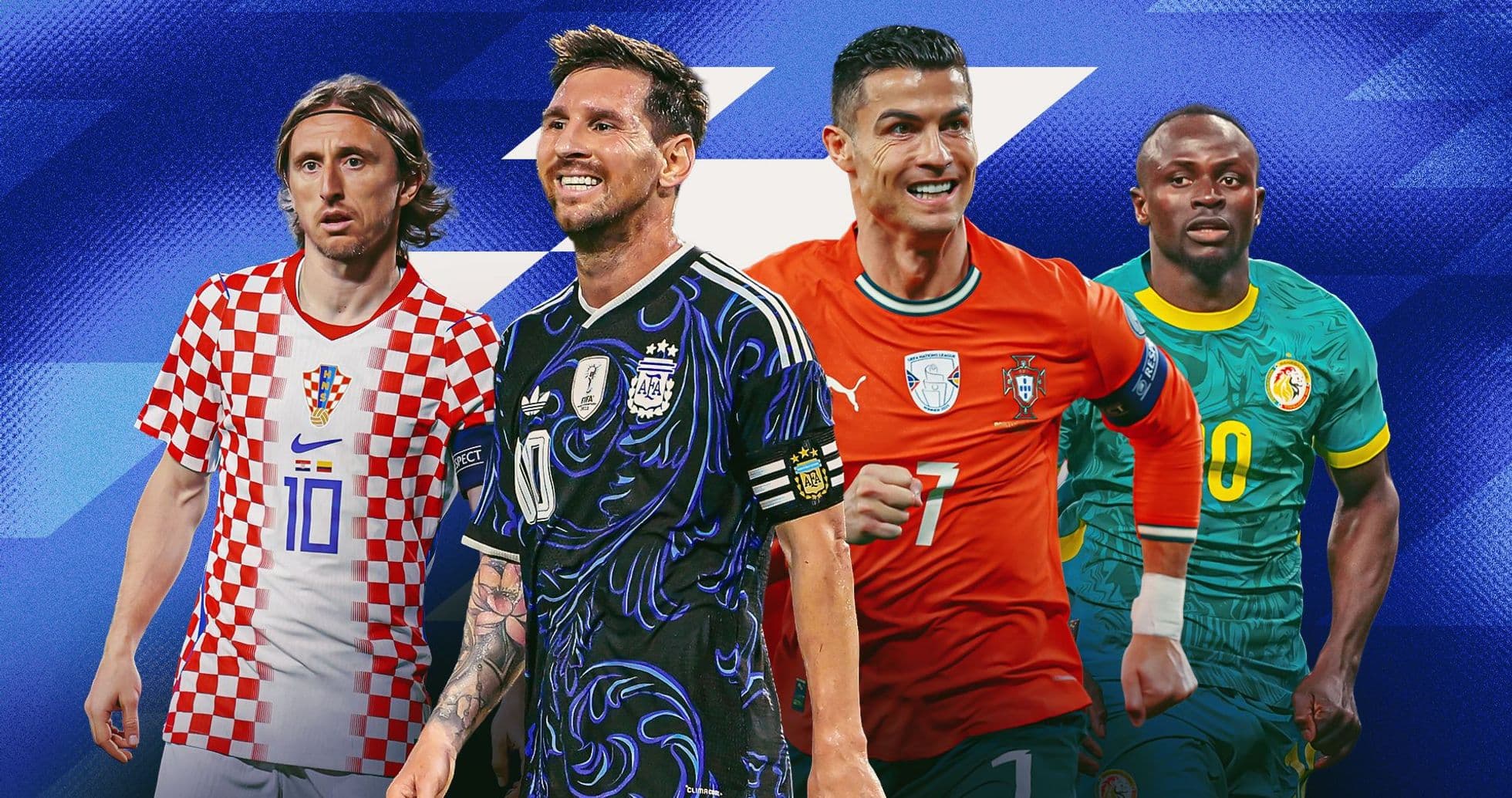
Messi, Ronaldo and Ochoa: Six and out?
Lionel Messi will arrive on the brink of 39, already having completed football, now daring to stretch the story into a sixth World Cup. He finally lifted the trophy in 2022, dragging Argentina past France in a final that instantly entered folklore. Since then he has swapped European intensity for the glow of Miami, managing his body in MLS while still flicking out passes and finishes that belong to a different universe.
He keeps turning up for his country, keeps deciding games, keeps bending time. The expanded format and the North American heat will test him in ways even he has not yet faced, but nobody sensible expects Messi to slip quietly into the background. Not now. Not here.
Cristiano Ronaldo will be 41. If he lifts the trophy with Portugal, he becomes the oldest World Cup-winning player in history. For all his medals and five Ballons d’Or, the World Cup remains the missing piece. No title. Not even a knockout-stage goal. For a figure of his scale, that gap glares.
Yet he refuses to fade. He still scores relentlessly for Al-Nassr in Saudi Arabia, still talks as if retirement is a distant concept. Portugal are loaded with talent – Rafael Leao, Pedro Neto, Goncalo Ramos and others waiting to take the reins – but Roberto Martinez continues to build his attack around Ronaldo. This will be his sixth World Cup. It has to be his last shot at the one prize he never claimed.
Guillermo Ochoa will join them on six, though his route back has been far less straightforward. The Mexican goalkeeper, a staple of the tournament for two decades, had virtually disappeared from the national picture after the CONCACAF Nations League finals in March 2024. One appearance since then. No real expectation he would be in Javier Aguirre’s plans.
Then Angel Malagon tore his Achilles in March. The door swung open. At 40, Ochoa walked back through it.
His career has criss-crossed Europe – Spain, Italy, France, Portugal, Belgium – before a recent spell in Cyprus with AEL Limassol. He has hinted that this World Cup will be his last act. For a man whose name has become shorthand for heroic tournament performances, there is a certain symmetry in saying goodbye on home soil.
Neuer, Modric and Dzeko: Old masters, one more canvas
Mexico are not the only hosts turning back to a familiar face in goal. Julian Nagelsmann has made his own bold call, dragging Manuel Neuer out of international retirement. With Marc-Andre ter Stegen battling injuries and doubts swirling around Oliver Baumann, Germany’s head coach went back to the old standard.
Neuer, who had stepped away after Euro 2024, will now play his fifth World Cup at 40. Another strong season with Bayern Munich convinced Nagelsmann that his former captain still sets the bar. He will be Germany’s No.1 again as they try to stop a third straight group-stage exit from becoming a national trauma.
Luka Modric will turn 40 during the tournament and still orchestrate games with that unhurried genius that first lit up the World Cup in 2018. He took Croatia to a final that year, then to third place in 2022, rewriting his country’s footballing history in the process.
He left Real Madrid for AC Milan last summer, not to wind down but to stay sharp enough for this very stage. This will be his fifth World Cup. He is on the brink of 200 caps, likely to follow Messi into that tiny club during the tournament. For a midfielder whose career has been defined by defying limits, this feels like the last great test.
Edin Dzeko’s path has been rougher. Bosnia and Herzegovina have not been regulars at major tournaments since their lone World Cup appearance in 2014. Many assumed that was Dzeko’s only dance with the competition.
He refused to accept that. At 40, he helped drag his country through the UEFA play-offs, beating Italy to book their place in North America. He is about to move beyond 150 caps and already has more than 70 international goals. A January switch to Schalke reignited his club form, his goals firing them back into the Bundesliga.
For a striker of his calibre, one World Cup always felt like too little. This second chance offers a fitting stage on which to bow out.
Asia and Africa’s icons on the clock
South Korea may also be approaching a goodbye. Son Heung-min turns 34 in July and remains the face, heartbeat and burden-bearer of his nation’s football obsession. He has already stepped away from Europe to join LAFC in MLS, a move that suggests he is thinking carefully about his remaining miles.
The armband, the expectations, the responsibility – they all weigh heavy. By the end of 2026, Son might decide he has given everything he can to the Korean cause.
Mohamed Salah, a few days older than Son, sits in a similar position for Egypt. He has carried the Pharaohs for years, often almost alone. This time he does at least have some help, with the likes of Manchester City’s Omar Marmoush emerging, but the plan remains the same: look to Salah and hope.
His Liverpool form has dipped sharply over the last year, and his only previous World Cup, in 2018, was scarred by the shoulder injury he suffered in the Champions League final. For a player of his stature, the global stage still feels incomplete.
A move to Saudi Arabia looks likely after his Anfield departure. Once that happens, the countdown on his elite career will accelerate. Expecting him to push on through another four-year cycle with Egypt feels optimistic. This may be the last time he carries his country into a World Cup.
Sadio Mane, forever linked to Salah from their Liverpool days, has been just as central to Senegal’s rise. Now 34, the Al-Nassr forward approaches what could be his final chance to lead the Lions of Teranga out at a World Cup.
He scored the decisive penalty to win Senegal their first Africa Cup of Nations in 2021. He then dragged them to consecutive World Cup qualifications, only to miss the 2022 tournament with injury. His move to Saudi Arabia has taken him out of the European spotlight, but his commitment to Senegal has never wavered. He still wears the armband. He still sets the tone.
With Ismaila Sarr and Illiman Ndiaye blossoming around him, Mane’s leadership and experience could be the difference between another brave showing and something deeper, more historic.
Riyad Mahrez completes a remarkable African trio. At 35, the Al-Ahli winger still glides past defenders with that same velvet touch that once lit up the Premier League. One of the most technically gifted players the continent has produced, he deserves more than a single World Cup appearance on his CV.
Yet that is all he has, from 2014, when Algeria last qualified. This tournament finally gives him another crack at it, another chance to bring his club brilliance to the biggest stage of all as he eases into the latter years of his career in Saudi Arabia.
De Bruyne, Van Dijk and James: Golden generations at the crossroads
Kevin De Bruyne’s body has started to argue with him. His first season at Napoli after leaving Manchester City has been disrupted by injuries, and he turns 35 later this month. When he plays, he still looks like the most complete playmaker in the game, but the gaps between appearances grow more worrying.
Belgium’s much-discussed ‘Golden Generation’ has already frayed, yet De Bruyne remains the conductor. Rudi Garcia’s squad is in transition, younger, less star-laden, but still built around the midfielder who can split a defence with a single pass or crash in a goal from distance. If he stays fit for one more month, Belgium might just slip into the role of dark horse again.
Virgil van Dijk will also turn 35 during the tournament. For years he has been the defensive pillar on which Liverpool’s modern success has rested, a centre-back so dominant that forwards have actively tried to avoid him in one-on-one duels.
The last season has raised questions. Some Liverpool supporters fear he has lost a yard, that the anticipation and command are not quite at their peak. Yet for the Netherlands he remains the anchor, the captain, the non-negotiable name on the team sheet.
This will be only his second World Cup, a quirk of timing and injuries. It is likely to be his last.
James Rodriguez, meanwhile, owes almost his entire career to this competition. In 2014, he stunned the world with a run of performances and a volley that launched him to Real Madrid and into the collective memory.
Since then, injuries have chipped away at his momentum. He has hopped between clubs, often staying just long enough to regain fitness and rhythm before moving on again. Most recently, he has been with Minnesota United in MLS, saving his finest bursts for Colombia.
He turns 35 in July. For Colombian fans, his presence in North America is non-negotiable. A final World Cup chapter for one of the tournament’s great one-summer stars feels not just appropriate, but necessary.
Neymar, Kane and England’s looming goodbye
Neymar’s relationship with the World Cup has veered between theatre and tragedy. Brazil’s all-time leading scorer has not played for his country since tearing his ACL in October 2023. When Carlo Ancelotti took the Brazil job in September and initially overlooked him, it looked as though the curtain had fallen.
Then injuries hit Brazil’s forward line. Ancelotti turned back to the past and named Neymar in his 26-man squad. The reaction in Brazil was instant and wild.
What role he can realistically play is unclear. He suffered yet another injury just days after the call-up and must now prove his fitness all over again. His body is clearly struggling to keep pace with his talent. The idea of him lasting until 2030 feels fanciful.
That makes this World Cup decisive. One last chance to chase the sixth star that Brazil craves, one last opportunity to reshape a legacy that has so often felt unfinished on this stage.
Harry Kane stands at a different point on the curve. At 32, he may be at his absolute peak. More than 60 goals for Bayern Munich this past season underline that his finishing remains as ruthless as ever. For England, he is already out on his own as the country’s record scorer.
He could, in theory, go again in 2030. England fans, aware of the drop-off behind him in the striking pecking order, will cling to that possibility. But the calendar poses a natural question.
In 2028, England will co-host the European Championship. A major tournament on home soil, under the arch, could offer the perfect stage for Kane to end his international career, especially if he finally delivers a trophy.
If that proves to be the plan, then 2026 becomes his last World Cup. And he will not be alone on that path. Jordan Pickford, John Stones, maybe even Marcus Rashford could look at the same horizon and see a logical endpoint: one more World Cup, then a final bow in front of their own fans two years later.
Across continents and generations, the pattern repeats. Bodies creak, squads evolve, but the pull of one last World Cup remains irresistible. North America will not just host a tournament; it will host a curtain call.
The only question now is which of these great careers finds its final, defining scene – and which leaves the stage still searching for the ending it deserves.