Espanyol's Tactical Masterclass in 2-0 Victory Over Athletic Club
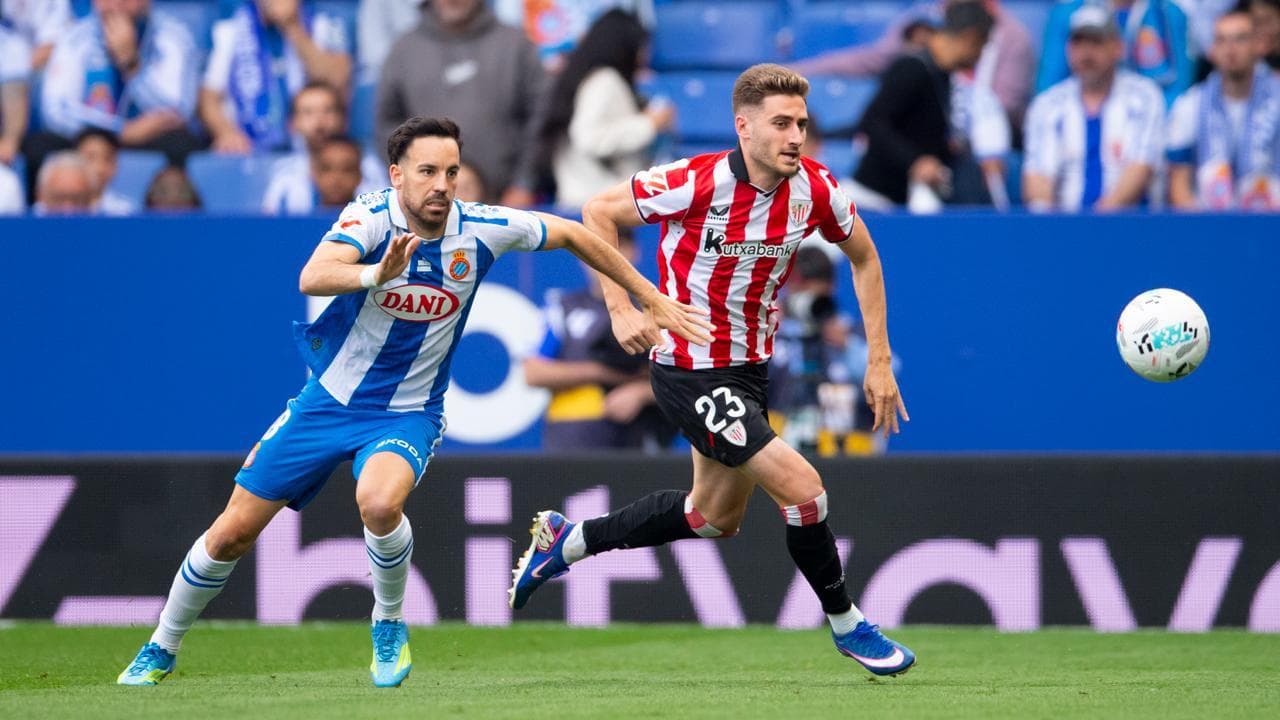
Espanyol’s 2-0 win over Athletic Club at RCDE Stadium was built on clear structural control rather than sheer chance, despite xG leaning almost level (0.76 vs 0.82). Manolo Gonzalez’s 4-4-2 imposed the game’s geometry and tempo, while Ernesto Valverde’s 4-2-3-1 never fully solved Espanyol’s width and pressing triggers.
Espanyol’s base 4-4-2 was very classic on paper but modern in execution. Out of possession, it became a compact 4-4-2 mid-block with the front pair, Exposito and R. Fernandez Jaen, screening passes into I. Ruiz de Galarreta and A. Rego. The wide midfielders, A. Roca on the left and R. Sanchez on the right, held relatively narrow starting positions, inviting Athletic Club to circulate wide and then springing to press full-backs on the touchline. With 63% possession and 492 passes (386 accurate, 78%), Espanyol were not just reactive; they built patiently from the back.
The back four of O. El Hilali, C. Riedel, L. Cabrera and C. Romero were key to this. With Athletic Club often leaving I. Williams as the highest outlet, Espanyol’s centre-backs could split, with U. Gonzalez (before his late substitution) or P. Lozano dropping to assist in the first phase. The full-backs advanced asymmetrically: C. Romero stepped higher on the left, which later became crucial on the opening goal, while O. El Hilali was slightly more conservative to manage transitions against Williams and the right-sided rotations of R. Navarro and A. Berenguer.
Athletic Club’s 4-2-3-1, with U. Gomez and R. Navarro between the lines, aimed to overload Espanyol’s double pivot. But with Espanyol’s forwards intelligently curving their pressing runs, Athletic were often forced into the wide channels and then into crosses from suboptimal zones. They finished with 11 total shots to Espanyol’s 12, and 10 of those inside the box, but the shot quality was diluted: many were from crowded central zones where Cabrera and Riedel defended aggressively.
The game’s turning point came through Gonzalez’s proactive use of the bench. At 63', he reshaped his attacking structure: A. Roca (OUT) was replaced by P. Milla (IN), and R. Sanchez (OUT) by Jofre (IN). This shifted Espanyol’s front line dynamics. P. Milla’s introduction gave Espanyol a more mobile, between-the-lines presence who could drop into half-spaces and link play, while Jofre offered directness on the flank.
Valverde responded simultaneously with a triple switch at 63': D. Vivian (OUT) for Y. Alvarez (IN) in central defence, I. Williams (OUT) for G. Guruzeta (IN) up front, and I. Ruiz de Galarreta (OUT) for M. Jauregizar (IN) in midfield. In theory, this freshened the spine; in practice, it briefly destabilised Athletic’s defensive relationships just as Espanyol were increasing their tempo.
The 69' opener encapsulated Espanyol’s tactical plan. P. Milla (scorer) finished a move assisted by C. Romero, who had pushed high from left-back. With Athletic’s restructured back line still adjusting, Espanyol circulated the ball patiently, drew the block to one side, and then exploited the far side through Romero’s advanced positioning. The left-back’s involvement highlighted how Espanyol used their full-backs as key outlets once Athletic’s first line was bypassed. P. Milla, arriving from a pocket rather than starting on the last line, attacked the space between centre-back and full-back, a pattern that had been building since his introduction.
Valverde kept searching for a solution. At 71', J. Areso (OUT) made way for A. Gorosabel (IN), a like-for-like at right-back but with a slightly different profile in build-up. At 78', U. Gomez (OUT) was replaced by N. Serrano (IN), adding fresh legs and more vertical threat in the attacking midfield line. These changes tilted Athletic even more towards chasing the game, increasing their attacking volume but also exposing them further to counters.
Espanyol’s late substitutions were clearly about game management and fresh energy around the ball. At 84', Exposito (OUT) was replaced by R. Terrats (IN), and R. Fernandez Jaen (OUT) by K. Garcia (IN). Terrats brought extra control and defensive work in midfield, helping Espanyol manage transitions and keep the ball under pressure. K. Garcia provided a new focal point up front, able to run channels and hold play. At 90+1', U. Gonzalez (OUT) was replaced by C. Pickel (IN), a final move to solidify the midfield line and protect the lead.
The second goal at 90' underlined the effectiveness of these changes. K. Garcia scored, assisted by R. Terrats. Both were substitutes, and the move reflected Espanyol’s late-game blueprint: win the ball in midfield through fresh legs (Terrats), exploit Athletic’s stretched shape, and attack the spaces left by their full-backs pushing on. The timing of the goal – just as Athletic were committing numbers forward – confirmed how Espanyol’s balance between control and verticality improved as the game went on.
From a goalkeeping perspective, both sides underperformed relative to goals prevented. M. Dmitrovic registered 4 saves but with goals prevented at -0.9, suggesting that the quality of chances conceded (0.82 xG) might have produced more damage on another day and that his shot-stopping was slightly below the expected benchmark. U. Simon, with 3 saves and the same -0.9 goals prevented, also fell short of fully compensating for the defensive breakdowns in front of him, especially on the two decisive Espanyol strikes.
Statistically, the match narrative is clear: Espanyol’s 63% possession and higher passing volume (492 passes, 386 accurate, 78%) translated into territorial and structural control, even if their xG of 0.76 did not dwarf Athletic’s 0.82. Athletic’s 273 passes (180 accurate, 66%) and 14 fouls reflected a team more often chasing than dictating. Their 9 corners to Espanyol’s 8 showed they could generate pressure, but Espanyol’s defensive organisation in the box held firm.
In synthesis, Espanyol’s win was less about overwhelming chance creation and more about superior structure, intelligent in-game adjustments, and well-timed substitutions that directly produced both goals. Athletic Club’s changes injected energy but eroded cohesion at critical moments, and in a match of fine xG margins, it was Espanyol’s tactical clarity that made the difference.