England's Heroic Night at Azteca: A World Cup Epic
England’s night of Azteca heroics ended with a jolt of cold reality.
Thomas Tuchel walked down the tunnel in Mexico City carrying two clashing emotions: the thrill of a World Cup epic, and the sinking worry that one of his senior players had suffered a “quite a serious injury” in the celebrations.
Bellingham blitz, Quansah red, Kane chaos
The Estadio Azteca, a stadium steeped in World Cup mythology, roared into life on Sunday evening and England answered it with a ruthless opening salvo.
Jude Bellingham, unfazed by the altitude, the noise or the occasion, ripped into Mexico with a rapid-fire brace that stunned the hosts and briefly silenced 80,000 voices. Two chances, two goals, and England were cruising in a last-16 tie that felt bigger than its billing.
Mexico, though, do not bow easily in this arena. They had lost only two of their previous 89 competitive games at the Azteca, and they refused to let a third slip by without a fight. Julian Quinones dragged them back into it, striking to ignite the stands and tilt the momentum.
The game then lurched again. Jarell Quansah saw red, and suddenly Tuchel’s side were staring at 40-50 minutes a man down, gasping in the thin air against a World Cup co-host that smelled blood.
England clung to their lead, then stretched it. Harry Kane, their captain, buried a penalty to restore daylight and appeared to have settled the contest. Moments later he handed Mexico a lifeline, conceding a spot-kick that Raul Jimenez converted to turn the closing stages into a siege.
Ten-man England dug in. They defended their box, threw themselves into tackles, and chased lost causes in a cauldron that demanded every last drop of energy. When the referee finally raised the whistle to his lips, it felt, as Tuchel admitted, less like a routine progression and more like a cup final won on willpower alone.
“It is a heroic performance and a heroic result in the end,” the England manager said. “We did it with pure mentality, with heart. We overcame every obstacle that was thrown at us.”
A heroic night, a harsh twist
The whistle brought release. Players spilled onto the pitch, arms aloft, some collapsing to their knees in exhaustion. They made their way to the travelling support for what has become a ritual: a booming, communal rendition of Oasis’ “Wonderwall” under the Mexican night sky.
Then came the twist no one saw coming.
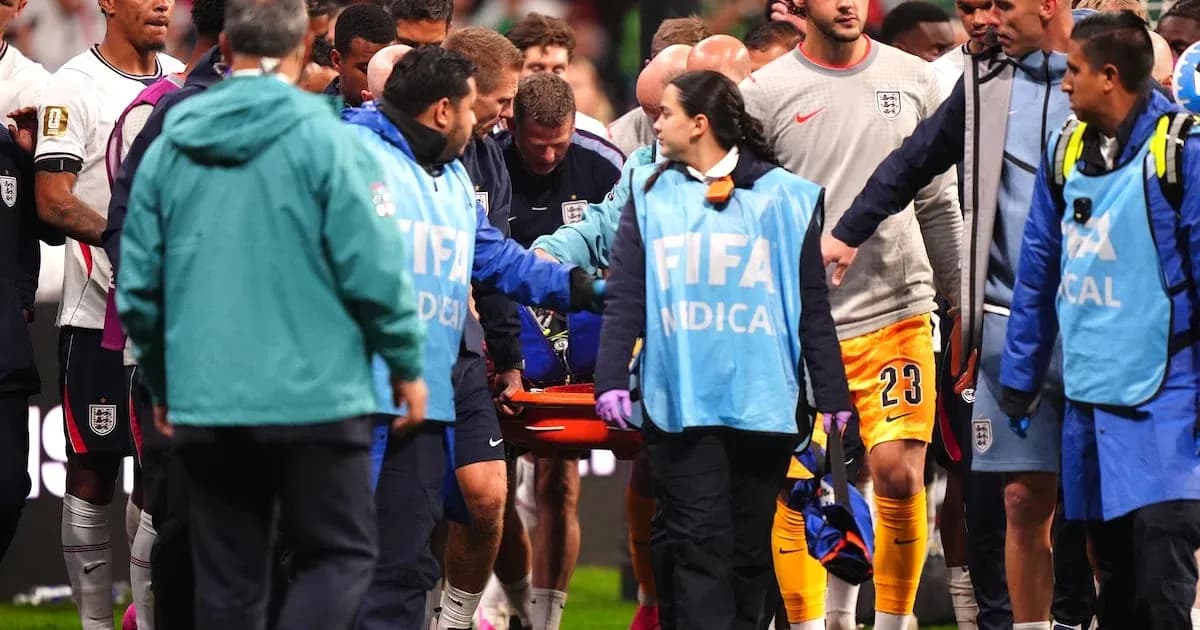
Jordan Henderson, an unused substitute but very much part of the celebrations — and even booked on the sidelines during the match — tried to climb back over the advertising hoardings after the singalong. He slipped. The fall looked awkward immediately.
The mood shifted. Medical staff rushed in. Henderson left the field on a stretcher, his wrist injured badly enough for Tuchel to describe it as “quite a serious injury”. The veteran midfielder was taken straight to a hospital in Mexico City and did not rejoin the squad for the flight back to Kansas City on Sunday evening, remaining behind for further treatment.
“It just doesn’t fit to the evening that Jordan is now not with us,” Tuchel said. “He injured his wrist. He is at the moment at the hospital… I am so proud of the mentality and the will of this team… but also sad because Jordan got injured.”
The contrast was stark: a team basking in one of its great away World Cup wins, and a senior figure lying in a Mexican hospital as the plane home left without him.
England stare down the Azteca – and what comes next
This was no ordinary round-of-16 tie. The delayed kick-off, the altitude, the ferocious crowd, the red card, the history of Mexico at this ground — all of it combined to turn a knockout match into a test of nerve and endurance.
“In the build-up it never felt like a round of 16,” Tuchel admitted. “It still now doesn’t feel like a round of 16. It feels almost like we won a final or something.”
He talked about the drive to the stadium, the people lining the streets, the sense of occasion. He talked about those final minutes, defending with 10 men against a “strong, strong Mexican team” in a place that rarely forgives visiting sides.
To survive all that, and win 3-2, gives this England campaign a different kind of fuel. They have stared down one of the World Cup’s most intimidating stages and come out the other side, battered but buoyant.
Their reward is a quarter-final in Miami against Norway on Saturday. The legs will be heavy. The lungs will still remember the altitude. And one of their most experienced players is, for now, stuck in a hospital bed thousands of miles away.
Tuchel called it “a very, very special night” that will hold “a very special place” for this group. The question now is simple: after a heroic escape in Mexico City, how far can this team ride that mentality through the rest of the tournament?