Egypt Achieves Historic First in World Cup Knockout
Under the closed roof and cold air of the Dallas Cowboys’ home, Egypt finally found their World Cup moment. It took 120 minutes, a shootout, and every ounce of nerve they had, but when Abdelmaguid rolled in the decisive penalty, seven-time African champions stepped into new territory and left Australia shattered.
Mohamed Salah, the country’s 34-year-old talisman, dropped to his knees in tears. Not from pain this time, but from release.
Egypt edge a historic first
This was a meeting of two nations chasing the same line in the record books. Neither Egypt nor Australia had ever won a knockout match at a men’s World Cup. That shared tension hung over a crowd of around 70,000, thickening every loose touch and mis-hit clearance.
Australia almost ripped up the script immediately. With less than five minutes gone, Cristian Volpato – the playmaker who switched allegiance from Italy to the Socceroos on the eve of the tournament – stepped inside and rattled the top of the crossbar. It was a warning shot and a reminder of why Tony Popovic had trusted youth in this squad.
Yet it was Egypt who struck first.
Against a side that had scored only twice in the group stage, Hossam Hassan’s men didn’t need many looks. After 13 minutes, Karim Hafez swung in a teasing cross to the back post. Nestory Irankunda lost his runner, and Emam Ashour ghosted in behind, thundering a header past Patrick Beach for his second goal of the tournament. One chance. One goal. Egypt in front.
Australia, suddenly chasing, looked what they had been for much of this World Cup: shot-shy. Their first effort on target did not arrive until 10 minutes before the break, Aziz Behich driving forward from full-back only to fire tamely at Mostafa Shoubir. The Egypt goalkeeper, son of Ahmed Shoubir who played at the 1990 World Cup, gathered comfortably.
Egypt, who had only just claimed their first ever World Cup win in the group phase by beating New Zealand 3-1, did not look entirely settled. They were nervy at the back, hesitant under pressure. But they had the lead, and with Salah struggling to influence the game after his recent hamstring strain, they were content to manage the tempo.
The first half ended with a jolt. Jordan Bos, one of the quickest players at this tournament, was wiped out by a flying challenge from Rabia. The wing-back stayed down, then had to be helped off and did not return after the interval. Kai Trewin replaced him, a significant blow to Australia’s attacking thrust on the flank.
Australia hit back as Egypt wobble
Seconds after the restart, Egypt should have buried the contest. Omar Marmoush, the Manchester City attacker, slid in at close range but somehow pushed his finish wide. It felt like a turning point even before the scoreboard changed.
Popovic’s side grew bolder. Egypt’s coach had warned about Australia’s physical edge, and now he saw it up close. The Socceroos began to win set-pieces, to load the box, to ask questions of a defence that suddenly looked unsure.
The pressure finally told.
From an in-swinging free-kick, Mohamed Hany, wrestling with the aerial challenge, could not sort his feet. Under heavy contact, he mistimed his header and diverted the ball into his own net. Australia were level, Egypt stunned. For Hany, it was a nightmare repeat: his second own goal of the tournament.
Salah remained on the fringes, more decoy than destroyer, but Egypt slowly wrestled back control. As normal time ticked into stoppage, the game tilted again. Salah helped knit together a move that ended with Ramy bearing down on goal, only for Beach to produce a superb, athletic save to his right. It kept Australia alive and dragged the tie into extra time.
Extra time tension, then the lottery
Egypt finished the 90 stronger, and they carried that momentum into extra time. Salah, on his weaker right foot, lashed a rising effort well over early in the added 30 minutes. The legs grew heavy, the passes safer. Penalties began to feel inevitable.
Popovic made his move. In a bold, late gamble, he turned to experience and brought on Mathew Ryan specifically for the shootout. Beach, who had kept them in the game, made way. It was a decision that would define the night.
The teams walked towards the end packed with Egypt supporters. Whistles poured down from the stands, a wall of sound aimed squarely at the Socceroos.
Harry Souttar stepped up first for Australia. A centre-back, a leader, usually unflappable. This time, the moment swallowed him. He leaned back and blazed his penalty over the bar. Immediate advantage Egypt.
From there, the next five takers all converted. Salah, who had looked short of his usual sharpness in open play, strolled up and buried his kick with icy calm. Ryan went one way, the ball the other. Clinical, emphatic.
Australia clung on, hoping for a twist. It never came.
Eighteen-year-old defender Lucas Herrington, thrust into one of the most pressurised moments of his young career, stepped up needing to score. His strike beat Shoubir but not the frame of the goal, crashing against the bar and flying out. Agony for the teenager; a roar of belief from the Egypt end.
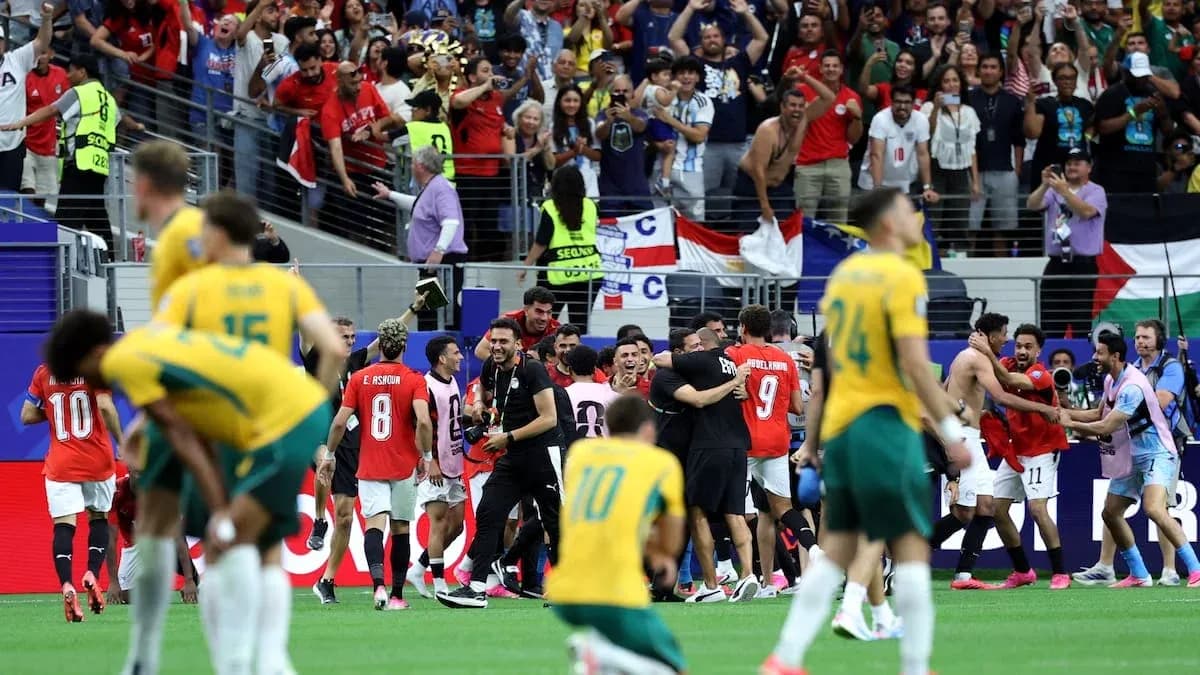
That left Abdelmaguid with the chance to end it. He did not blink. A measured run, a clean strike, and Egypt were through.
Salah wept, embraced by team-mates. Australia sank to their knees, a campaign of grit and narrow margins ending in the most brutal fashion.
Egypt, who once dominated Africa but never cracked the World Cup’s knockout code, finally have their breakthrough. The question now is simple: having crossed that line at last, how far can they go?