Egypt Defeats Australia in Round of 32: Tactical Analysis
Australia’s Round of 32 exit to Egypt at AT&T Stadium was defined by a structural contrast: Australia’s compact 3-4-2-1 ceding territory and possession, Egypt’s 4-4-2 using the ball to probe patiently, and a contest that remained tactically tight across 120 minutes before Egypt’s superiority from the spot (4-2 on penalties after a 1-1 draw) decided it.
Egypt controlled the rhythm with 58% of the ball and a clear passing edge — 723 passes with 614 accurate (85%) — against Australia’s 507 passes, 404 accurate (80%). That territorial dominance translated into better shot quality: Egypt generated 1.36 xG to Australia’s 0.87, underlining that the North Africans consistently reached more dangerous zones despite only a marginal advantage in total attempts (14 to 16). Both goalkeepers’ underlying numbers (each side posting -0.9 goals prevented) suggest that the finishing and defensive interventions broadly matched the chances created, rather than the game being stolen by shot-stopping heroics.
Structurally, Tony Popovic’s 3-4-2-1 for Australia was clearly designed to compress central space and protect the back three of Lucas Herrington, Harry Souttar and Alessandro Circati. Wing-backs Jordan Bos and Aziz Behich had to manage Egypt’s wide threats while also providing width in transition. In practice, Australia often sank into a 5-4-1 block, with Cristian Volpato and Connor Metcalfe dropping alongside the midfielders to screen passes into Mohamed Salah and Mostafa Ziko.
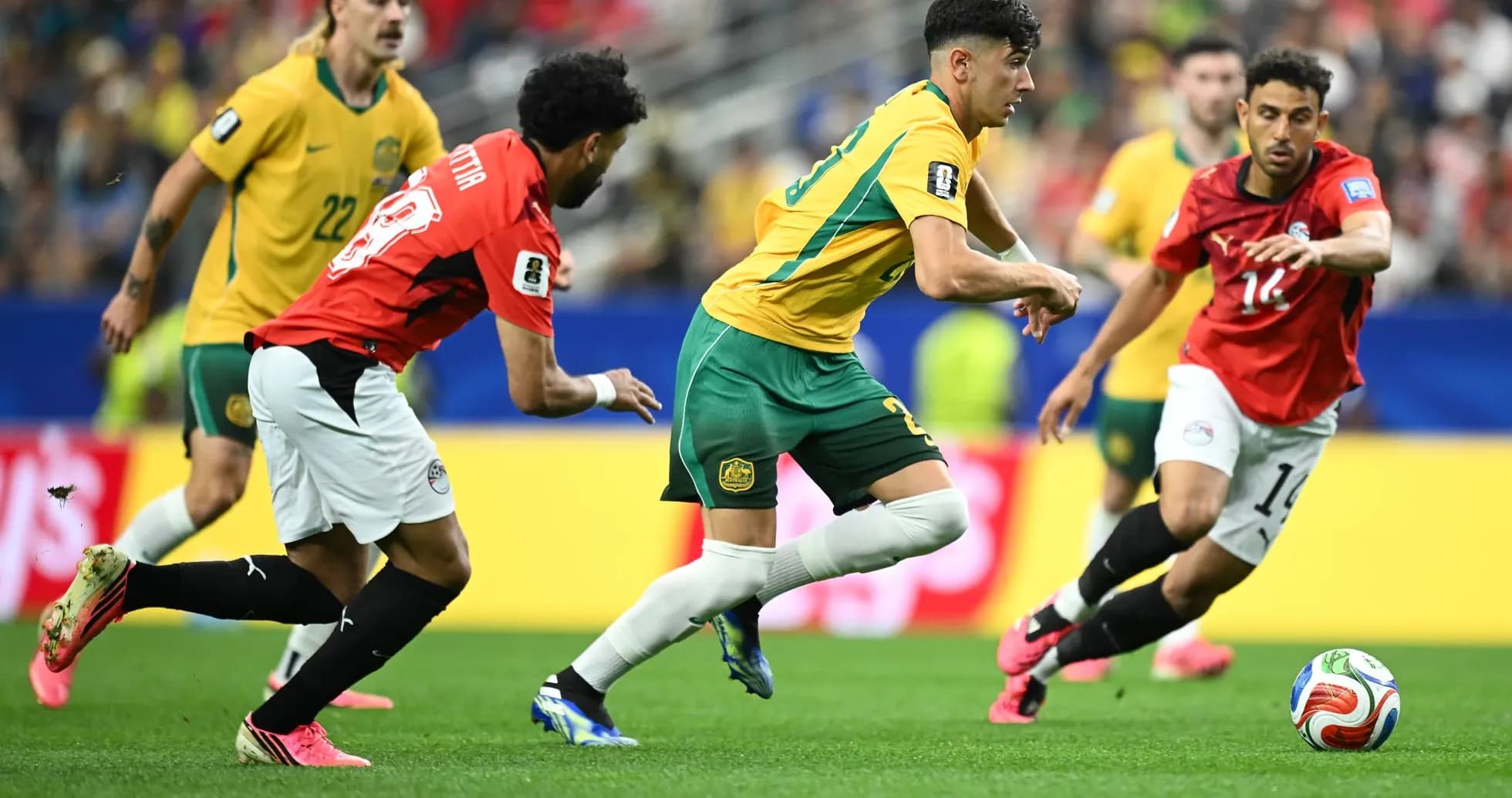
Egypt’s 4-4-2 under Hossam Hassan was built on a more expansive platform. Full-backs Mohamed Hany and Karim Hafez pushed high to create wide overloads, supported by Omar Marmoush from the left and Emam Ashour from the right. Central midfielders Hamdy Fathy and Marwan Attia (before and after his late re-introduction) looked to recycle possession and shift Australia’s block horizontally, patiently waiting for gaps between the lines. The passing differential and Egypt’s superior number of shots on goal (4 to 1) reflected this territorial control.
The opening goal at 13 minutes encapsulated Egypt’s plan. Emam Ashour drifted into an advanced right-sided pocket, fed by Karim Hafez, and punished Australia’s back line with a “Normal Goal” that arrived after sustained Egyptian pressure. The move underlined how Egypt’s wide players were able to receive in advanced positions, forcing Australia’s wing-backs deep and isolating the Australian forwards from their midfield.
Australia’s equaliser at 55 minutes came from a very different tactical dynamic: an own goal by Mohamed Hany under Australian pressure. With Australia having pushed their wing-backs and attacking midfielders higher after the break, the Socceroos managed to ask more questions of Egypt’s back four, even without a surge in shot accuracy. The own goal reflected the increased stress on Egypt’s defensive line rather than a crafted chance from open play, aligning with Australia’s modest 0.87 xG despite 16 attempts and 10 shots inside the box. Many of those efforts were heavily contested — the 9 blocked shots figure is telling, showing Egypt’s back line and midfield closing down shooting lanes aggressively.
In goal, Patrick Beach (Australia) started and was later replaced, with the team’s statistics crediting 3 goalkeeper saves overall. Mostafa Shobeir (Egypt) recorded 1 save from Australia’s solitary shot on target. That distribution is consistent with the pattern of the match: Egypt created more clear sights of goal but also saw several efforts diverted or misdirected before testing the keeper, while Australia’s attacking play was more volume-based but rarely clean.
The substitution patterns reveal how both coaches tried to tilt the tactical balance. At 46', Kai Trewin (IN) came on for Jordan Bos (OUT) for Australia, a move that shifted the defensive profile on the flank and suggested a desire for greater defensive solidity or aerial presence against Egypt’s wide deliveries. Later, at 74', Mohamed Touré (IN) replaced Nestory Irankunda (OUT), and Ajdin Hrustić (IN) came on for Cristian Volpato (OUT), freshening the attacking midfield band in an attempt to carry the ball more effectively through Egypt’s press and offer different profiles between the lines.
For Egypt, the double change at 67' — Hossam Abdelmaguid (IN) for Hamdy Fathy (OUT) and Haissem Hassan (IN) for Mostafa Ziko (OUT) — subtly rebalanced the side. Egypt looked to maintain their central control while injecting new energy and movement up front. Later, Mahmoud Trézéguét (IN) for Karim Hafez (OUT) at 80' added a more direct wide threat, with the full-back line adjusting accordingly, while Hamza Abdelkarim (IN) for Omar Marmoush (OUT) at 106' and Mahmoud Saber (IN) for Marwan Attia (OUT) at 120' were clearly aimed at sustaining pressing intensity and adding reliable penalty-takers or fresh legs for the closing stages.
Australia’s late changes — Awer Mabil (IN) for Connor Metcalfe (OUT) and Paul Okon-Engstler (IN) for Aiden O’Neill (OUT) at 91', followed by Mathew Ryan (IN) for Patrick Beach (OUT) at 119' — were particularly telling. The 119' goalkeeper switch pointed directly to the looming penalty shootout, with Popovic trusting Ryan’s experience and penalty reputation. In open play, however, the numbers suggest Australia never fully solved the problem of turning possession phases into high-quality chances: just 1 shot on goal from 16 attempts, despite reaching the box 10 times, indicates that Egypt’s defensive structure consistently forced rushed or blocked efforts.
Discipline also played a tactical role. Egypt committed 14 fouls to Australia’s 12, and received both yellow cards in the match. At 105', Haissem Hassan (Egypt) was booked — “Foul” — reflecting the increased physicality as legs tired in extra time and Australia tried to break in transition. At 120', Yasser Ibrahim (Egypt) also saw yellow for “Foul”, another sign of Egypt’s defenders stepping in aggressively to prevent late Australian surges. That Egypt could maintain their defensive line’s composure despite these interventions was crucial; the fouls broke rhythm without spiralling into chaotic defending.
Statistically, Egypt’s 7 corners to Australia’s 4 further underline their territorial advantage, repeatedly pinning Australia back and forcing the Socceroos to defend set-piece situations. Yet Australia’s back three, supported by wing-backs and midfielders dropping deep, largely handled those moments, keeping the score level through 120 minutes despite the xG deficit.
In the end, the match was a clash between a possession-dominant, structurally sound Egypt and an Australia side that relied on compactness, work rate and transitional bursts. The numbers — more possession, better pass completion, higher xG, more shots on goal and more corners for Egypt — show that Egypt’s approach produced the more sustainable attacking platform. Australia’s resilience and organisation carried them to penalties, but the underlying tactical balance always leaned towards Egypt, and the shootout merely confirmed what the data had hinted at throughout the 120 minutes.