Eddie Howe Leaves Newcastle After Transformative Five-Year Tenure
Eddie Howe’s Newcastle reign is over. Almost five years after walking into a relegation fight and a club under new ownership, he leaves St James’ Park with a trophy, Champions League nights and a reshaped identity in his wake.
This is not a sacking. It is a manager stepping off the treadmill by choice, at a moment when the club itself is pivoting towards a different future.
From relegation fear to the top four
When Howe arrived in November 2021, Newcastle were sinking. Steve Bruce had gone, the Saudi-led takeover was still raw, and the team sat in the bottom three, five points adrift of safety. The mood on Tyneside was anxious, hopeful, and deeply uncertain.
Howe changed that quickly.
Newcastle climbed out of danger with something approaching a surge, not a scramble. The football grew braver, the press more aggressive, the atmosphere inside St James’ Park louder and more united. By the end of that 2021/22 campaign, they were not fighting for survival but finishing 11th, miles clear of the drop that had once seemed inevitable.
The following season removed any doubt about the direction of travel. In Howe’s first full year, Newcastle finished fourth in 2022/23, barging their way back into the UEFA Champions League after a 20-year absence. What had been a rescue mission became a revival.
A long-awaited trophy and European milestones
For all the noise around the ownership, it was Howe who delivered something no Newcastle manager had managed in more than half a century: silverware.
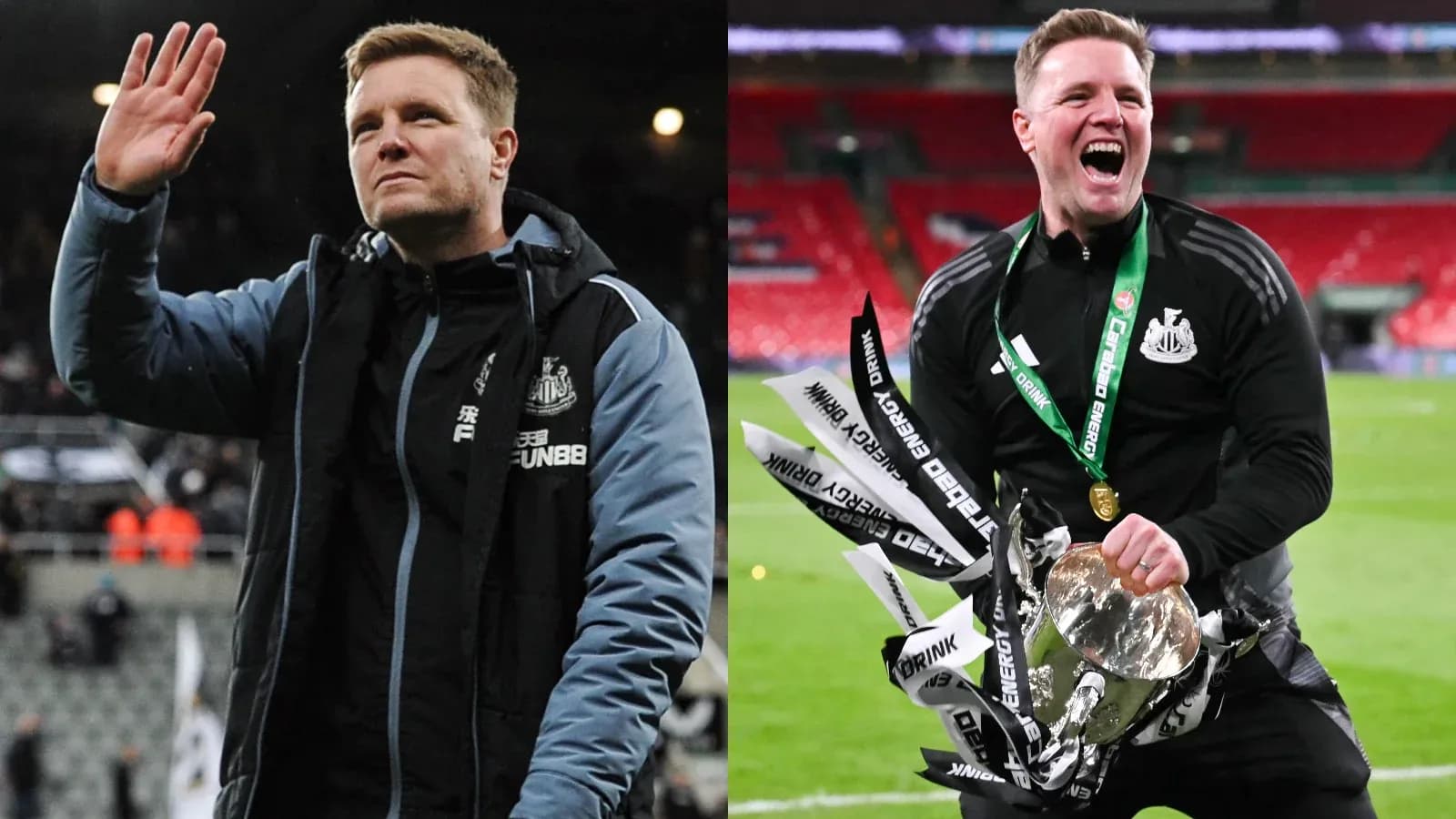
The 2-1 win over Liverpool in the 2025 EFL Cup final ended a 56-year wait for a major trophy. That afternoon will sit in the club’s modern folklore – a new generation’s reference point, the day the drought finally broke.
Europe followed. Under Howe, Newcastle qualified for the Champions League twice. The first return, in 2023, ended two decades in the wilderness of Europe’s elite competition. The second campaign went one step further: the club reached the round of 16 for the first time in their history, a landmark that underlined how far they had travelled from those anxious days in the bottom three.
The numbers back up the feeling. Howe departs with more Premier League wins than any Newcastle manager in the competition’s history: 84 victories from 179 games. His win percentage, 46.9 per cent, is second only to Kevin Keegan’s 51.2 per cent among the club’s Premier League-era managers, and he edges Keegan and Sir Bobby Robson in total league wins.
For a club that has seen eras defined by Keegan’s “Entertainers” and Robson’s European charges, Howe has carved out his own chapter.
Why Howe walked away
The timing, on the surface, feels jarring. Newcastle are not in crisis. They are not drifting. Yet Howe’s explanation is blunt and personal.
“After a period of personal reflection, I have decided that now is the right time for me to step away from my role as head coach of Newcastle United,” he said, stressing the toll of “nearly five years of giving my life, heart and soul into the club with unrelenting energy” and the need to “step away, recharge and take a break”.
He framed the decision as one made, as ever, in the club’s interests as well as his own. “I have always put the best interests of Newcastle before my own in every single decision I have made whilst I’ve been here and this one is no different. It has been the privilege of my lifetime to have been the manager of Newcastle United.”
This is not just about one man’s fatigue, though. Newcastle are undergoing a broader reset.
Anthony Gordon has gone to Barcelona. Sandro Tonali has joined Tottenham Hotspur. Two of the side’s most prominent figures in recent seasons have been moved on, and the recruitment strategy has shifted sharply towards youth.
- Bazoumana Toure has arrived from Hoffenheim
- Sean Steur from Ajax
- Ewen Jaouen from Reims
- Alhadji Bamba from Monaco
Four signings, average age 19.5. Raw talent, not finished products.
With that kind of squad refresh, a change in the dugout feels less like a shock and more like a calculated new phase.
A new era loading
Newcastle’s statement was respectful and brisk. “The club has accepted Eddie’s decision and would like to thank him for his extraordinary contribution,” it read. The search for a successor, they added, is “at an advanced stage”.
All roads appear to lead to Matthias Jaissle.
The 38-year-old German has been winning on a different continent, lifting back-to-back AFC Champions League titles with Al-Ahli, where Ivan Toney and Edouard Mendy are among his players. Before that, he followed the familiar Red Bull pathway, guiding Red Bull Salzburg to consecutive Austrian Bundesliga titles and the Austrian Cup after starting out with their feeder side, FC Liefering.
In Saudi Arabia he also worked with Riyad Mahrez and Allan Saint-Maximin, the latter still adored on Tyneside. Jaissle is young, tactically modern, and used to operating inside multi-club, data-driven structures. He fits the profile of a project coach, one comfortable moulding emerging players rather than simply managing stars.
The club are not yet naming him, but the direction is clear.
Howe’s last act and what lies ahead
Howe’s final game in charge came not under the floodlights of a European night or in a domestic final, but in a pre-season friendly: a 4-1 defeat away to Bristol City on 29 July. On paper, it is an oddly low-key full stop for a manager who has dragged Newcastle back into the spotlight.
The schedule does not pause for reflection. Four more friendlies follow before the Premier League begins: Valencia away on 8 August, Everton at a neutral venue on 12 August, then Bayer Leverkusen and Strasbourg at St James’ Park on 15 and 16 August.
The league campaign starts on Sunday 23 August, with five fixtures to navigate before the first international break of the 2026/27 season. Whoever steps into Howe’s shoes will barely have time to learn the training-ground routines before the scrutiny begins.
Newcastle now stand at a familiar crossroads for ambitious clubs: a successful era, but not yet a completed one; a squad being rebuilt with teenagers; expectations reset by Champions League nights and a long-awaited trophy. Howe has delivered them to this point. The question is simple and unforgiving.
Can the next man take them further, or will this be remembered as the peak of the project?