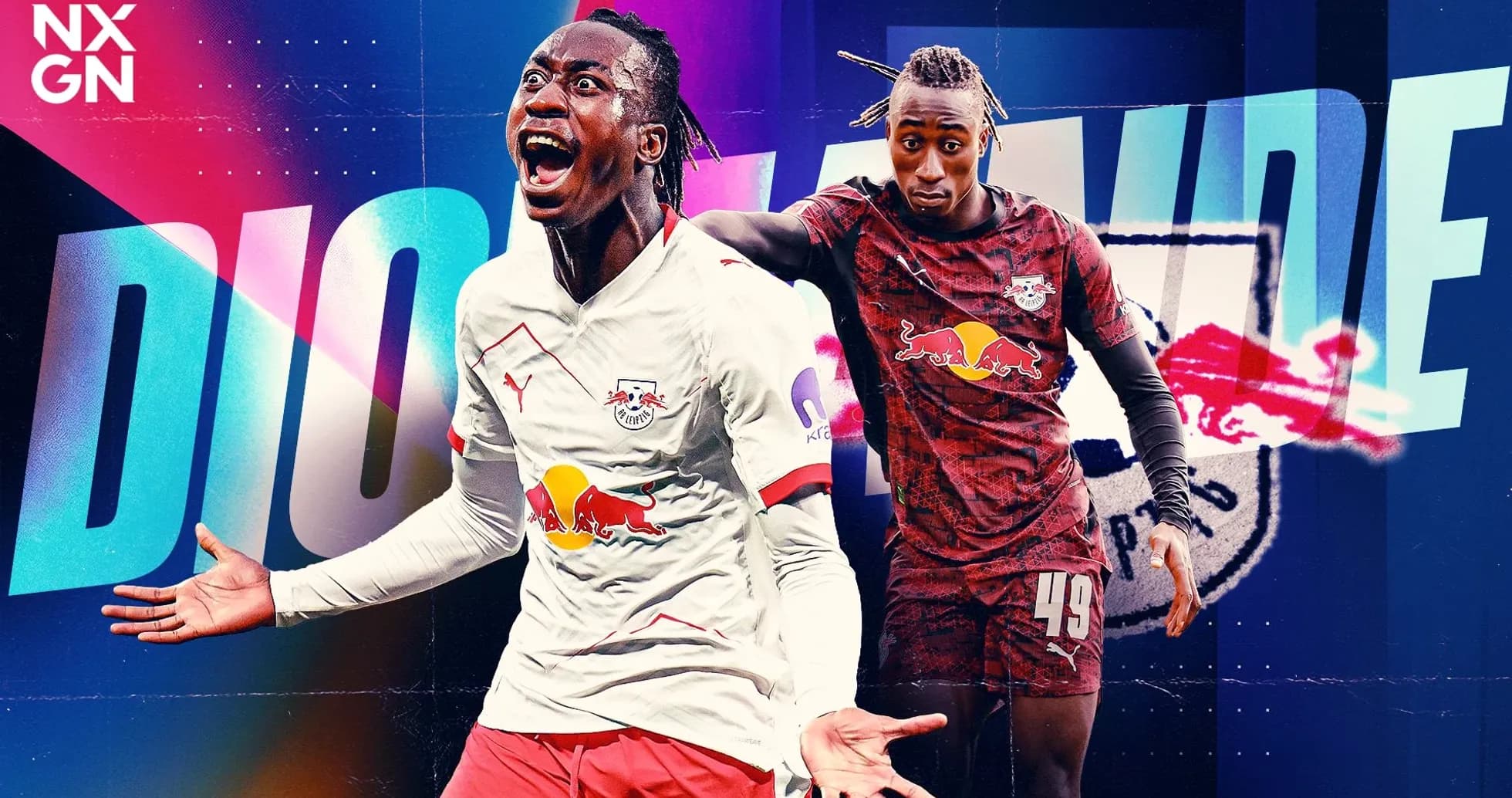
Diomande: The Vertical Threat Transforming Madrid's Attack
Diomande is not Vinicius. That’s the first thing Marca underlined, and it matters. He isn’t the touchline showman who toys with defenders or knits attacks together between the lines.
He’s something else entirely.
He’s vertical. Violent in his running. A straight-line threat who rips games open.
At the last World Cup he was clocked at 34.7 km/h – quick enough to terrify most full-backs, even if it still sits just behind Kylian Mbappé’s 37.6 km/h. When he goes, he goes. There’s no half-pace, no hesitation.
The numbers from the Bundesliga tell the same story. Diomande completed 118 successful dribbles from 213 attempts last season, almost double the tally of the league’s next-best dribbler, Michael Olise (65 from 149). That’s not a stylistic flourish. That’s volume. Relentless, repeatable, game after game.
Two Wings, Two Faces
What truly separates Diomande from a winger like Vinicius is not just his speed or his dribbling, but his versatility. Naturally a right-sided player, he handled both flanks for Leipzig last season, though the distribution of minutes shows where he really lived: 1,591 minutes on the right, just 478 on the left.
Marca broke down his performances on each side, and the split is striking.
On the right, Diomande plays like an old-school wide man. He receives to feet, wide and high, almost glued to the touchline. The first instinct is not chaos; it’s control. He takes the ball, draws his marker in, weighs up the scene. If he doesn’t like what he sees, he resets and goes again.
On his natural side he hunts for space down the line, hits the byline, then pulls the ball back. He doesn’t rely on intricate feints. He leans on raw attributes – strength, power, a sudden change of pace – to break through.
What he doesn’t have on that side is the natural, slicing diagonal run of a left-footer like Olise. His left foot is still more tool than weapon. It produced several goals last season, often when he shifted the ball onto it at the edge of the box at the last instant, but it’s not his primary blade. He tends to use it on those long, snaking runs where he simply outstrips opponents.
That’s where his most fearsome quality emerges. Even without fully mastering the classic winger’s move inside, he’s built an “escape route” against deep, packed defences that block his path outside. He drags defenders across with him, then punishes the weak side with a cross or a switch. If you close one door, he sprints through another.
The data backs up the eye test. On the right wing, per 90 minutes, Diomande:
- Attempts more dribbles (4.41 vs 3.23 on the left)
- Delivers more crosses (0.91 vs 0.67)
- Plays more passes into the box (2.21 vs 1.48)
- Takes more shots (1.7 vs 1.48)
- Generates higher expected goals (0.21 vs 0.16)
He also loses the ball more often (2.21 vs 1.48), the natural cost of constant risk.
Shift him to the left, though, and the entire personality of his game changes.
The Left-Sided Agent of Chaos
On the left, with his weaker foot, Diomande looks bolder. Freer. Less bound to the touchline and more willing to tear into central spaces.
He still starts wide, but not as frequently, and the heat of his game moves closer to goal. He records more touches inside the opposition box on the left – 7.8 per 90 compared to 6.51 on the right – a small numerical difference that signals a big positional shift.
He no longer obsesses over winning the flank or bulldozing past his full-back. His right foot becomes the dominant weapon: he cuts inside to shoot or to cross, and that inside lane unlocks his confidence. You see it in his body language. He drives at defenders, backs his dribbling, and commits to the direct route.
Two metrics jump out. On the left, his:
- Expected goals rise from 0.84 to 1.17
- Expected assists climb from 0.21 to 0.43
The right flank turns him into a machine of repeated actions – beating men, crossing, forcing situations. The left turns him into a high-impact attacker, someone who doesn’t just create chances but injects disorder. He doesn’t just stretch games; he distorts them.
Even with his limited minutes on that side, a recurring pattern appears. Diomande thrives in empty spaces away from the ball. What started as a necessity – operating on his weaker foot – has become an advantage. He sneaks into tight pockets with his back to goal, draws contact or pressure, then solves it with a quick lay-off, a one-two, and a ruthless sprint into the gap behind.
Give him space and a running start, and he becomes almost impossible to stop.
Relentless Without the Ball
Wherever he starts – right or left – one part of his game barely shifts: his defensive work.
Energy defines him. Once the ball is lost, his pressing is sharp and effective, not just cosmetic. He doesn’t just close angles; he wins things back.
Across the Bundesliga last season, among forwards with at least 1,000 minutes, Diomande led the pack for ball recoveries with 148. He ranked second in pass interceptions (16) and fourth in successful tackles (19). Those are not winger numbers. Those are all-action forward numbers.
At set pieces he keeps it simple, holding his position and waiting. The moment the ball is recovered, though, he explodes into life.
On the counter, he often occupies more central zones, and that’s where his dribbling becomes lethal. He thrives when he can run into the space behind a broken defensive line, especially when he starts his move off the ball and arrives with maximum speed.
It’s a profile that feels familiar at the Bernabéu. Counterattacks were the lifeblood of José Mourinho’s first Real Madrid, with Cristiano Ronaldo and Ángel Di María tearing into open grass for fun. Diomande carries the tools to attack those same corridors of space, to hit those same brutal transitions that once defined a Madrid era.
The only real question is simple, and it will shape how he’s used at the highest level: will he carve teams open from the right, or embrace the chaos and cut inside from the left?