Cristiano Ronaldo: A Legend's Last World Cup
Cristiano Ronaldo sat down, looked the room in the eye and stripped away the illusion.
"I am not the player I used to be."
No dodging, no rehearsed deflection. Just a 41-year-old great, seven months from turning 42, walking straight into the storm on the eve of Portugal’s World Cup last-16 tie with Spain in Texas.
This is his last World Cup. He confirmed it again. The end is no longer a theory or a distant horizon; it is a date circled in red. Yet even here, in the twilight, the noise around him feels as loud as it did two decades ago.
"You have been trying to kill me for the past 23 years," he told the media on Sunday. "But you must have seen that is not worth it, it's a waste of time, but you try and try and try and try and try.
"As I said before, [I will stop] when I choose, not when you choose. You always ask the same question.
"This will be my last World Cup, but let's hope tomorrow isn't my last game."
A legend under the microscope
Ronaldo has split opinion at this tournament like never before. Three goals on the board, yet long spells where he drifts to the fringes of the contest. Captain, leader, symbol of a generation – but no longer untouchable.
Seven World Cups in, his aura has changed. The all-time leading scorer in international football with 146 goals is still the face of Portuguese football, the man who dragged the national team into a new era and transformed its mentality. Still, the calls are growing: step back, accept a smaller role, let the next wave breathe.
"He doesn't play to win, he plays to be the main figure," said Antonio Simoes, a member of the Portugal side that finished third in 1966. "Do you understand that it's the opposite of Eusebio? Let's call things by their name."
The criticism has grown sharper since he turned 40. Ronaldo, though, leaned into it.
"I am not going to be more Cristiano Ronaldo or less because I win the World Cup," he said. "I even say thanks for the attacks I feel after I turned 40... the criticism is how you grow, so thank you for doing this.
"Whatever happens tomorrow, Cristiano Ronaldo will leave with a clear conscience – not 100% but 1,000% because in life and football I gave everything."
He walked out of the press room to applause. Not sympathy. Respect.
Croatia scare, Ramos rescue
This World Cup has already come close to writing his final line.
Against Croatia in Toronto in the last 32, his 232nd cap looked in danger of becoming his last when Ivan Perisic struck in the 53rd minute. Portugal were flat, Croatia ruthless, and the narrative felt ready-made: one of the game’s greats bowing out in silence.
Ronaldo refused it. He levelled from the penalty spot – his first ever goal in a World Cup knockout match – and dragged Portugal back from the brink. Then came the moment that cut to the heart of the current debate.
Roberto Martinez took him off.
Ronaldo did not hide his displeasure as he walked to the touchline. Shoulders tight. Expression fixed. Yet the decision paid off. Goncalo Ramos, the man many see as his natural heir, stepped in and settled a chaotic finish with the decisive goal that sent Portugal through.
One kick, one name, and a new question: should Ramos now start against Spain? Or does Ronaldo’s legacy still command the first place on the teamsheet?
Martinez has nailed his colours to the mast so far.
"His leadership and that work in the final third is still one of the best in the world," the Portugal head coach said when asked why he keeps starting him.
Since taking over in 2023, Martinez has used Ronaldo in 36 of Portugal’s 44 games. When Ronaldo has been missing, the team have sometimes looked freer, looser. The numbers are hard to ignore: a 9-0 demolition of Luxembourg in Faro, a 9-1 thrashing of Armenia in Porto – both without their captain.
Each time, the same debate roared back: are Portugal better without him?
The numbers behind the myth
On the surface, Ronaldo’s tournament reads well enough: three goals, Portugal’s top scorer. Dig a little deeper and the picture changes.
He has taken 15 shots – almost double any of his team-mates – yet has not created a single chance. No other player at this World Cup has shot that often without fashioning an opportunity for someone else.
His involvement has shrunk. In three of Portugal’s four matches, he has had fewer than 25 touches – the lowest tallies of his World Cup career. He is averaging fewer touches per match than at any of his previous tournaments.
Against Croatia, his only touch in the opposition box was the winning penalty.
His movement tells its own story. He is making just 4.4 runs in behind the defence per match, well down on the previous two World Cups when he operated in a similar lone-striker role. The explosive, relentless runner of old has become a penalty-box specialist, living off moments rather than 90-minute dominance.
And yet he keeps scoring. He has now found the net at all six World Cups he has played in.
The journey is a map of modern football history: a penalty against Iran in 2006, a strike against North Korea in Cape Town in 2010, a lone goal versus Ghana in Brasilia in 2014. The hat-trick against Spain in Sochi in 2018, followed by the winner against Morocco in Moscow. A penalty against Ghana in Qatar in 2022.
This time, two goals in a 5-0 win over Uzbekistan in Houston on 23 June, then the pressure penalty against Croatia in Toronto.
The numbers say he is fading. The record books insist he is still writing chapters.
A country that still belongs to him
Step outside the spreadsheets and the picture changes again.
For many Portugal fans, the argument is simple: he has earned the right to decide his own ending.
"I feel he should dictate whether he wants to stay on or not," supporter Angelo said before the Croatia match. "What he has done for Portugal as a nation, he should dictate that 100%."
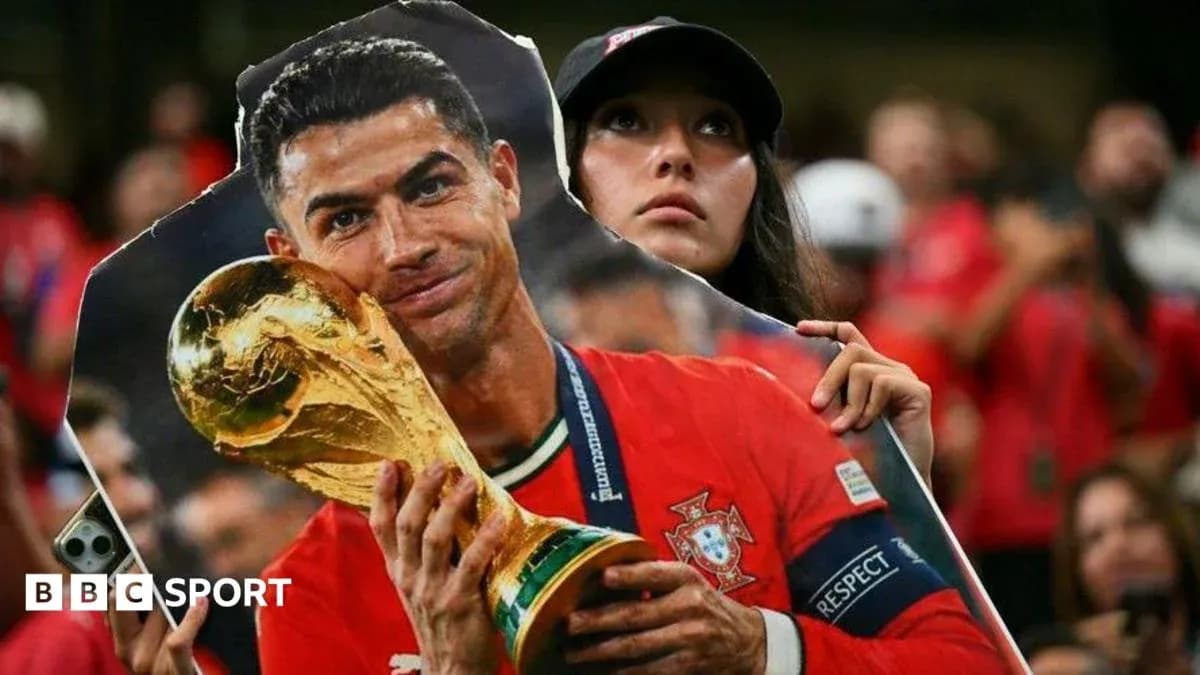
The devotion is everywhere. In Toronto, it was harder to spot a Portugal shirt without his name on the back than with it. Ronaldo-mania, far from fading, has surged again in what is supposed to be his farewell.
Before the Croatia game, excitement spilled onto the streets. Fans clogged a major highway in the Canadian city just to glimpse the team bus, hoping for a momentary view of the man from Madeira.
My taxi driver from the airport claimed not to be a football fan. He still knew Ronaldo was in town.
"The local TV and radio have been going nuts about him for days," he said. "He must be special."
One local fan said she had spent an entire month’s wages on a ticket just to see him live at a World Cup, to say she had been in the same stadium as one of the greats.
Among the Portugal support, the emotion runs deeper than goals and assists.
"On the world stage we didn't really have anyone after Eusebio," said Joao. "Ronaldo came in and made us dream."
Lucilia put it even more starkly: "People talk about Portugal because of him. He doesn't forget where he's from, he remembers the people. I love him. Ronaldo means more to Portugal than any politician."
Diana, another fan, is already steeling herself for the inevitable announcement of his international retirement.
"Of course I'm going to be sad," she said. "The whole world will be sad because it doesn't matter who you support. Ronaldo has had a wonderful career and been an exemplary player.
"I would say to him: 'Well done, Cristiano. Enjoy your retirement. You deserve it after entertaining the world.'
Spain, Texas, and the final act?
So here he stands, between legacy and logic.
On one side: age, data, and the evidence of the eyes. On the other: history, aura, and the belief of a nation that this man, more than any other, made them dream.
Will Martinez stick with the icon who has defined an era? Or turn fully to Ramos, the young striker who seized his moment against Croatia?
Global icon. National treasure. Lightning rod for every argument about when greatness should step aside.
Ronaldo says he will stop when he chooses. Spain on Monday night might tell him whether football agrees.