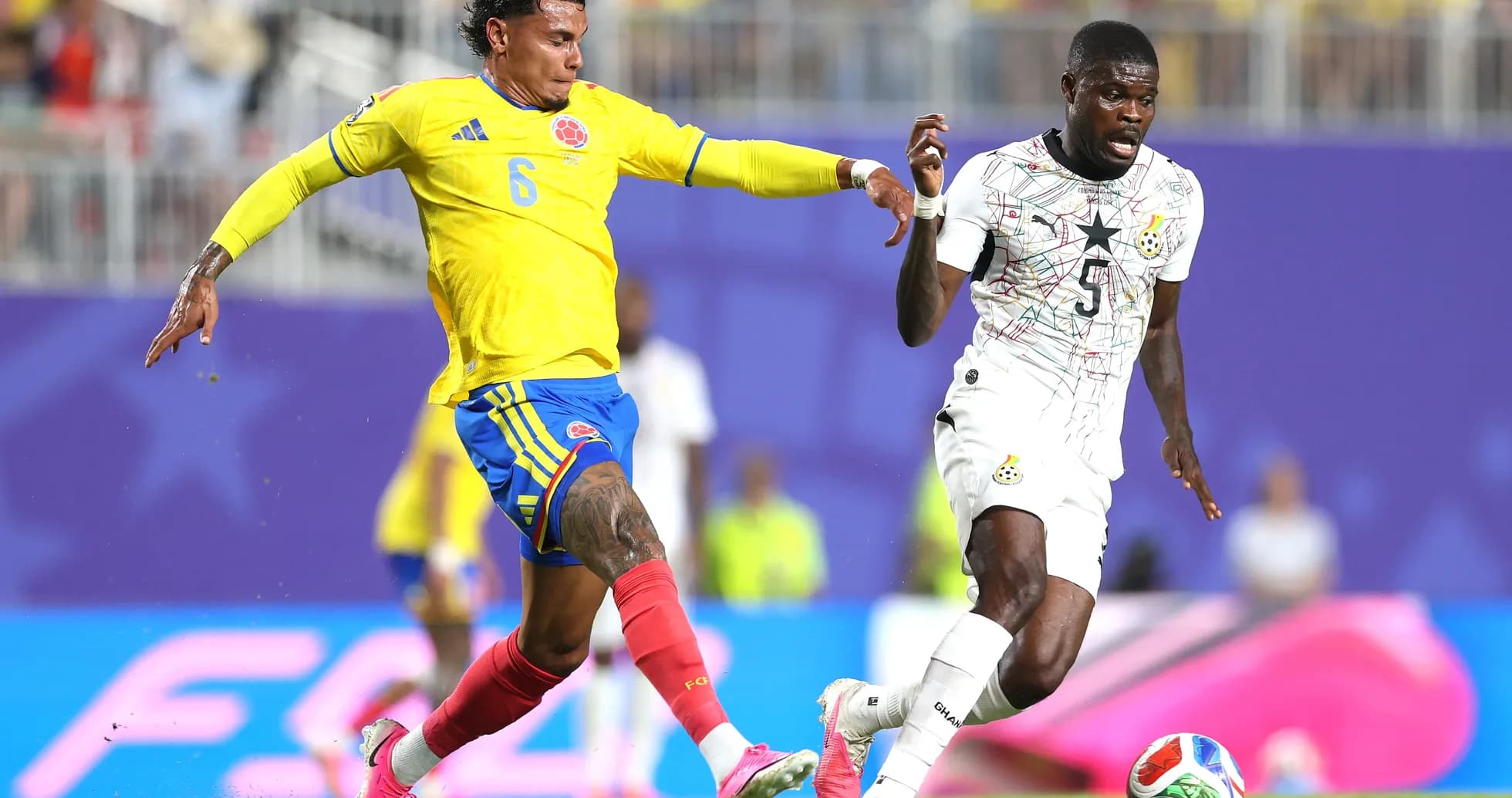
Colombia Defeats Ghana 1-0 in World Cup Round of 32 Clash
Arrowhead Stadium in Kansas City staged a World Cup Round of 32 tie that felt like a clash of footballing philosophies as much as a knockout match. Colombia, who had topped Group K with authority, arrived as a side defined by control and clean sheets. Ghana, third in Group L, came as survivors—battle-tested, compact, and still searching for a consistent attacking rhythm. Over 90 minutes, Colombia’s 1-0 victory confirmed the trends suggested by the numbers: a team that bends games to its tempo against one still trying to unlock its own.
Colombia's Season Overview
Heading into this game, Colombia’s seasonal DNA was clear. Overall, they had played 4 matches, winning 3 and drawing 1, with no defeats. They had scored 5 goals in total and conceded just 1, giving them a goal difference of +4. At home, they had played 3 times with 2 wins and 1 draw, scoring 2 and conceding 0; on their travels, they had played once, scoring 3 and conceding 1. The pattern was unmistakable: a side that could be patient and low-scoring at home, then more expansive away, but always defensively sound.
Ghana's Path
Ghana’s path was rougher. Overall, they had played 4 matches, winning 1, drawing 1, and losing 2. They had scored 2 goals in total and conceded 3, for a goal difference of −1. At home, they had 1 win from 1, scoring 1 and conceding 0, but on their travels they had played 3 times, scoring just 1 and conceding 3. Their away average of 0.3 goals for and 1.0 goals against underlined the challenge of facing a Colombian side that, overall, conceded only 0.3 goals per game.
Tactical Lineups
Nestor Lorenzo’s Colombia lined up in their familiar 4-3-3, a shape they had used in all 4 matches. The back four of D. Munoz, D. Sanchez, J. Lucumi, and J. Mojica in front of C. Vargas embodied the defensive solidity that had already produced 3 clean sheets in total this campaign, all of them at home. In midfield, G. Puerta, J. Lerma, and J. Arias formed a triangle built for both pressing and progression, while the front three of J. Rodriguez, J. Cordoba, and L. Diaz gave Colombia a blend of creativity, penalty-box presence, and direct dribbling threat.
Carlos Queiroz answered with a 4-1-4-1 for Ghana, a structure he had leaned on in 3 of their 4 matches. L. Ati Zigi anchored the side, protected by a back line of M. Senaya, D. Luckassen, J. Opoku, and G. Mensah. In front of them, T. Partey sat as the single pivot, with an energetic band of four— I. Williams, C. Yirenkyi, K. Sibo, and A. Semenyo—operating behind lone forward J. Ayew. It was a shape designed to compress space centrally and hit in transition, a necessary gamble against a Colombian side comfortable with the ball.
Disciplinary Trends
The tactical voids in this fixture were less about absences and more about discipline and emotional control. There were no reported injuries or suspensions stripping either side of key personnel, but the disciplinary trends hinted at potential fault lines. Colombia’s yellow-card distribution showed a pronounced late-game edge: 33.33% of their yellows came between 0-15 minutes, another 33.33% between 76-90, and 16.67% in the 46-60 window, plus 16.67% in added time from 91-105. That profile suggested a side that starts with intensity and can become stretched or emotional as matches close.
Ghana’s yellow-card pattern, by contrast, built gradually. They picked up 16.67% of their yellows in each of the 16-30, 61-75, 76-90, and 91-105 minute ranges, with a heavier 33.33% between 46-60. The danger zone for them was clearly the early second half, where the combination of fatigue and tactical adjustment had already produced a third of their bookings. Neither side had seen a red card in this tournament, and neither had any penalties to manage—no attempts, no conversions, no misses—removing spot-kicks as a variable from the tactical equation.
Key Matchups
Within that framework, the key matchups crystallised. The “Hunter vs Shield” duel centered on Colombia’s front line against Ghana’s defensive record on their travels. Overall, Colombia averaged 1.3 goals per game, but the split was telling: just 0.7 at home versus 3.0 away. Even in a neutral World Cup setting, that suggested their best attacking performances had come when space opened up. Ghana, away, conceded 1.0 goals per match and scored only 0.3, a ratio that left little margin for error. The 1-0 scoreline at Arrowhead Stadium fit that arithmetic almost too neatly: Colombia needed only a single breakthrough to tilt a game they were structurally built to protect.
In the “Engine Room,” J. Lerma and G. Puerta were tasked with dictating tempo against T. Partey and the industrious C. Yirenkyi. Yirenkyi’s tournament profile for Ghana had already marked him out: 4 appearances, 3 starts, 272 minutes, and a rating of 6.73, with 70 passes completed at an 88% accuracy, 1 key pass, and a willingness to work both ways—2 tackles, 2 blocked shots, and 3 interceptions. His 7 fouls committed and 2 yellow cards painted him as a combative presence, one likely to test the referee’s line in a match where Colombia’s midfielders constantly rotated into pockets between the lines.
Tactically, the intersection of strengths and weaknesses leaned heavily Colombia’s way. They arrived with a defensive unit that, overall, allowed only 0.3 goals per match, supported by a goalkeeper in C. Vargas who had already been protected by 3 clean sheets at home. Ghana’s attack, particularly away, had not yet found a consistent cutting edge, failing to score in 2 of their 3 away fixtures and managing just 2 goals overall this campaign.
Conclusion
Following this result, the numbers and the narrative aligned. Colombia’s narrow 1-0 win in the Round of 32 was not an accident of a single moment, but the natural extension of a team built on structure, clean sheets, and just enough attacking incision. Ghana, organised and resilient, were again undone by their inability to turn effort into goals on their travels.
In statistical prognosis terms, Colombia’s defensive solidity and balanced scoring profile make them a credible threat deeper into the tournament. Ghana exit with a foundation—particularly in players like C. Yirenkyi and the spine in front of L. Ati Zigi—but also with a clear mandate: if they are to return to this stage and progress, their away attacking output must rise to match their competitive spirit.