Canberra United Secured: A-League Women and Future Men’s Team Plans
Canberra United has a future. After two years of uncertainty, the club has been pulled back from the brink and handed to private owners for the first time in its history.
Australian Sports Group (ASG) has bought the licence from Capital Football, securing Canberra’s A-League Women side for the 2026-27 season and laying out a clear, if slightly delayed, path towards an A-League Men team in 2028-29.
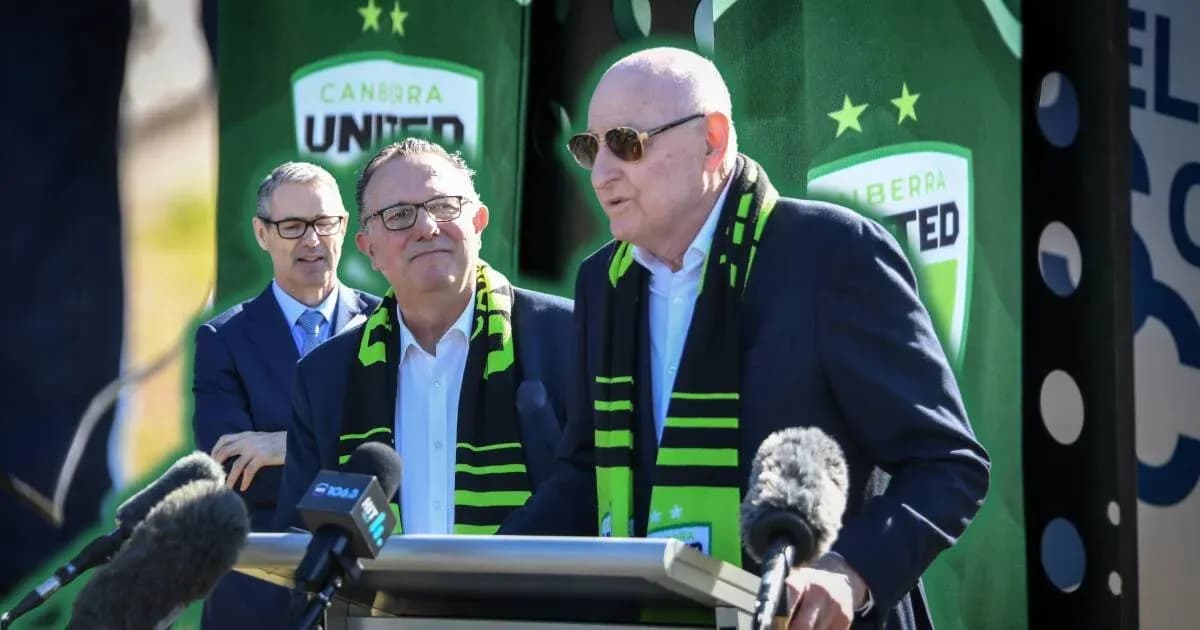
On Friday at McKellar Park, the club’s “spiritual home”, ASG chief executive Theo Fotopoulos and chairman Morris McAlister fronted up to explain what comes next. The message was blunt: United is staying, and it’s growing.
McKellar at the heart of the rebuild
The new regime wants Canberra United anchored where its fanbase already lives. McKellar Park will remain home ground, and the adjoining Belconnen Soccer Club will become a “strategic partner”, with ASG setting up its office there.
The ambition stretches beyond matchdays. ASG is actively exploring a dedicated training base on the McKellar site, a project that would fill the void left when Capital Football and the ACT government’s planned facility at Throsby fell over on cost grounds.
“It’ll come down to what we can get approved in terms of the facility here,” Fotopoulos told The Canberra Times, pointing to McKellar’s rare status as a private ground and its six-hectare footprint. He has already spoken with key stakeholders and believes the prospects are “very positive”.
The intention is clear: build a permanent football home in the capital, not just rent one.
A $15 million play – and a guarantee
Fotopoulos sidestepped the exact price of the licence, but it is understood the total deal sits around $15 million, covering both the women’s team and the option on a future men’s side.
Crucially, ASG has guaranteed to underwrite Canberra United’s A-League Women operations up to $3 million over multiple years. For a club that has lived season-to-season under Capital Football, that level of backing changes the conversation from survival to strategy.
Capital Football, which has run United since its inception in 2008, had simply reached the ceiling of what it could afford. Last season was its last in charge. Without a buyer, Canberra risked losing its ALW presence altogether.
That threat has now gone.
Coaching continuity the priority
On the football side, ASG has moved quickly. The new owners have already held talks with coach Antoni Jagarinec, who has steered United to the finals in each of the last two seasons, and are pushing to lock in the coaching position and playing squad before pre-season starts in six weeks.
“That is our priority to get that finalised,” Fotopoulos said. He confirmed recent meetings with Jagarinec and said the PFA is working with the players, with ASG keen to move “quicker than later”.
Jagarinec’s record gives him a strong hand. “It’s never a no-brainer, but yeah, look, I think [Jagarinec’s] results speak for themselves. We’re looking for continuity and consolidation,” Fotopoulos said, hinting strongly that an announcement is not far away.
The A-League Women draw is due next month, with the season to kick off on October 16. United wants its key decisions made well before then.
Men’s team: option now, deadline set
The men’s side is the other half of ASG’s plan, but it will test Canberra’s patience once more.
ASG currently holds an option, not a full licence, for an A-League Men team, with entry targeted for the 2028-29 season. After 18 years of false starts and failed bids, another three-season wait was always going to raise eyebrows in the capital.
Fotopoulos, though, left no room for doubt about ASG’s intentions.
“Well, we’re here today, so that’s your best guarantee,” he said. “That is part of our twin strategy. When we started speaking to the APL … that was part of our mix. We believe the strength comes from both. It would be almost discriminatory not to work with the men. It’s always been part of our plans.”
ASG has effectively given itself a two-year window to build out the men’s project while bedding down the women’s team under private ownership.
APL chair Steve Conroy backed the move, thanking the ACT government and Canberra’s football community and describing ASG’s arrival as “an exciting next step for professional football in the ACT” and a clear sign of the league’s growth ambitions in the region.
For Canberra bid leader Michael Caggiano, who has driven the men’s push for eight years, ASG’s commitment should finally draw a line under the long, frustrating saga.
United in name – and in identity
One thing will not change: the badge.
Canberra United will remain Canberra United, for both women and men. Fotopoulos was emphatic. With 18 years of history, the brand is staying.
“You’ve got 18 years of Canberra United. Why would you change it?” he said, noting there was no sense the public held a negative view of the club.
What may evolve is the nickname. Fotopoulos wants the city to shape that identity, floating the idea of a public campaign – potentially through The Canberra Times – to find a moniker that fits. The Cosmos, Arrows, Greens, Lakers, Green Machine: nothing is off the table yet.
For now, the kids watching from the McKellar sidelines can still dream of playing for Canberra United. Soon, they might be choosing between the women’s and men’s sides under the same banner.
Pathways and infrastructure back on the agenda
ASG’s plans stretch beyond the first team. Fotopoulos has pledged to rebuild academy pathways after Capital Football controversially axed United’s academy three years ago, leaving a hole in the development ladder for local talent.
He has also talked up broader investment in football infrastructure across the capital, tying it to a vision of “community engagement, football excellence, commercial growth, new infrastructure and strengthening the football development pathways for boys and girls in the territory and the capital region”.
The takeover brings heavyweight business backgrounds into the fold. McAlister, ASG’s chairman, is the governing director of Petron Plus 7 Australian and New Zealand and a senior consultant with MEC Team Consultants, linking Australian companies with Chinese markets. Fotopoulos, a marketing executive and chief executive of FOS Group Australia, has deep roots in the game, having worked with Sydney Cosmos, Newcastle Breakers and Sydney Olympic.
They are not newcomers to football’s sharp end. That experience will now be judged in Canberra.
A long wait finally rewarded
For the A-Leagues, this is the announcement Canberra has been waiting on since the APL named the city a preferred expansion location almost three-and-a-half years ago, alongside Auckland. Auckland has already lifted a championship; Canberra has been left watching, waiting, lobbying.
Now the capital has certainty on one front and a clear runway on another.
The women’s team is secure. A men’s team has a date on the horizon. McKellar Park is set to become more than just a matchday venue. The academy is on its way back. After years of treading water, Canberra’s professional football project finally has a direction.
The question now is not whether Canberra belongs at the top level, but how quickly United can turn that promise into a club that reflects the scale and hunger of the city around it.