Canada vs Morocco: Tactical Preview of the Round of 16 Clash
Under the Houston heat at NRG Stadium, this Round of 16 tie brought together two sides with contrasting World Cup identities. Canada arrived as one of the tournament’s more chaotic stories: in total this campaign they had scored 9 goals and conceded 6 across 5 matches, a goal difference of 3 built on high-scoring home games and a willingness to trade blows. Morocco, by contrast, came in as a methodical machine: in total they had 11 goals for and only 4 against from 5 fixtures, a goal difference of 7 and no defeats on their record.
The lineups underlined those profiles. Jesse Marsch stuck to his 4-4-2 that had been used in all 5 of Canada’s matches, with M. Crepeau behind a back four of A. Johnston, M. Bombito, L. De Fougerolles and R. Laryea. The midfield band of four — T. Buchanan, N. Sigur, S. Eustaquio and A. Ahmed — was tasked with feeding a front two of J. David and T. Oluwaseyi. Across from them, Mohamed Ouahbi’s Morocco deployed their now-familiar 4-2-3-1: Bono in goal, a back line of A. Hakimi, I. Diop, R. Halhal and N. Mazraoui, the double pivot of A. Bouaddi and N. El Aynaoui, and an attacking trio of B. Diaz, A. Ounahi and B. El Khannouss behind lone striker I. Saibari.
Canada’s squad carried a notable tactical void before a ball was kicked. I. Koné was ruled out with a lower-leg fracture, depriving Marsch of a dynamic midfield presence who might have helped them wrestle control against Morocco’s technically secure centre. That absence pushed more creative and defensive responsibility onto S. Eustaquio and the relatively inexperienced N. Sigur, while also increasing the importance of wide ball progression through Buchanan and Ahmed.
Discipline was always going to be a subplot. Heading into this game, Canada had shown a spiky edge: in total this campaign L. De Fougerolles had already collected 2 yellow cards, and C. Larin — starting on the bench here — had also been booked twice. As a team, their yellow cards were spread across the match, but with a pronounced spine in the middle phases: 27.27% of their cautions had arrived between 31–45 minutes, and another 27.27% between 46–60. It is a profile of a side that tends to become more aggressive as the half wears on.
Morocco’s card map was more concentrated and controlled. In total this campaign, their yellows had come exclusively between 16–60 minutes, split evenly at 33.33% across the 16–30, 31–45 and 46–60 ranges. It hints at a team that knows when to break rhythm and commit tactical fouls without descending into chaos. I. Diop, with 2 yellows of his own and 4 shots blocked in the tournament, embodied that blend of ruggedness and composure at the heart of their defence.
The “Hunter vs Shield” duel was stark. For Canada, J. David arrived with 3 goals in total this campaign, 12 shots and 8 on target, the focal point of an attack that at home averaged 2.3 goals for and 1.3 against. His movement between the lines in a front two is designed to drag centre-backs out and open lanes for a partner like T. Oluwaseyi. But Morocco’s shield is elite: in total this campaign they have conceded only 4 goals, with an away average of just 0.5 goals against per match. With Diop’s aerial presence and reading of danger, plus Hakimi and Mazraoui’s recovery pace, Morocco are built to compress space around a central striker and funnel play into wide areas where they can double up.
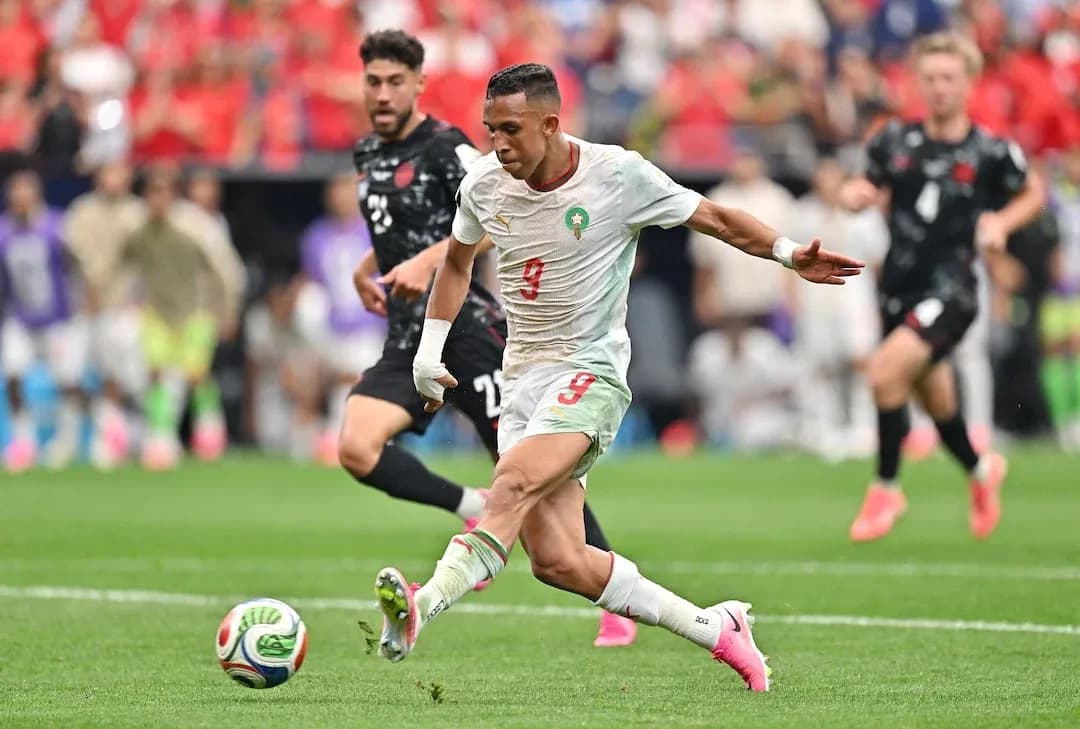
On the other side, Morocco’s own hunter, I. Saibari, also came in with 3 goals in total this campaign. He is less a pure penalty-box striker and more a powerful, line-breaking forward who can drop off and combine. Behind him, the creative burden is shared. B. Diaz, with 4 assists and 8 key passes so far, is one of the tournament’s premier chance creators, while Hakimi has added 2 assists and 15 key passes from right-back, effectively giving Morocco a dual playmaker structure: one between the lines, one from deep and wide.
That sets up the “Engine Room” confrontation. Canada’s midfield axis of Eustaquio and Sigur had to cope with Bouaddi and El Aynaoui’s calm distribution, while also tracking the drifting movements of Ounahi and El Khannouss. Eustaquio’s passing range and A. Ahmed’s energy are crucial if Canada want to transition quickly into the channels for Buchanan and the front two. Yet Morocco’s double pivot is designed to smother exactly that: win second balls, recycle possession, and allow Diaz and Ounahi to receive in advantageous pockets.
In wider zones, Hakimi versus Buchanan is a matchup that shapes the entire tactical story. Hakimi’s 11 tackles, 1 blocked shot and 5 interceptions in total this campaign show that his attacking licence is underpinned by serious defensive work. If he can pin Buchanan back, Canada’s main outlet becomes a pressure point instead of a weapon. On the opposite flank, Mazraoui and El Khannouss can target the spaces behind Laryea, especially when Canada’s full-back steps high to support Ahmed.
Statistically, the prognosis leans toward Morocco’s structure and efficiency. In total this campaign they average 2.2 goals for and only 0.8 against per match, with 2 clean sheets and no defeats. Canada, while brave and enterprising, average 1.8 goals for and 1.2 against, with just 2 clean sheets and 1 match in which they have failed to score. Their openness is both their charm and their vulnerability.
Morocco’s penalty record adds another layer: in total this campaign they have taken 5 spot-kicks, scoring 3 and missing 2. That 40.00% miss rate is a reminder that their dominance does not always translate to ruthless finishing from the spot, but it also underlines how often they get into dangerous areas.
Blend all of this together, and the tactical preview crystallises: Canada will look to turn this into a transition-heavy contest, leveraging David’s runs and Buchanan’s directness, but they do so against one of the tournament’s most balanced sides. Morocco’s compact 4-2-3-1, anchored by Diop at the back and orchestrated by Diaz and Hakimi, is built to absorb those waves and respond with controlled, positionally sound attacks. On paper and in the numbers, the xG and defensive solidity angles both tilt toward Morocco, leaving Canada needing not just courage, but near-perfect execution to bend this tie their way.