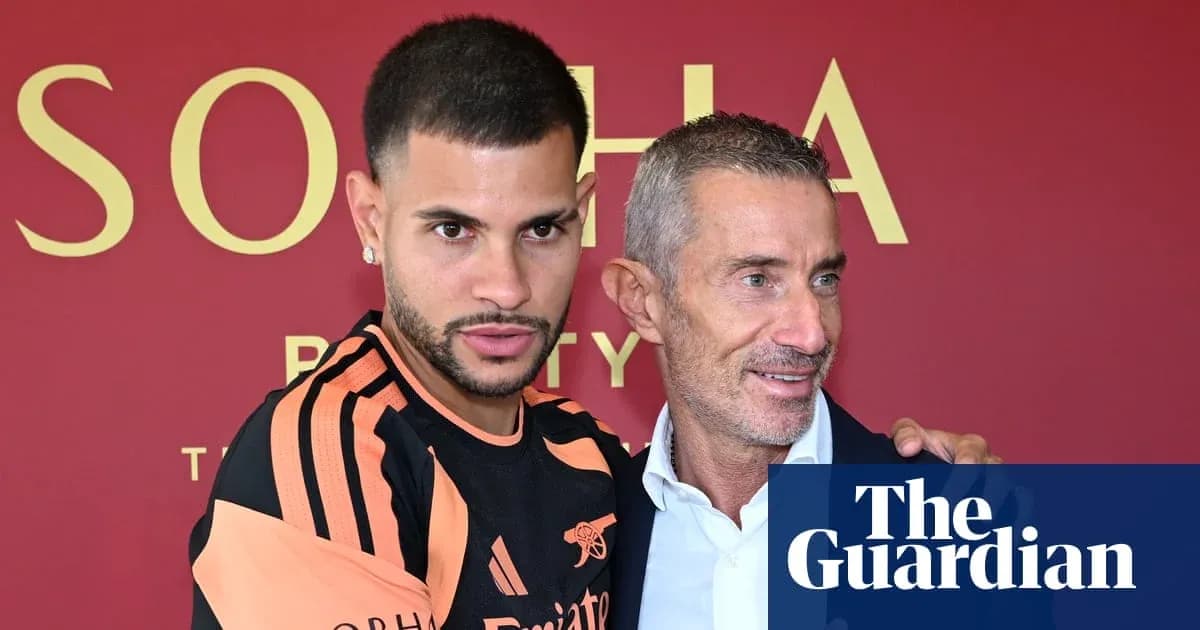
Bruno Guimarães Joins Arsenal: A New Challenge Awaits
Bruno Guimarães has swapped black and white for red and white, and he has done it with a clear message: this is about legacy.
Arsenal have landed the Brazil midfielder from Newcastle in a £75m deal, handing the 29-year-old a four-year contract with an option for a fifth. It is a transfer that has been years in the making and, in the end, too powerful for Newcastle to resist once their captain made his intentions plain.
A move years in the making
Arsenal’s admiration for Guimarães is not new. They looked at him in 2020 when he was still at Athletico Paranaense, then again during his spell at Lyon before Newcastle pounced and took him to the north east. Each time, Arsenal watched him slip away.
This time, they did not.
Fresh from captaining Newcastle to their first trophy since 1955 with last season’s Carabao Cup triumph, Guimarães met Arsenal’s hierarchy this week and pushed the door open himself. After talks with Mikel Arteta and sporting director Andrea Berta, he made it clear to Newcastle that his future, as he saw it, lay in north London with the reigning Premier League champions.
Newcastle’s sporting director Ross Wilson laid bare the club’s position. Guimarães, he said, had behaved “very respectfully” and “very emotionally”, but the message was unambiguous: he wanted to leave and move on. Once that was on the table, Newcastle’s resistance crumbled.
“I need a new challenge in my life”
Guimarães did not dress it up. Speaking to Arsenal’s club channels, he framed the move as a personal and professional turning point.
“Since the first time I spoke to Berta and Mikel, I was excited,” he said. “I just felt inside of me that I need a new challenge in my life and I think to be an Arsenal player is going to be an exciting challenge in my life.
“After playing two World Cups, I’m at the point of my life, I need a challenge like this. I want to win trophies, I want to make history and I think I’m in the right place to do it. I’m so excited to start. We have tough games to play this season, so the squad is going to be very, very important and I’m hopeful we can achieve our dreams.”
It is a revealing choice of words. This is not a player looking for comfort or status. He is walking into a midfield already stacked with pedigree and demanding to be judged alongside it.
Arsenal’s midfield arms race
Arteta’s options in the centre of the pitch now look intimidating. Declan Rice, Martin Ødegaard, Martin Zubimendi, Mikel Merino, Myles Lewis-Skelly – and now Guimarães. It is a core built not just for a title defence, but for a team that expects to go deep in every competition.
“We are further strengthening the heart of our team,” Berta said. “As we have all seen, Bruno can play as a defensive midfielder and as a box-to-box player. He combines quality with quantity, and has provided goals and assists for his team every year.
“Bruno will allow Mikel to further develop our playing style and will also increase our internal competitiveness, which is essential for maintaining the standards required when we are aiming to win major trophies.”
That phrase – internal competitiveness – is the key. Rice, the cornerstone of last season’s title win, has already reached out, sending Guimarães a message that read: “come here and please no more fights, now we’re friends.”
The subtext is obvious: those fierce battles in midfield are now an in-house asset.
Guimarães smiled at the welcome and did not shy away from the scale of the challenge he has walked into. “I was happy he messaged me, but the midfield we have here, in my point of view, is one of the best in Europe,” he said. “Everyone is an amazing player, I’m so excited to start chatting and play, and know the players very, very well, but we have an amazing midfield.”
He is right. On paper, this is a group built to dominate games, to suffocate opponents with possession, and to carry a goal threat from every angle. On the training pitch, it is a daily trial by fire.
Newcastle’s loss, Arsenal’s statement
For Newcastle, the sale cuts deep. Guimarães was not just their captain; he was the symbol of their resurgence, the man who lifted the Carabao Cup and seemed to embody the club’s new ambition. Letting him go underlines the financial and emotional tightrope they must walk in the current landscape.
Wilson’s admission that they “had no option” once Guimarães made his wishes clear speaks to the power of player agency at the top end of the game. When a captain decides his story has another chapter elsewhere, clubs can only negotiate the best possible exit.
For Arsenal, it is another decisive stroke in a project that has moved from hopeful to ruthless. Arteta now has a midfield that can be rotated without a drop in quality, reshaped to suit any opponent, and driven by players who expect to be lifting trophies, not just competing for them.
Guimarães wanted a new challenge. He has walked straight into one: keep his place, shape a dynasty, and prove that leaving a club where he was already a hero was not a gamble, but the next logical step in a career aimed squarely at history.