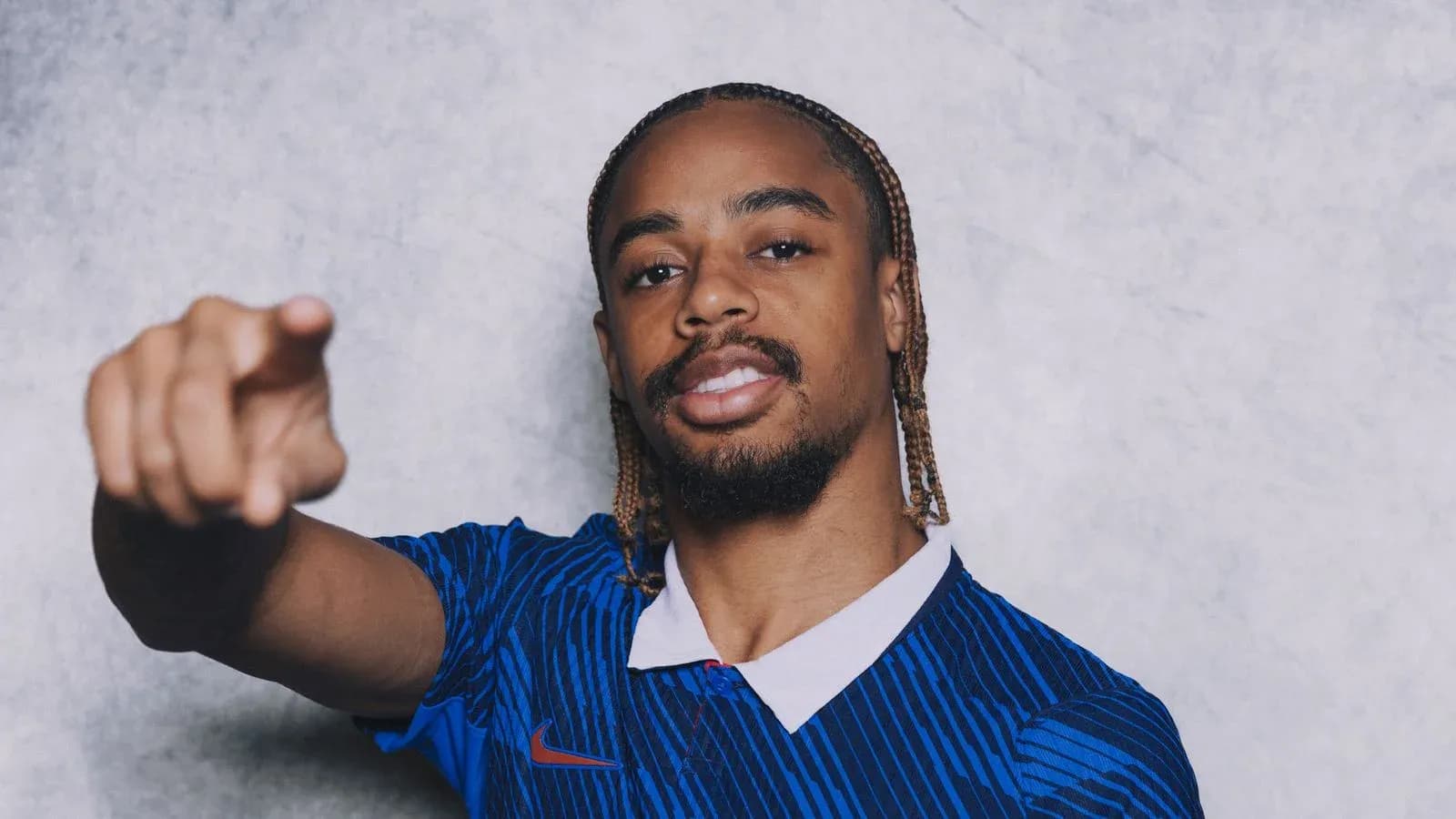
Bradley Barcola: From Fringe Player to Champions League Star
Bradley Barcola is about to discover what a Champions League medal is really worth.
Two, in fact. Back-to-back titles with Paris Saint-Germain at just 23, part of a squad that has finally cracked Europe. Liverpool and Arsenal are circling, the fee is climbing towards the top of this summer’s market, and the obvious question hangs in the air: how has a player who cannot yet nail down a starting spot in Paris become one of the most coveted forwards in Europe?
The answer is not a simple highlight reel. It is a slow burn.
From fringe to focal point
At Lyon, Barcola was not the prodigy who lit up every age group. He was not the boy wonder fast-tracked through the system. He was on the fringes of the first team under Laurent Blanc, waiting, watching, almost leaving.
A loan to Switzerland was on the table. Lyon were ready to let him go because he was not playing. Then Karl Toko Ekambi decided he wanted out. That single choice flipped Barcola’s career.
The club cancelled the proposed loan. Toko Ekambi left. One game later, an injury opened up a spot and Blanc turned to the tall, rangy academy kid who had always been “good” but rarely labelled “special”.
It was, as Jean-Francois Vulliez calls it, a turning point.
Vulliez had known Barcola as a boy in Lyon’s academy. He now works as a development coach at PSG, a man who has seen a conveyor belt of young talent up close. Barcola did not dominate that conveyor belt. He moved along it at a normal pace.
No skipping age groups. No France youth caps. No hype machine.
“He was a normal kid,” Vulliez recalls. The maturation was steady, not spectacular. He was not physically ready to bully defenders, so he had to find other ways to survive. That constraint shaped the player Europe wants to buy now.
Intelligence before muscles
Because he could not overpower opponents, Barcola learned to out-think them. He learned to scan, to see space early, to take in information and use it. The speed was there, but it was the brain that came first.
He became the player who arrives in the right pocket at the right moment, who slips between the lines, who times his run beyond the back four rather than simply running into them. Only later did the body catch up. The frame filled out, the legs added power, and suddenly that intelligence had a new weapon to work with.
“It is a combination,” Vulliez says. Tactical understanding, technical quality, then the physical tools to execute both at full tilt. That blend is what top clubs pay for.
Lyon’s patience paid off quickly once opportunity finally knocked. After Toko Ekambi’s departure, Barcola hit five goals in nine games in early 2023. He then impressed at the European Under-21 Championship that summer. At that point, his future felt inevitable.
“His body was in Lyon but his head was in Paris,” Vulliez admits. The move to PSG dragged, but it always felt like a matter of when, not if.
Shaped by Luis Enrique
Three seasons later, Barcola has 13 trophies and over 150 PSG appearances behind him, with 39 goals to his name. Those are not the numbers of a bit-part squad player. They are the numbers of a young forward learning his trade in an elite environment and still finding room to grow.
Under Luis Enrique, his game has sharpened. He is more careful with the ball, more selective about when to take on a man and when to play the simple pass. The raw winger who once tried to force the game has been refined into a forward who reads it.
Khvicha Kvaratskhelia’s arrival from Napoli in January 2025 has pushed him out of the automatic starting XI on the left. The Georgian is first choice now. Barcola has had to accept the role of impact substitute in both Champions League finals.
That context matters. He is not leaving Paris as a failed starter. He is leaving as a Champions League winner who cannot quite dislodge an established star but has shown enough to convince some of Europe’s sharpest recruitment teams that he can be a star elsewhere.
A winger who thinks like a No 9
Barcola’s starting position at PSG has mostly been on the left. His instincts, though, belong to a striker.
He grew up playing through the middle at Lyon until the age of 17. That education never left him. From the flank, he loves to cut inside and whip shots towards the far corner with his stronger foot. He attacks the box, not the touchline.
Those are the traits modern clubs crave in their wide forwards. It is no longer enough to look electric one-on-one. You need numbers. Goals. Assists. Threat.
Barcola brings that balance. He scores and he creates. His shot volume last season ranked him among the top 10 players in Ligue 1 per 90 minutes, despite starting from wide areas. He does not hug the chalk and disappear from the game. He drives into the heart of it.
“He is very clever with his runs inside,” Vulliez notes. Years spent as a central striker mean he knows when to drift in, when to burst beyond the defensive line, when to arrive late from deep. Put him in a team that understands those movements and he becomes a constant problem.
That is the attraction for clubs like Liverpool and Arsenal, whose systems rely on wide forwards who can both finish and connect play.
Versatility and velocity
There is more. Barcola can switch flanks, operating on the right when required. There, his pace becomes a different kind of weapon, stretching teams to the byline, playing quick one-twos and knock-and-run combinations that turn defenders.
He ranked among the top 10 fastest players in the Champions League last season. In a competition defined by transitions and space, that matters. Give him grass to attack and he devours it.
Coaches like that flexibility. They like the idea that he can start left, drift central, or flip to the right mid-game without losing impact. Vulliez even wonders whether the long-term future might be back where it all started: at centre-forward.
“Maybe the left wing is the better position for him right now,” he says, “but I am curious to see how he develops because I believe he is able to become a No 9.”
For a buying club, that is not just one profile. It is three.
The unfinished part of the package
For all the excitement, Barcola is not the finished article. His finishing can be slack. The composure is not always there. Enrique has pushed him hard to become more clinical, to turn dangerous positions into ruthless outcomes.
History is full of forwards who sharpened that edge in their mid-20s. Barcola has time. What matters is that the mindset is there. Vulliez insists he listens, he adapts, he takes on information. That makes him easier to coach and quicker to improve.
Crucially, the intelligence was in place early. Vulliez is blunt on that point: you do not invent game intelligence after 17. You can polish it, not implant it. With Barcola, the foundation exists. That is why his position can be tweaked, his role adjusted, his responsibilities increased.
He has already improved from the player who arrived in Paris. He is unrecognisable from the teenager who never jumped an age group in Lyon’s academy. “Nobody could have imagined this,” Vulliez concedes.
And yet here he is: a double European champion, a France international at 23, a forward with pace, power and a brain that processes the game at speed, standing on the brink of becoming the most expensive transfer of the summer.
The only real question left for Liverpool, Arsenal and anyone else brave enough to pay the price is not what he is now. It is how much better he is going to get.