Banyana Banyana's Fight Continues After Draw Against Ivory Coast
South Africa left Casablanca with their tournament lives still flickering, not exactly revived, but certainly not extinguished.
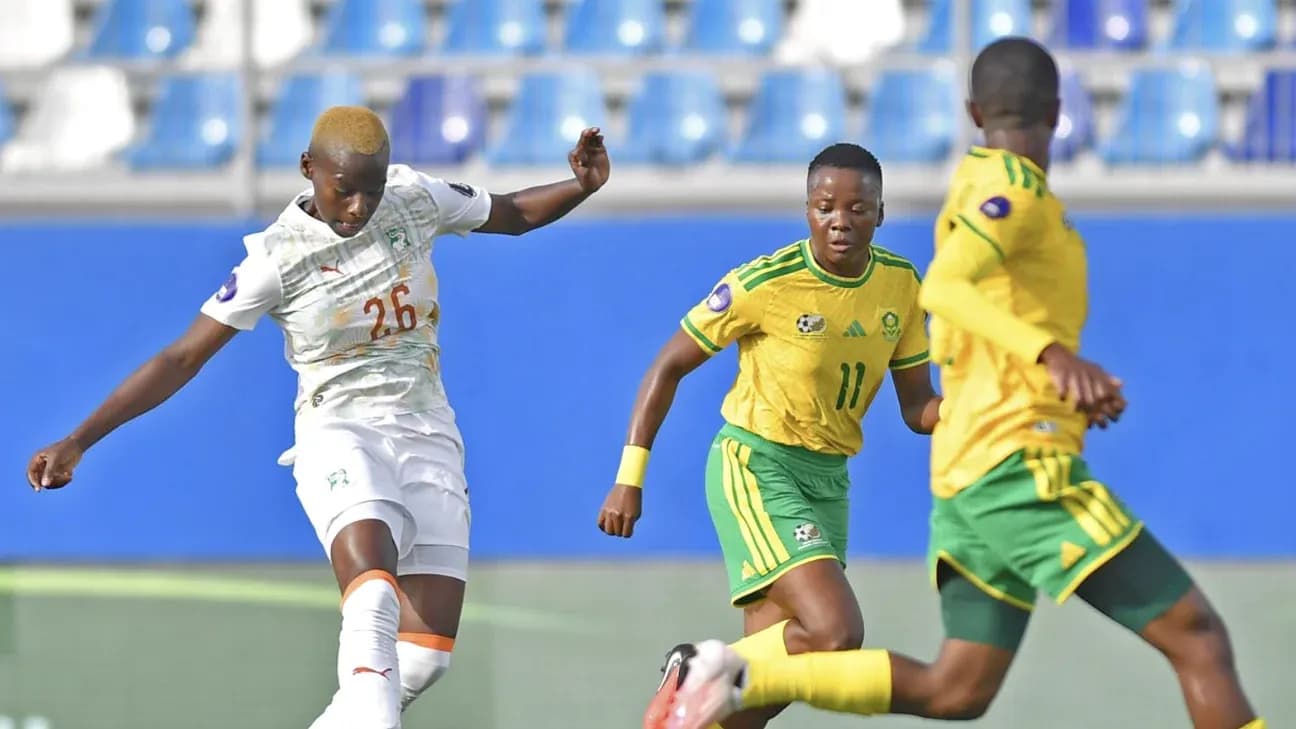
A 2-2 draw with Ivory Coast on Friday keeps Banyana Banyana in the Women’s Africa Cup of Nations fight, even if it exposed just how fragile their campaign has become. For long stretches, they were second best. For the final 20 minutes, they were something else entirely – urgent, direct, and finally ruthless.
Torn Apart, Then Dragged Back
The damage came early. Twice.
Ivory Coast needed only 18 minutes to slice through South Africa on the counter, Grace Sery finishing the move with the kind of composure Banyana sorely lacked in that first half. Eighteen became 36, and the pattern repeated: another break, another exposed back line, another Sery goal. Two counter-attacks, two clinical blows. South Africa were reeling.
In response, there was almost nothing. Just one moment of clarity: Linda Motlhalo threading a superb ball into Thembi Kgatlana’s path, forcing Aramatou Diakité to race off her line and smother. That was it. Kgatlana, marooned and starved of service, drifted out of the game. Ivory Coast controlled the tempo; South Africa chased shadows.
By half-time, the questions that have followed this team all year grew louder. Was this the end of Kgatlana as the fearsome spearhead of Banyana’s attack? Had the post-Jermaine Seoposenwe era left her permanently isolated?
The second half offered a firm answer.
Kgatlana Reminds Africa Who She Is
Kgatlana has heard the whispers. That her Tigres UANL move hasn’t translated into dominance in green and gold. That her best days in Banyana colours might already be behind her.
Give her a partner, though. Give her chaos around her. Give her a ball in the right area.
With just under 20 minutes plus stoppage time to play, the game finally tilted.
Ronnel Donnelly, introduced off the bench and immediately in the thick of it, carved out space for herself in the box. She couldn’t get the shot away, but she refused to let the move die. The ball was recycled, worked back into Kgatlana’s orbit. This time, the 28-year-old didn’t hesitate.
She cut inside, opened her body, and buried it. One touch to create the angle, one strike to drag South Africa back into the contest. From nowhere, belief.
This is the version of Kgatlana South Africa still needs: not the lone runner chasing lost causes, but the finisher with options around her and defenders suddenly unsure where to look.
Donnelly Answers Her Critics
If Kgatlana has been questioned, Donnelly has been hammered.
The Mamelodi Sundowns striker has not enjoyed a run of regular minutes at club level, and every call-up has been met with raised eyebrows. She is not Seoposenwe, that much is obvious. She doesn’t glide between the lines in the same way, doesn’t knit together moves with the same elegance.
What she does bring is something else entirely: aerial presence, a willingness to fight centre-backs for every ball, and a knack for dragging defenders into places they don’t want to go.
On Friday night, that was enough to change the game.
She won headers. She held the ball up. She gave Kgatlana a partner to bounce off. And then, deep into stoppage time, she produced the moment that justified Desiree Ellis’s faith in her.
A long ball, a flicked header, perfectly weighted into Hildah Magaia’s stride. No panic, no misjudgement. Just a clean touch that turned a hopeful launch into a crafted chance. Magaia did the rest, smashing home the equaliser and sending the South African bench into a frenzy.
From 2-0 down and drifting out of the tournament, Banyana had clawed back a point. It was messy. It was late. It might yet prove vital.
Group B on a Knife-Edge
The draw leaves Group B finely balanced, but brutally unforgiving.
Ivory Coast sit on four points from two games, with a healthy +3 goal difference after their 4-1 dismantling of Burkina Faso in the opener. Tanzania, who beat South Africa 2-1 in their first match, went into their own clash with Burkina Faso on three points and a +1 goal difference.
South Africa, by contrast, have just one point from two games and a goal difference of -1. Burkina Faso are still pointless.
The equation for Banyana is simple and harsh: they must beat Burkina Faso on August 4 to have any chance of reaching the quarter-finals. Nothing else will do.
Complicating matters is the tiebreaker system. Head-to-head results come before goal difference. In a group where multiple teams could finish level on points, that detail could decide who stays and who flies home.
Beyond WAFCON, the stakes are even higher. The four semi-finalists will book their tickets to the 2027 FIFA Women’s World Cup in Brazil. The two best losing quarter-finalists will still have a lifeline, moving into African playoffs for a place in the Inter-Confederation Playoff.
For now, South Africa are a long way from that conversation. But they are not out of it.
Ellis’s Big Call
Desiree Ellis now faces a defining selection decision.
If she wants her team to start on the front foot against Burkina Faso and chase not just a win but goals, Friday’s final act in Casablanca offered a blueprint. Kgatlana, Donnelly, Lebohang Ramalepe and Magaia as a front four looked dangerous, unpredictable, and far more in sync than anything seen in that flat first half.
Donnelly may never be Seoposenwe. She doesn’t have to be. What she showed against Ivory Coast is that she can be the foil Kgatlana has been missing, the player who occupies defenders and frees up space for Magaia’s late runs and Kgatlana’s bursts in behind.
South Africa’s defending will have to sharpen. Their transitions must improve. They cannot afford another 45 minutes as disjointed as the first half in Casablanca.
But if they are going out of this tournament, they have at least signalled how they intend to go: not quietly, not passively, but throwing everything they have at one last group game.
Backs to the wall, one match to save their campaign, and a front line that finally showed signs of life. Now the question is whether Ellis dares to trust it from the very first whistle.