Andy Robertson: Liverpool's Best Left-Back Joins Spurs
For eight years at Anfield, Andy Robertson did not just play left-back. He redefined it. Now, at 32, with his Liverpool chapter closed and his medal collection complete, he walks into Tottenham Hotspur as a free transfer with a very clear brief: raise the level.
A Liverpool great, by any measure
In a club steeped in full-back history, Robertson belongs in the inner circle. In the Premier League era he stands alone as Liverpool’s best in that position. Across all eras, only Alan Kennedy – scorer of two European Cup-winning goals – can seriously be mentioned in the same breath.
The honours list is exhaustive. Two Premier League titles. A UEFA Champions League. An FA Cup. Two League Cups. A FIFA Club World Cup. Robertson did not just witness Liverpool’s renaissance under Jurgen Klopp; he powered it from the left flank.
Klopp’s high-octane football suited him perfectly. He tore up and down the touchline, aggressive with and without the ball, his intensity mirroring the team’s identity. It was a marriage of system and player that looked almost too perfect at times.
Opposition coaches noticed. After a 3-1 defeat at Anfield in December 2018, then Manchester United manager Jose Mourinho could barely believe what he had seen. He described Liverpool as “fast”, “intense”, “aggressive”, “physical”, and singled out Robertson as “absolutely incredible”, joking that just watching the Scot’s repeated 100-metre sprints had left him tired.
A running machine with a defensive snarl
The numbers back up the eye test. In 2020/21, Robertson covered 389.3km in the Premier League, the second-longest distance of any full-back, just behind Luke Ayling. Between 2019 and 2022 he topped the sprint charts for full-backs three seasons running: 567 sprints in 2019/20, a staggering 843 in 2020/21, then 656 in 2021/22.
Those figures are not just trivia. They explain why coaches trusted him, why team-mates leaned on him, and why supporters adored him. He played like a man who took every duel personally.
One moment captured that better than any statistic. In a 4-3 thriller against Manchester City in January 2018, Robertson produced a 13-second pressing sequence that has since entered Premier League folklore. He harassed Bernardo Silva, then Kyle Walker, then John Stones, then Ederson, then Nicolas Otamendi, in one ferocious, continuous chase. Anfield roared. A left-back turned into a one-man press. That clip still does the rounds because it distilled exactly what he is: relentless.
Spurs fans will warm to that very quickly.
Elite output from the left flank
Robertson’s game, though, has never been just about running. The end product is elite.
Only two full-backs in Premier League history have recorded 10 or more assists in three separate seasons: Trent Alexander-Arnold and Andy Robertson, who hit those marks in 2018/19, 2019/20 and 2021/22. For Liverpool, the symmetry was remarkable: 11 assists for Robertson and 12 for Alexander-Arnold in 2018/19; 12 and 13 respectively in 2019/20; 10 and 12 in 2021/22. Two playmakers, starting from the back.
Since arriving from Hull City for a reported £8million in 2017, Robertson has been the benchmark for Premier League left-backs in almost every attacking metric. From 2017/18 onwards, he ranks:
- 1st for touches in the opposition box among left-backs (612) and among all defenders
- 1st for chances created including assists (430) among left-backs, 2nd among defenders
- 1st for big chances created (88) among left-backs, 2nd among defenders
- 1st for assists (56) among left-backs, 2nd among defenders
- 1st for open-play crosses (973) among left-backs, 2nd among defenders
- 2nd for successful open-play crosses (191) among left-backs, 3rd among defenders
- 1st for successful passes ending in the final third (4,000) among both left-backs and all defenders
He leaves Liverpool as the Premier League’s most prolific left-back creator. Only Lucas Digne has more successful open-play crosses from that side.
Is he the greatest left-back the league has seen? Ashley Cole, with his longevity at the very top and his defensive excellence, probably still edges that debate. But Robertson sits just behind him, and that alone tells you the level Spurs are getting.
Why Tottenham moved
Spurs did not stumble into this transfer. They chased it.
They were among several clubs trying to secure Robertson on a free once it became clear his Liverpool contract would not be extended. A January move was explored but collapsed when Liverpool were unable to recall Kostas Tsimikas from his loan at Roma.
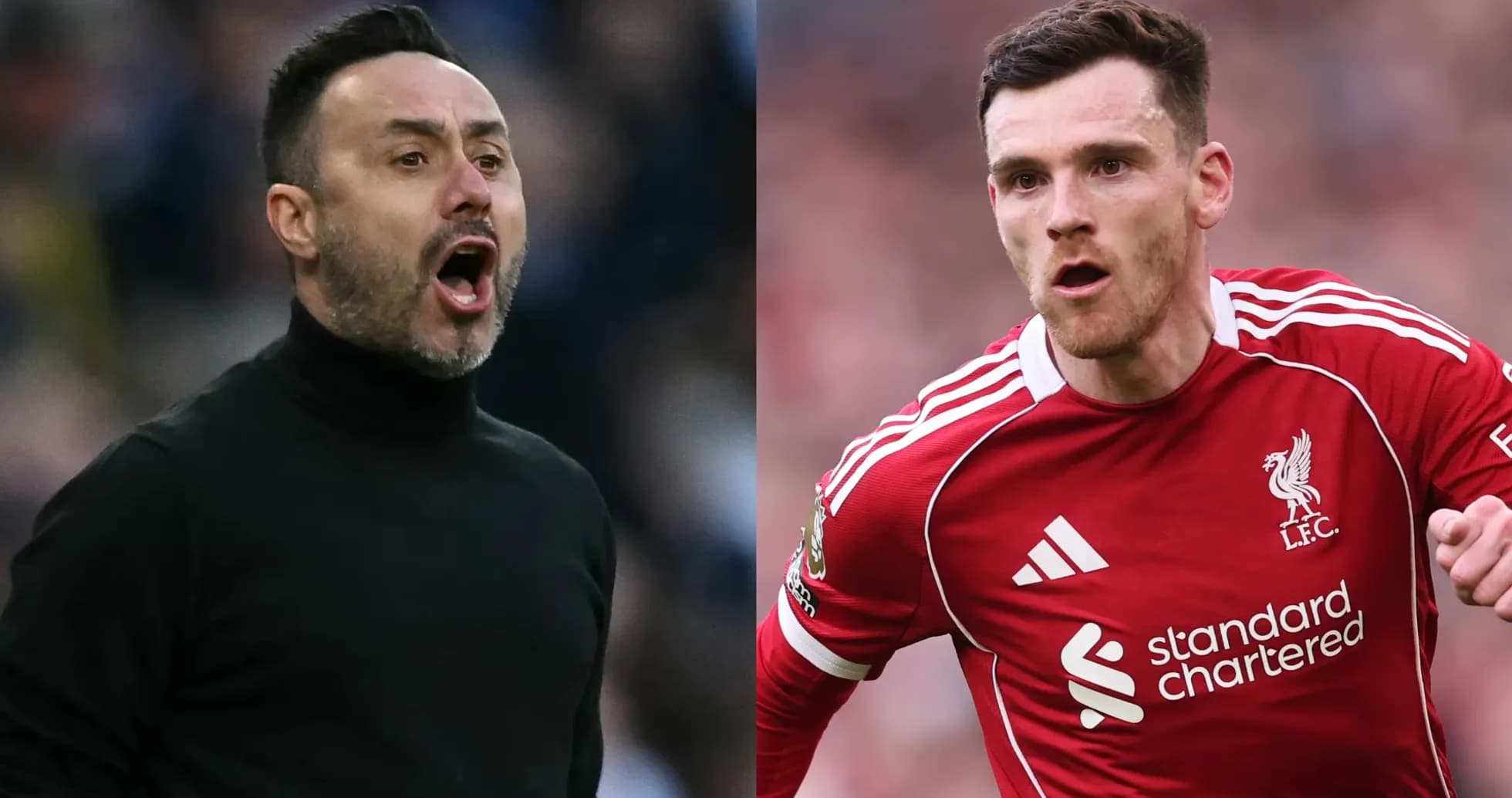
New head coach Roberto de Zerbi pushed to revive the deal. With Juventus also reportedly circling, Spurs won the race and handed their new manager a proven winner and a voice for the dressing room.
On paper, left-back is not an obvious weakness. Destiny Udogie has impressed, and Djed Spence offers another option. The problem is not numbers. It is profile. Tottenham’s dressing room has lacked senior figures with a history of winning major honours and setting standards day to day.
De Zerbi was blunt about why he wanted him: “He brings experience, mentality and qualities. He’s a big player for us.” Spurs need those things after back-to-back 17th-place finishes that have left the club searching for identity as much as points.
Robertson arrives used to demanding environments, where trophies are the expectation, not the surprise. That culture is as valuable to Spurs right now as his left foot.
What’s left in the tank?
The obvious question hangs over any 32-year-old full-back: how much is left?
Plenty, by the looks of it. Robertson will captain Scotland at the FIFA World Cup 2026, a responsibility that underlines his continued importance at international level. For Liverpool in 2025/26, he started 11 Premier League matches and made 13 appearances from the bench, featuring 35 times in all competitions.
He no longer storms into the penalty area with the same frequency as in his mid-20s, but his heat map from last season shows a player still operating high and wide, still aggressive in his positioning, still heavily involved in the attacking phase.
Crucially for Spurs, his numbers remain superior to their current options. Per 90 minutes in 2025/26:
- Passes played into the box: Robertson 5.07, Spence 2.67, Udogie 1.75
- Tackle success: Robertson 75.00%, Spence 61.36%, Udogie 61.29%
- Successful open-play crosses: Robertson 0.92, Spence 0.44, Udogie 0.34
- Chances created: Robertson 1.54, Spence 0.81, Udogie 0.44
That is not just marginal improvement. It is a clear upgrade in delivery, decision-making and defensive reliability. On this evidence, he walks into De Zerbi’s starting XI.
The right player at the right moment
Robertson’s signing feels like more than a neat market opportunity. It feels like a statement about how Spurs want to play and who they want to be.
De Zerbi demands intelligent, technically sharp footballers who also play with edge and courage. Robertson ticks those boxes. He has lived inside a high-pressing, high-line system for years. He understands when to go, when to hold, when to risk the pass and when to recycle. He is used to being a creative hub as well as a defender.
Spurs are not buying the whirlwind of 2019, the left-back who seemed to run on battery packs. They are buying the seasoned version: still quick, still intense, but now armed with a decade of elite experience and a clear idea of how to drag standards up around him.
For a club trying to escape mid-table drift and re-establish itself among the Premier League’s elite, that might be the most valuable quality of all.