Alvaro Cortes: The New Defensive Leader for Barcelona
Ronald Araujo’s move to Liverpool has ripped a hole straight through the heart of Barcelona’s defence. Instead of rushing to patch it in the transfer market, the club has chosen a different answer — one grown just a few metres away from the Camp Nou pitch.
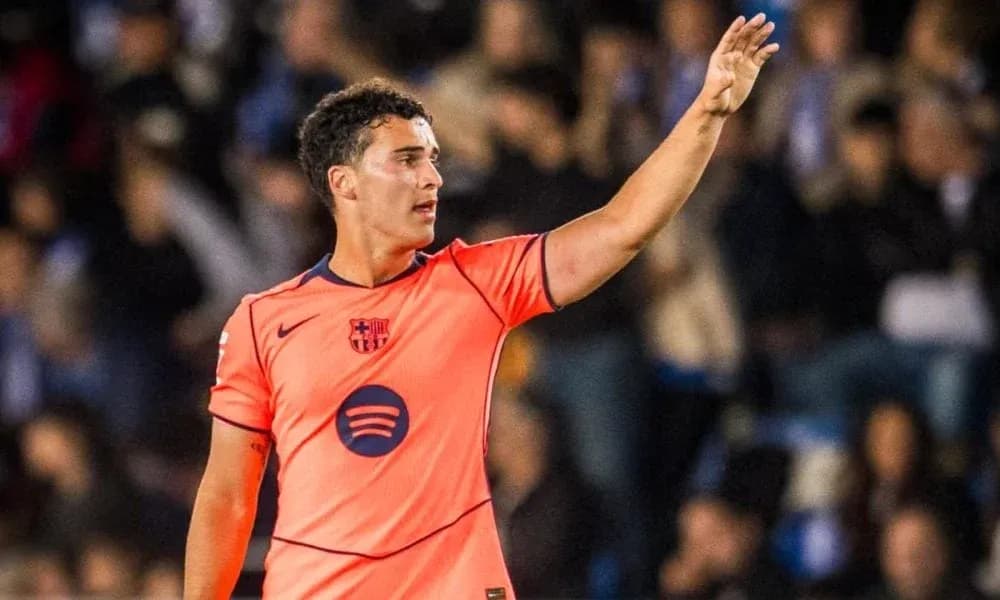
His name is Alvaro Cortes.
Araujo out, Cortes up
Inside the club, the message is clear: Cortes is not a stopgap. He is the chosen successor.
With Araujo on his way and the chances of landing a high-profile centre-back fading, Barcelona have accelerated one of their most delicate internal projects. The 21-year-old La Masia graduate, long earmarked for a bigger role, is now being positioned as the direct replacement for the departing captain.
The plan for this season had already been to keep Cortes with the first team. Araujo’s departure hasn’t changed that. It has hardened it. One less heavyweight in central defence means one more open lane for the academy product to step through and stay there.
So much so that the club has effectively shut the door on moves for names like Cristian Romero or Aymeric Laporte. No big-money chase. No late scramble. The bet is on what they already have.
Flick, Deco and a decisive debut
Inside the sporting structure, there is alignment. Hansi Flick and Deco are fully sold on Cortes.
Last season, Flick handed him his first-team debut and did not hide him on the fringes. Cortes started and did so in one of the most tactically demanding roles in the squad: left-sided centre-back in Barcelona’s high defensive line.
That position is pivotal in Flick’s structure. It asks for bravery, precision and a calm head when the pitch feels wide open. Cortes handled it well enough to convince both coach and sporting director that he belongs in that zone more regularly.
From there, the internal debate shifted. Not “Is he ready to be around the squad?” but “Is he ready to be one of the options?” Araujo’s exit has turned that into: “He has to be.”
A profile built for risk
Cortes is not being promoted just because he is young and from La Masia. His profile fits the football Flick wants to play.
At around 1.90 metres, he brings the kind of aerial dominance Barcelona have often lacked when defending crosses and set pieces. He relishes contact, holds his ground in duels and does not shy away from physical battles. But the key lies in how he moves, not just how he stands.
He is comfortable defending high up the pitch, stepping out aggressively to intercept, and then spinning to cover the space behind a daring defensive line. That blend — front-foot defending with recovery speed and positional awareness — is essential in an aggressive, high-risk setup.
On the ball, he looks like a Barcelona defender should. Naturally left-footed, he can open up the pitch with his passing, break lines and start attacks from deep. He doesn’t just recycle possession; he helps shape it.
A new hierarchy at the back
Pau Cubarsi remains the cornerstone of the back line. The teenager has already claimed that status with a maturity that belies his age. Gerard Martin can also operate on the left side of central defence and offers reliability in that role.
Cortes, though, brings a different dimension. Height. Anticipation. A left-sided balance that allows Barcelona to build with natural angles rather than forcing players onto their weaker foot. In practical terms, he gives Flick a genuine alternative without forcing the club into the market.
Around them, the depth chart is being redrawn. Andreas Christensen is still a key figure. Eric Garcia and Jules Kounde add flexibility, each capable of sliding centrally when required. Rodri, with his previous experience in defence, offers yet another layer of cover.
That collection of options has convinced the club that a direct, like-for-like signing for Araujo is not essential — at least not now.
The present, not just the future
Barcelona are not closing the door on the market entirely. Inside the offices, they continue to weigh the overall balance of the squad and the possibility that another reliable centre-back might be needed if injuries or form dictate it.
But for the moment, Araujo’s departure has done something very specific for Alvaro Cortes: it has dragged his timeline forward.
He is no longer being spoken about as “one for tomorrow.” He is being prepared for today — with a clear path to minutes, a coach who trusts his profile, and a club willing to stake a piece of its defensive future on a defender who has grown up with its ideas.
The question now is not whether Cortes can belong at this level. It is how quickly he can turn opportunity into authority in a back line that suddenly needs new leaders.