Graham Potter's Journey: From West Ham Struggles to World Cup with Sweden
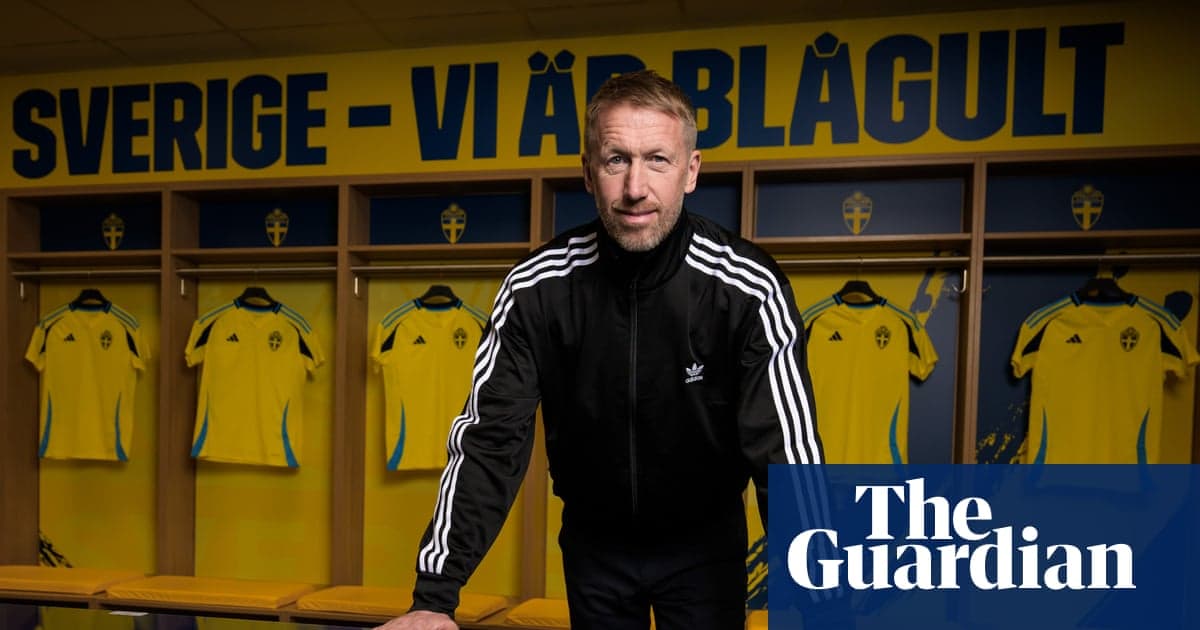
Graham Potter sits with his scars on show and doesn’t bother pretending they don’t exist.
“If management has taught me anything it’s that there’s no point trying to run away from failure,” he says. “You’ve got to face the bad stuff.”
He has had plenty of it to confront. Seven bruising months at Chelsea. A chaotic, short‑lived stint at West Ham that left his reputation wobbling. A career once hailed as one of the sharpest in the English game drifting towards the margins.
And yet here he is, 51 years old, about to lead Sweden into a World Cup, talking about “beautiful moments”.
From West Ham wreckage to a lifeline in yellow
Potter’s journey back has not been neat or romantic. It has been hard, uncomfortable, occasionally humiliating. He walked away from the stability of Brighton for Chelsea in September 2022, plunged into the noise and churn of a super‑club in flux and was gone within seven months. After a long break, West Ham called at the start of last year. He took it.
It was the wrong call.
He walked into dysfunction and never really found the floor. Six wins from 25 games, a dismal start to his first full season, and by last September he was out, staring at a crossroads. The man once tipped for the England job was suddenly fighting not to be forgotten.
“I have had enough life experience to be able to put all these things into perspective,” he says. “I’m grateful for all the experiences I have had, pluses and minuses. In the end, you have to deal with what life throws at you. After West Ham, I could have done two things. I could have sat around and done media. Or you can go and work.”
The call from Sweden arrived as he was weighing those options. They were in trouble, floundering in their World Cup qualifying group and searching for a replacement for Jon Dahl Tomasson. Before he could say yes, Potter had to deal with himself.
“You have to deal with the failure,” he says. “But I think you become a better person for it. And then sometimes in football you just can’t rationalise it. You just go: ‘Maybe it wasn’t meant to be.’ Then you try to move on with your life.
“The learnings you take from these experiences, they’re painful. I won’t share my learnings with you because it’s hurt me to get them. I think it should because that’s how you improve.”
He shut out the noise. “If I worry about what people think about me that’s a miserable life,” he says. Still, he knew exactly what was at stake when he agreed a short‑term deal with Sweden in October. They had already blown their qualifying group. Only a Nations League back door into the playoffs kept the dream alive. Fail again and his own standing would take another heavy hit.
The pressure finally told – in his favour.
Gyökeres, a city in delirium and a manager reborn
Everything changed in March. Sweden hit the playoffs with a clarity and calm that had been missing for months. Viktor Gyökeres, the powerful forward whose first year at Arsenal drew as much criticism as praise, took over.
He scored a hat‑trick in a 3-1 semi‑final win over Ukraine. Then came Poland in Stockholm, a tight, frantic decider that swung on an 88th‑minute winner from the same man.
“You go on to YouTube and go into the Swedish commentary of the game; I looked at it a couple of months afterwards and it’s the emotion in the voice,” Potter says. “Viktor scores and it’s like an out-of-body experience. All our subs are just running on the pitch. There’s 15 players on the pitch and I’m thinking: ‘That’s yellow cards, that’s problems.’ But it’s a World Cup, so all the rules are out the door.”
The goal didn’t just send Sweden to the World Cup. It anchored Potter. He has since extended his contract to 2030 and talks about the job with a sense of belonging that goes beyond tactics and training schedules.
He is not a stranger parachuted into a foreign federation. Sweden is where his coaching story really took off, at Östersund, the club he dragged from the fourth tier into Europe over seven years. Two of his children were born there. The culture, the football, the rhythm of life – it all fits.
“I feel very Swedish when I’m working,” he says. “I look a bit Swedish. Two of my kids were born in Sweden.”
With the national team, he feels something deeper. “You’re aware with the national team that you’re doing something for more than you. It’s a bigger thing. You can feel the intensity. That’s what’s beautiful about it.”
Club builder learning the art of the short burst
Potter’s reputation was built on long‑term projects, on slow, detailed construction. International football laughs at that kind of luxury. You get days, not months.
“You haven’t got the time to develop ideas,” he says. “The mistake you could make is that you could form all these ideas from the camp in November ahead of the camp in March, forming tactical plans to beat Ukraine, and the reality is that you have two days to prepare for a game. You don’t want to make it too complex.”
The euphoria of qualification quickly gave way to the hard edge of selection. Some players who helped drag Sweden to the World Cup did not make the final squad. The conversations were blunt, necessary, and, in their own way, another test of management.
“Even if you play 11 v 11 in a training game, four players are standing on the outside,” Potter says. “That’s not easy. You want the group to be on the same path.”
He knows unity will be vital. Sweden are in Stockholm for a training camp before they fly to their base in Texas, a reminder that this World Cup carries echoes of history. The country still measures itself against USA 94, when they finished third. That shadow hangs over everything.
This time, Group F offers Japan, the Netherlands and Tunisia. On paper, it is unforgiving. Potter sees the margins shrinking even further in the heat of Monterrey, where Sweden open against Tunisia on 14 June.
Managing the conditions will be as important as any tactical wrinkle. He expects slower games, more attrition, more set‑piece battles.
“You can see the way the game has gone,” he says of dead balls. “Tournament football, you know the knife is at your throat so it’s less easy to be expansive. Games become tight. It’s a way to create chances so I think teams will focus on it a lot.”
Life without Kulusevski – and the twin threat up front
Sweden will go to the World Cup without Dejan Kulusevski, a major blow. Yet the attack still crackles with potential. Up front, Potter has a pairing that could unsettle any defence: Alexander Isak and Gyökeres.
Gyökeres has been dissected all season at Arsenal, his every touch judged against the scale of the club’s ambitions. Potter’s view is simpler, and rooted in what the forward has done for his country.
“It’s a great example of the modern world,” he says. “From our perspective, he got us to the World Cup, so his impact is incredible. From Arsenal’s perspective he’s played his role in the team, scored his goals, the team have won the Premier League and got to the Champions League final. You look at how much work he does. He’s had a brilliant season.”
Isak’s year has been very different. His move from Newcastle to Liverpool last summer was supposed to be the next great leap. Instead, a disrupted pre‑season and a broken leg left him chasing fitness and form.
“It hasn’t gone as well as he would have liked,” Potter says. “We sometimes make the assumption that when you sign a player it’s going to improve everything. I’ve lived that – it’s not always the case. Alex playing for Newcastle does this but how does he adapt to what Liverpool want him to do? The player doesn’t change. His quality doesn’t change. He’s still a top player. It’s just how they interact as a team together. It can take a bit of time. He’s a great lad.”
Potter’s relationship with Isak stretches back to the striker’s first steps in senior football. He still remembers preparing Östersund to face AIK and feeling quietly relieved when the usual centre‑forward dropped out, replaced by an unknown teenager.
“We were quite happy before the game because the centre‑forward wasn’t playing and some 16‑year‑old kid was playing,” he says. “Then he scored, we got beat 2-0 and I learned my lesson.”
Isak reminded everyone of his ceiling with a stunning goal in Sweden’s 3-1 defeat by Norway on Monday. Potter wants him and Gyökeres together.
“They’re different in their styles, which is good for us. We haven’t played with them together yet so that’s exciting to develop.”
Tournaments, soul and a manager back where it matters
As the World Cup draws closer, the anticipation around Sweden is building. Inside the camp, Potter can feel it. He has exchanged messages with Zlatan Ibrahimovic, the great striker who once carried the nation’s hopes almost single‑handedly. He has spoken to managers who have walked both club and international paths.
“I’ve spoken to people who’ve done both and people have said the tournaments are the best feeling in football,” he says. “In the national team you feel like you’re doing something with more soul.”
The contrast with his recent past is stark. West Ham sacked him and still went down. Potter left, reset, and now walks into a World Cup with a country that feels like a second home.
“My first football memories are ’86, 11 years old, watching Diego Maradona rip football up,” he says. “As a kid, that’s where I started. To get the chance to work in that environment, it’s just a dream.”
He has faced the bad stuff. Now comes the biggest stage of all – and the chance to decide whether his story is one of redemption, or something even bigger.