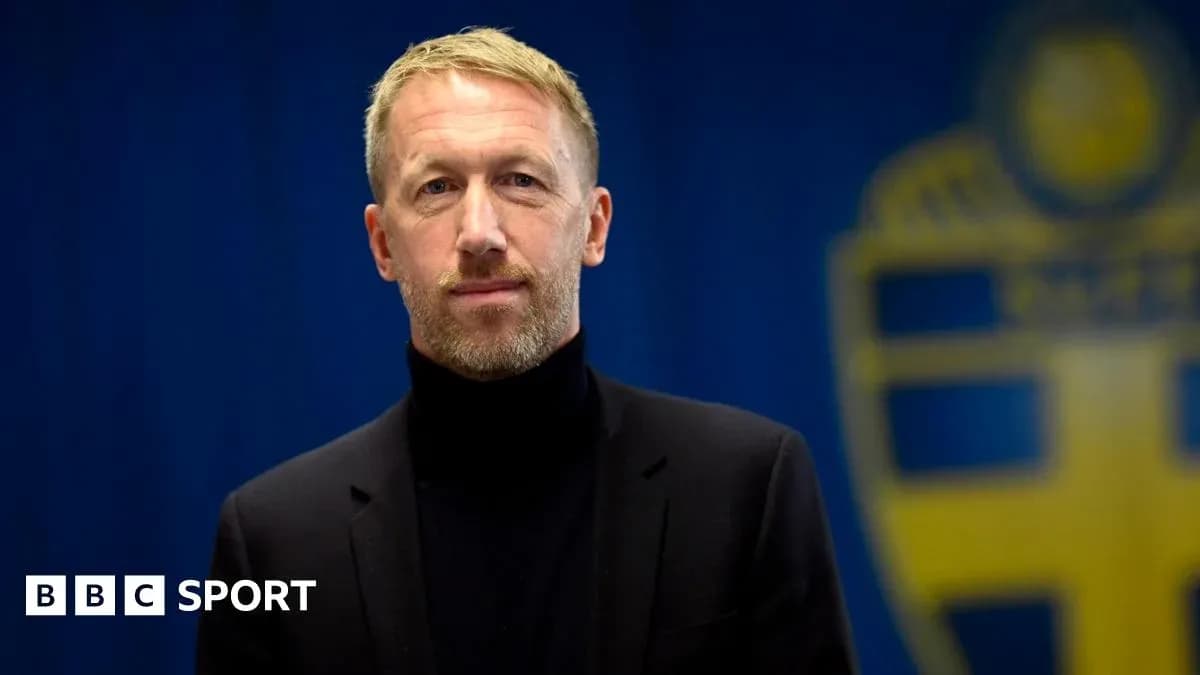
Graham Potter's Journey from Chelsea to World Cup Glory with Sweden
Graham Potter stood on the touchline in Stockholm, swallowed by noise and tension, and let the words rip out of him.
"We are going to the World Cup, baby."
An 88th-minute winner from Viktor Gyokeres had just detonated inside Strawberry Arena, a late, wild twist in a 3-2 play-off victory over Poland that sent Sweden back to the World Cup for the first time since 2018. Fifty thousand fans bounced. Substitutes sprinted onto the pitch. Potter, the Englishman who had been burned by the Premier League and rebuilt in Scandinavia, finally had his night.
He called it "the best night of my career". Nobody in that stadium would have argued.
From Chelsea scars to Stockholm euphoria
Potter did not arrive at this moment untouched. His sacking by Chelsea after seven bruising months, followed by another short, difficult spell at West Ham that ended last September, left scars.
"It hurt. They are painful experiences," he admitted. "I have lived failure. I've had quite a bit of success too. That's what life is."
He talks now like a man who has done the emotional work. Perspective. Feedback from people who matter. Gratitude, even for the dark bits.
"In the end you have to find some way of being grateful for it but, when you're going through it, it isn't easy," he said. "You have to deal with the failure, but you become a better person for it, that's for sure."
Then came Stockholm. Gyokeres, already fresh from a hat-trick against Ukraine in the previous game, cut through Poland late on and finished. The stadium shook.
"Viktor scores and it's like an out of body experience, I can only describe it as that," Potter said. "All our subs are running on the pitch. There's 15 players on the pitch and I'm thinking, 'That's yellow cards, that's problems'. But of course it's a World Cup, so all the rules are out the door."
When the final whistle went, the tension drained and something else took over.
"The feeling in the stadium was just incredible," he said. "It's so nice to have to experience positivity through football, because obviously recently I haven't had too much of that, so it's quite nice, of course, on a human level."
Asked how he celebrated, he just smiled: "What do you think I did?" A few drinks, a few hours to let it all sink in. Then, as ever with Potter, the reset.
"I don't think you should necessarily get carried away. You're never quite as good as you say when you're there [high], and you're never quite as bad as they say when you're there [low]. So, you've got to find some way of keeping some perspective."
The Englishman who became Swedish
If this feels like a perfect fit, that’s because Potter is no tourist in Sweden. His coaching story there runs deep.
Long before Swansea, Brighton, and the glare of Chelsea, he took Ostersunds FK from the fourth tier to the Allsvenskan. He won a domestic cup. He led them into Europe. Seven years of graft, creativity and culture in a remote football outpost changed him.
"I feel very Swedish when I'm working," he said. He even sings the national anthem before matches. "I even look a bit Swedish. Two of my children were born in Sweden. I had seven unforgettable years at Ostersunds, with memories that will stay with me for life."
He speaks the language. On his new Instagram account he looks more like a local than a visiting coach – walking through forests, reading Nordic literature, turning up at cultural events. The fourth-tier outsider has become part of the fabric.
"I came from the fourth tier of Swedish football, which is quite low, and worked my way up through the system to the Allsvenskan," he said. "You almost become Swedish in a coaching sense because of the experiences you have. I think it has definitely helped.
"Now I'm working for the Swedish FA as head coach of the national team, so I feel very Swedish."
So when the national job opened up in November and he stepped in on a short-term deal to replace Jon Dahl Tomasson, it was not some wild leap. It was a return. A calculated one.
He knew the history. He could recall the 1994 World Cup in the United States, the bronze-medal run, and the tournament song "När vi gräver guld i USA" – When We Dig for Gold in the USA – which, like England's "World in Motion" and "Three Lions", is welded to national football memory.
This time, he would not just be watching.
A contract to 2030 and a nation revived
The early months went well enough that before the March international break – and before qualification was even secured – Sweden moved to lock him in. His contract now runs to 2030. He will lead them at this World Cup, and, if they make it, the 2028 European Championship and 2030 World Cup.
It is a statement of faith and a recognition of what qualification means here.
"Maybe in England we have taken it for granted because we usually qualify," Potter said. "But the reality is that many countries do not, so it is special when they do. It is also very important for the finances of the football structure."
The call from Zlatan Ibrahimovic soon followed, a nod from the country’s most famous modern player. Potter called him "one of the kings of Sweden". Kings recognise momentum when they see it.
Isak and Gyokeres: twin weapons for Group F
Now comes the hard part: turning that emotion into performance on the world stage. Sweden drop into Group F with Tunisia, the Netherlands and Japan, and Potter will lean heavily on two Premier League centrepieces.
Liverpool forward Alexander Isak and Arsenal striker Viktor Gyokeres give him a front line that most coaches would envy.
"I think they are different in their styles, which is good for us because you can hopefully use them effectively," he said. "The honest truth is that we haven't played them together yet in my time, so that will be exciting to develop. If we can get them enjoying their football and firing, they are top players."
Isak, a £125m signing from Newcastle to Liverpool last summer, has endured an injury-hit season and has yet to start under Potter for the national side.
"It can take a bit of time," Potter said. "At the biggest clubs there is pressure and expectation, and when expectation and reality begin to diverge, it can create problems."
"His injuries have been disappointing, but I know him well. He is a top professional who wants to play and help his team."
Gyokeres arrives from the opposite direction. Twenty-one league goals, a Premier League title and a Champions League final in his first season at Arsenal after a £55m move from Sporting. On paper, a dream year. In reality, still criticism.
"It is a good example of the modern game," Potter said. From his vantage point, the verdict is simpler. "From our perspective, he has scored four goals in two matches and helped take us to the World Cup, so his impact has been significant."
Their stories intertwine with Potter’s in another way. He remembers Isak scoring his first professional goal as a 16-year-old for AIK – against Potter’s Ostersunds. The boy has become a star. The coach who watched that debut now needs him to lead a nation.
Humble base, heavy decisions
As one of the last teams to qualify from an expanded field of 48, Sweden did not get the pick of the training bases. They will work out of SDJA, a high school facility in San Diego. It sounds modest for a World Cup camp, but there are no complaints from the coach.
He has highlighted the importance of set-pieces in the heat, the small details that can tilt tight group games. The bigger strain, he says, lies elsewhere.
Squad selection has meant "the toughest conversations as a father and human being". Careers, dreams, and family pride sit on the other side of those phone calls. No tactical board can soften that.
While England head to Miami for a pre-tournament base, Sweden will do it differently. They will stay at home in Stockholm before flying out, allowing players to spend time with family and friends after long, draining club seasons. Potter wants them mentally recharged as much as physically sharp.
Norway and Greece provide the final friendlies. Then, on 15 June, Tunisia await and Sweden step back onto football’s biggest stage.
From Maradona on TV to the World Cup touchline
For Potter, the journey stretches back to a living room in 1986. He was 11, watching Diego Maradona at the World Cup, discovering in real time what this sport could be.
"My first football memory is from 1986 - I was 11, watching Diego Maradona," he said. "That was when I realised how special the game was. To work in that environment now is a dream."
From the fourth tier of Swedish football to Strawberry Arena in full roar. From Chelsea’s unforgiving spotlight to a nation belting out its anthem with him on the front line. From a boy staring at a television to a man standing on the touchline of the tournament he once watched in awe.
The failures still exist in his story. So does the pain. But the next chapter opens in San Diego, under the World Cup lights, with a team that now believes again.
The question is no longer whether Graham Potter has recovered. It’s how far this reborn Sweden can run with him.