Germany's Coaching Crisis: A Repeat Mistake?
Germany have been here before. Too often.
Since lifting the World Cup in 2014, the four-time champions have turned the art of waiting too long on a coach into a damaging habit. Joachim Löw stayed beyond the point of no return. Hansi Flick did too. Now, with Julian Nagelsmann, the DFB stand on the brink of making the same mistake for a third time.
From summit to spiral
The slide began in Russia. Germany arrived at the 2018 World Cup as holders and left humiliated, dumped out in the group stage after defeats to Mexico and South Korea. It was not a blip; it was a crash. Löw, the architect of 2014, had presided over a catastrophe.
Logic said that was the end. Twelve years in charge, legacy intact but exhausted. Instead, the DFB doubled down. Löw’s “credit in the bank” bought him another tournament cycle. The team staggered on, showing almost no meaningful progress, and at Euro 2020 – delayed to 2021 – Germany fell limply to England in the last 16. Only then did Löw finally walk away.
Flick arrived as the fresh start. A serial winner with Bayern Munich, a coach who knew many of the players inside out, he carried Germany into Qatar on a wave of optimism. The wave broke almost instantly. Germany lost their opening game to Japan despite taking the lead, never found their footing, and crashed out in the group stage again. Flick survived the World Cup but not the hangover. By autumn 2023, a series of poor results forced the DFB to act.
Nagelsmann was the bold, modern answer. Young, tactically sharp, a coach who promised to drag the national team back to the forefront of the game. For a brief moment, it felt like the reset had finally arrived.
The home Euros high – and the slow unravelling
At Euro 2024 on home soil, Nagelsmann did something no Germany coach had managed since 2016: he made a tournament feel fun again. The team played with energy, the crowd reconnected, the mood around Die Mannschaft softened. A run to the quarter-finals, ended by eventual champions Spain, looked like a platform, not a ceiling.
The exit still hurt, though. And Nagelsmann’s response set the tone. Almost immediately, he framed his next target: winning the 2026 World Cup. Ambition is one thing; delivery another.
Back then, he was the most popular national coach since peak Löw. Now that feels like a different era. In less than two years, Nagelsmann has burned through his public capital at startling speed, undone by misjudgments on and off the pitch. The nadir arrived in Foxborough on Monday, with a lifeless defeat to Paraguay that laid bare just how little this team has evolved since the Euros.
A coach who talked too much – and chose badly
Nagelsmann’s football ideas were meant to be his strength. Instead, his words became the story. He used press conferences and interviews as a stage, returning every few weeks with pointed, detailed critiques of individual players. It played badly in a dressing room that expects unity from the top.
He chased the spotlight, made statements that ranged from clumsy to simply untrue, and walked back promises on roles and status within the squad. When questioned, he often bristled. The composure vanished, replaced by a tone that veered towards patronising – and it happened repeatedly during the World Cup.
The decisions on the pitch did not rescue him. After Toni Kroos’ successful return for Euro 2024, Nagelsmann went a step further and hauled Manuel Neuer back out of international retirement for this World Cup. He had denied for months that he would do it. Then he did it anyway.
The fallout was predictable. Oliver Baumann, outstanding through qualifying, saw his place and trust evaporate. Neuer, 40, did nothing in this tournament that Baumann could not have done. The move felt unnecessary, badly handled and symbolic of a coach listening to the past rather than backing the present.
Joshua Kimmich became another emblem of the muddle. Once again, Nagelsmann could not resist tinkering, shuffling his captain between right-back and central midfield – even within the same game, as in the defeat to Paraguay. It screamed indecision, not flexibility.
A World Cup without conviction
On the pitch, the diagnosis is brutal. Germany’s World Cup was a comprehensive failure, and the warning signs were there long before Foxborough. Since the Euros, there has been no clear step forward, no defined identity, no sense of a team building towards something coherent.
Apart from a short second-half surge against minnows Curacao, Germany underperformed throughout the tournament. They looked blunt in attack, short of ideas and combinations in the final third. At the back, they were fragile, repeatedly opened up by opponents who, on paper, should not have frightened them.
- Ivory Coast.
- Ecuador.
- Paraguay.
These are respectable sides, but not giants. Germany made them all look more than that. In pure footballing terms, this campaign was even more disappointing than 2022. Back then, they at least salvaged a draw against Spain. This time, there was no such anchor point, no performance to cling to as a sign of life.
To their credit, the players fronted up after the exit. They spoke of collective responsibility and went out of their way to absolve Nagelsmann of blame. That might speak to loyalty, or to a dressing room wary of throwing another coach under the bus. But international football is unforgiving. The head coach’s job is to impose a structure, a plan that allows talent to flourish. With this squad’s quality, that never materialised.
Nagelsmann’s in-game management only deepened the doubts. Substitutions against Ecuador raised eyebrows. The decision to start super-sub Undav against Paraguay, stripping him of the very impact that makes him valuable, felt like change for its own sake.
Klopp in the studio, Klopp in every conversation
If all of that were not uncomfortable enough for Nagelsmann, his every misstep was being dissected in real time by the man many see as his natural successor.
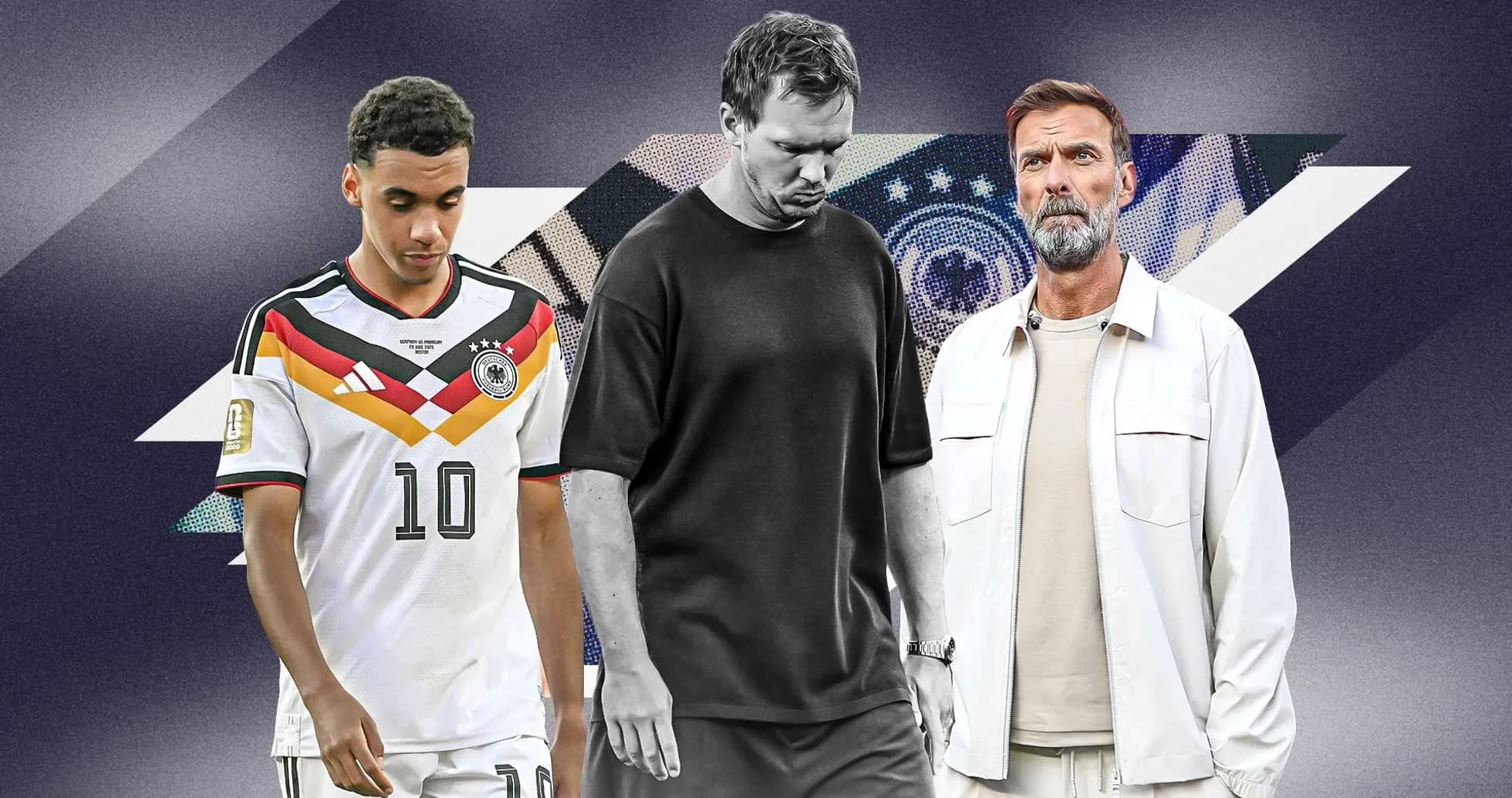
Jürgen Klopp, now Red Bull’s head of soccer, sat in the television studio and pulled no punches. On Magenta TV, he spelled out what millions of Germans had just watched.
“You have to attack down the wings. There’s no alternative,” he said after the elimination. “We all know how well these guys can play, but they didn’t bring that to the pitch. In three months, we’ll be raving about [Florian] Wirtz and [Jamal] Musiala again about how great they are, but not now.
“Paraguay had the opportunity to achieve something, Germany was under pressure to achieve something. Everyone in the stadium thought: Now they’ll turn it around! But we didn’t. We let them off the hook... We can talk about the DFB. We absolutely have to change a few things.”
He did not push himself for the job. He did not need to. His analysis, his clarity, his presence did the work for him.
Among supporters, the dream is obvious: Klopp on the touchline for Euro 2028 and the 2030 World Cup, the ex-Liverpool and Borussia Dortmund coach leading Germany with his trademark intensity and connection. It would ignite a level of euphoria German football has not felt in a decade.
Klopp, asked in Boston, refused to bite.
“I haven’t thought about that yet. I understand that when the national coach position is discussed, my name is mentioned in some form. But it’s not the moment to really talk about it. There’s nothing to say about it. I have a job that I enjoy very much. As far as I know, it’s not a part-time job.”
The door is not open. It is not closed either. It is simply there – and that alone changes the pressure on the DFB.
The decision the DFB can’t dodge
Publicly, Nagelsmann still has allies. The squad have backed him. Sporting director Rudi Völler has done the same. Yet the pattern of the last decade is impossible to ignore. Germany waited too long with Löw. They waited too long with Flick. The price was paid in early flights home and a steadily eroding aura.
They cannot afford a trilogy.
If the DFB truly believe Nagelsmann can lead a reboot before 2026, they must show it with conviction and a clear plan. If they do not, then the hesitation of the past cannot be repeated. Klopp will not sit by the phone forever, and the chance to reset the entire direction of the national team will not linger indefinitely.
Germany have spent eight years drifting away from the summit they once owned. The next call from the DFB will decide whether that drift finally ends – or becomes the new normal.