Bradley Barcola's Struggles at PSG: From Star to Rotation
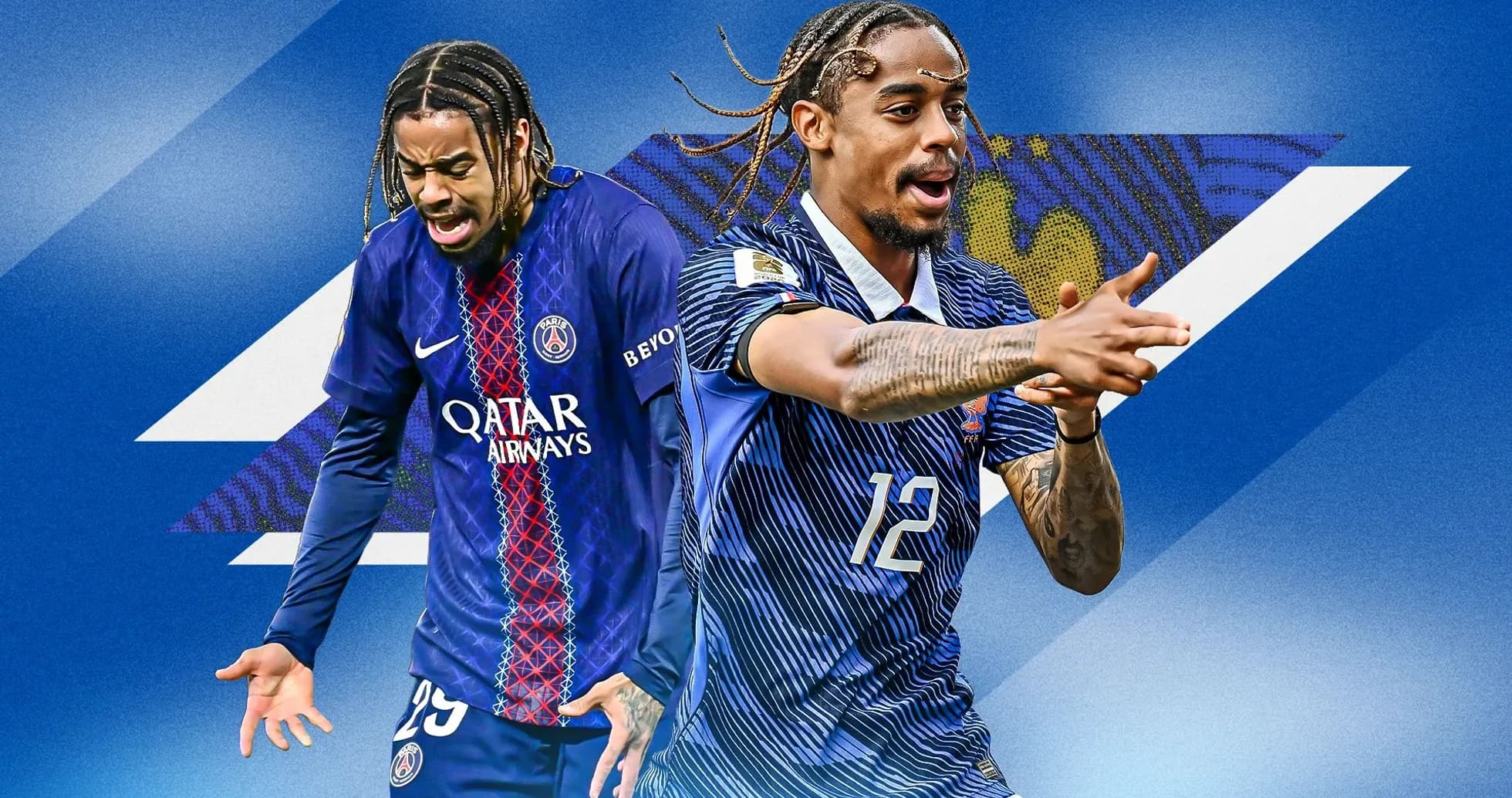
Three years on from swapping Lyon for the Paris lights, Bradley Barcola was supposed to be the next great winger to own the Parc des Princes touchline. A guaranteed starter. A pillar of the project. Instead, he finds himself trapped between roles: too good to ignore, never quite trusted enough to build around.
From rising star to rotation piece
His first season in Paris was solid, if not spectacular: 14 goal contributions, a respectable return for a young forward learning the demands of a superclub. Then came the real leap. In 2024-25, Barcola exploded – 21 goals, 21 assists – the kind of numbers that usually end any debate about status.
Yet when the games truly mattered, he watched too often from the sidelines.
PSG, reeling from Kylian Mbappé’s departure, did not hand Barcola the keys to the left flank. They doubled down on competition. Desire Doué arrived in the summer of 2024, another dazzling young winger. Khvicha Kvaratskhelia followed in January 2025, a blockbuster signing who instantly altered the hierarchy.
Barcola’s season stayed exceptional on paper, but in the biggest matches he was nudged aside. He did not complete 90 minutes regularly. He was overlooked for the Champions League final against Inter. The message was subtle yet brutal: you are important, but not indispensable.
The following campaign stripped away even that comfort. In 2025-26, his output dropped sharply – 13 goals and seven assists – and the pattern hardened. Luis Enrique rotated heavily in Ligue 1 to keep his stars fresh for Europe, and when the Champions League knockouts arrived, Barcola was no longer among the chosen few. No start in the quarter-finals, none in the semi-finals, none in another victorious final.
In the league, it stung just as much. Unused substitute against Lyon. Unused again against Monaco. For a 23-year-old who had just delivered a 42-goal-contribution season, the glass ceiling felt very real.
France’s nearly man
The stop-start rhythm has followed him onto the international stage.
On talent alone, Barcola had every right to imagine himself as France’s long-term answer on the left wing. The World Cup has underlined just how precarious that ambition remains.
He did not start the opener against Senegal. Instead, he came on and changed the game, scoring the decisive goal within two minutes of his introduction. A cameo that screamed for a promotion.
Deschamps rewarded him with a start against Iraq on matchday two. Barcola did not seize it. The performance lacked the spark of his substitute appearances, and he was promptly back on the bench for the final group match against Norway.
Again, he responded. Introduced with 25 minutes to play, he bent in a pinpoint cross for Doué’s late header, adding shine to the scoreline and reminding everyone of his quality in short bursts.
Deschamps went back to him for the last-32 tie with Sweden. This time, Barcola delivered from the XI, lashing home a fine second-half finish on a night dominated by a virtuoso display from Michael Olise. The winger finally kept his place for the round-of-16 clash with Paraguay, but in an ill-tempered 1-0 grind, he drifted to the margins. Anonymous. Forgettable.
Now, on the eve of a quarter-final against Morocco, his place is under threat again. France’s nearly man, still fighting to be more than a luxury option.
Contract stalemate, future in doubt
All of this is playing out against a complicated backdrop in Paris.
Talks over a new contract have stalled. Barcola’s current deal runs until 2028, but negotiations are frozen as he weighs his position in a squad where the left flank is overcrowded and his status uncertain. He wants clarity. PSG, for a long time, wanted control.
Earlier this summer, the message from the French champions was blunt: not for sale. Internally, they rated him far above the £116 million Manchester City paid Nottingham Forest for Elliot Anderson, according to reporting from The Athletic. Barcola was framed as part of the core.
That stance has begun to crumble.
Transfer specialist Fabrizio Romano summed it up on his YouTube channel this week: “Until last week, Barcola was untouchable; now I see him linked to several clubs. The reality is that Barcola is not untouchable. Barcola has serious possibilities to leave Paris in the summer transfer window.”
Something has clearly shifted at PSG.
Diomande, the market opportunity that changes everything
The pivot has a name: Diomande.
The RB Leipzig and Ivory Coast sensation has been one of the breakout stars of the 2025-26 season. Liverpool were widely viewed as favourites to land him this summer in a deal worth around €100m, the next big piece in their post-Salah rebuild.
Then came the twist. Diomande, just 19, is understood to prefer Paris. He sees PSG, and Luis Enrique’s project, as his best shot at trophies and a future Ballon d’Or.
Leipzig, though, are holding firm. Their valuation is an eye-watering €130m. Even for PSG, that fee bites. To make it work, the European champions will need to move pieces. Gonçalo Ramos has already gone to AC Milan. Lee Kang-in is heading to Atletico Madrid. And if Diomande walks through the door, Barcola’s minutes on the left shrink again.
At that point, a sale starts to look less like a sacrifice and more like a solution.
Liverpool’s opening
Liverpool, ironically, could profit from missing out on Diomande.
If PSG cash in on Barcola to fund the Leipzig deal, Anfield becomes a logical destination. The Frenchman would finally get what Paris never quite offered him: the status of nailed-on starter.
The Reds are reshaping their attack after Mohamed Salah’s departure. Victor Muñoz has already arrived. New head coach Andoni Iraola must manage the development of wonderkid Rio Ngumoha, who does not turn 18 until late August, and cannot be overloaded. That leaves space – and responsibility – for a ready-made, Champions League-hardened wide forward.
Barcola fits the brief. Direct, creative, capable of both scoring and supplying, he looks tailor-made for Iraola’s aggressive, high-tempo game. Liverpool also need a marquee name to ease the shock of losing Salah. There are not many available attackers with Barcola’s blend of star power, age profile and experience at the sharp end of European competition.
Compared to Diomande, who is younger and less tested at the highest level, Barcola offers fewer unknowns. You know he can handle the pressure of a Champions League run. You know he can produce across a full season. At Anfield, he would not be an accessory. He would be a reference point.
“Honestly, I don’t know”
Any lingering doubt about whether a move is truly on the table vanished at the World Cup.
“Right now, I’m really focused on the World Cup,” Barcola said in a France press conference before facing Paraguay. “But regarding what happens afterward, honestly, I don’t know at the moment.”
For a player once labelled untouchable, that uncertainty is striking. PSG’s pursuit of Diomande threatens to push him further towards the fringes. The club’s position has softened. The market is watching.
Barcola is 23, with a 42-contribution season already behind him and another Champions League medal in his pocket. He should be entering the years where he defines games, not waiting to see if his number goes up on the fourth official’s board.
If Paris cannot offer that stage, someone else will. The only real question now is whether his next decisive goal comes in front of the Kop or under the Parc’s floodlights – and how much longer he is willing to wait for the answer.